body modifications
A form of transhumanism, body modifications are made to enhance the human form.
Everything the Ash Remembers. AI-Generated.
AI-Generated Content Disclosure: This story was written with the help of Claude (Anthropic) The condensation on the inside of the bunker wall always ran in the same direction. Not down — never simply down — but at a slight diagonal, tracing the same invisible channel in the concrete every single morning, as though the wall itself had a preference. Ananya had noticed it on her first week underground, three years ago, and she had not stopped noticing it since. She kept a small mark in her logbook: a tally beside the word “diagonal.” One thousand and twelve marks now. She did not know why she kept counting. The implant, she supposed, had made her attentive to patterns she could not yet explain.
By 10min Stories3 months ago in Futurism
When taken as a whole, the findings are assisting researchers in filling in important knowledge gaps on how prehistoric people lived and adapted during a poorly recorded period.
At the very least, outrageous ideas that assert Russian President Vladimir Putin has somehow survived two world wars may help to explain his heinous actions in the twenty-first century. Thousands of people have died on both sides of the battle in eastern Europe, and the 73-year-old has blood on his hands after ordering Russian forces to invade Ukraine.
By Francis Dami4 months ago in Futurism
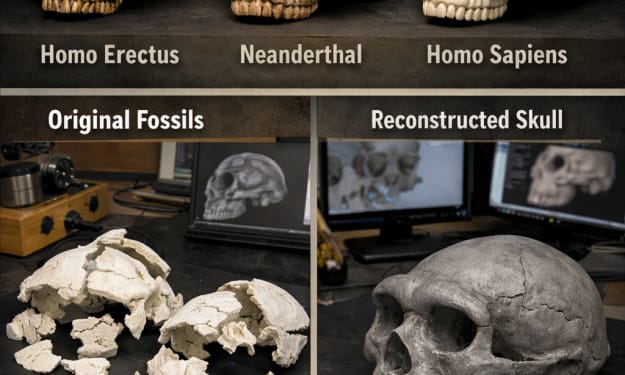
Yuxian Skull discovered in China has challenged this long-standing narrative of Human Evolution
Rethinking Human Evolution: A Discovery That Changes the Timeline For decades, the story of human evolution appeared relatively straightforward. Scientists believed that early advanced humans emerged around one million years ago, belonging to the species Homo erectus. According to this widely accepted model, this species eventually split into two major branches around 600,000 years ago. One branch led to the Neanderthals, while the other gave rise to modern humans, Homo sapiens. This linear and orderly progression formed the foundation of how we understood our origins.
By Ibrahim Shah 4 months ago in Futurism
The Detox Products Market Is Booming — But Who's Really Cashing In?. AI-Generated.
Why the Detox Industry Is Having a Serious Moment Walk into any pharmacy, grocery store, or even a gas station these days and you'll spot them — liver support capsules, colon cleanse kits, green powder blends promising to flush out everything you did wrong last weekend. Detox products used to feel like a fringe wellness obsession. Now they're shelved between multivitamins and protein bars, and the brands behind them are raising serious capital.
By Kathryn J. Lemos5 months ago in Futurism
Kids don't trust a robot's eyes, but they do trust human eyes.
Before they can do nearly anything else, babies gaze at faces. The message somehow lands when a parent's gaze darts to a toy. Check this out—it's fascinating. One of a child's earliest social abilities is the tiny act of eye-reading. However, a recent study reveals that there is a tight restriction: the eyes must be human, not robotic.
By Francis Dami5 months ago in Futurism
In five countries, coastal communities are safeguarding the environment; this new evaluation demonstrates what truly works.
Without government patrols, fishing communities in the Southwest Indian Ocean have long managed their own reefs. They have accomplished this through collective decisions, established boundaries, and local laws. It has been difficult to ascertain whether those agreements truly protect anything.
By Francis Dami5 months ago in Futurism
The discovery that a blind cave fish was hidden in underground waterways could alter scientists' perceptions of evolution.
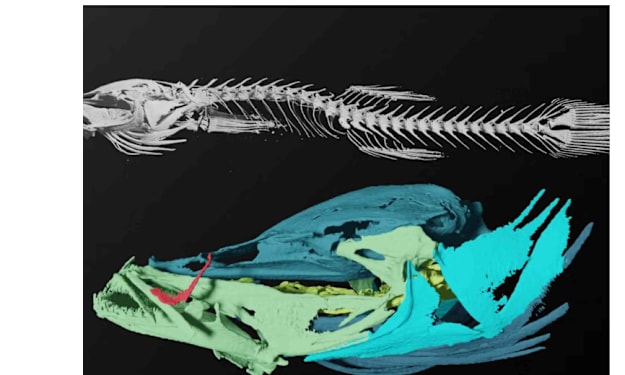
For over 150 years, scientists have thought of the Southern Cavefish as a single species, but a recent genomic study shows that there are actually three kinds. A new species of cavefish that evolved independently for almost eight million years is included in the discovery.
By Francis Dami5 months ago in Futurism
A fungus can be found inside a 407 million-year-old plant fossil.
For over a century, researchers have been studying an early terrestrial plant from Scotland. Its stem was known to harbour a type of fungus, and this relationship appeared to be well-established. Something else emerged from a further examination of nearby rock. Researchers looked at a deposit that had never before revealed signs of fungus cooperation.
By Francis Dami5 months ago in Futurism