
Everything the Ash Remembers
For eleven days, her implant showed her a door. On the twelfth day, she found it.

AI-Generated Content Disclosure: This story was written with the help of Claude (Anthropic)
The condensation on the inside of the bunker wall always ran in the same direction. Not down — never simply down — but at a slight diagonal, tracing the same invisible channel in the concrete every single morning, as though the wall itself had a preference. Ananya had noticed it on her first week underground, three years ago, and she had not stopped noticing it since. She kept a small mark in her logbook: a tally beside the word “diagonal.” One thousand and twelve marks now. She did not know why she kept counting. The implant, she supposed, had made her attentive to patterns she could not yet explain.
The implant had been installed by a field medic named Gael, six weeks before the Cascade — what the old broadcasts had called the Cascade, at least, before the broadcasts stopped. A coronal mass ejection of a scale no model had predicted, followed by three days of electromagnetic silence, followed by the fires. Gael had pressed the device against the base of her skull with the flat of his thumb, told her it would help with the migraines she’d been logging, and sealed it in with a strip of biopaste that smelled faintly of copper. It was a civilian-grade predictive-assist unit, designed to monitor neurological stress patterns and surface mild anticipatory signals — the kind of low-grade foresight that helped a person decide to step back from a curb a half-second before a vehicle ran it. Standard issue for field personnel working in high-stimulus environments. Unremarkable technology, in the world that used to exist.
In this world, it had become something else entirely.
The bunker was a converted water-treatment facility beneath the eastern edge of what had once been a mid-sized city. Ananya knew the city’s name but had stopped using it. Names for places implied those places still had a future, and she was not ready to make that assumption. The facility had three functioning levels. She occupied the second. The first level flooded periodically and smelled of sulfur. The third level she had not entered since the winter, when she had gone down to retrieve a box of protein rations and had found, in the far corner beneath a collapsed shelf unit, a nest of something she could not identify — warm, breathing, organized in a way that unsettled her more than any single creature would have. She had taken the rations and climbed back up and sealed the hatch with a length of rebar and had not spoken of it to anyone, because there was no one to speak to.
She was entirely alone. Had been since Milagros left in the autumn, following a signal on a salvaged radio that may or may not have been real. Ananya had not tried to stop her.
The implant had shown her what would happen if she did.
That was the thing about the device now — the thing that had changed. In the early months, the anticipatory signals had been faint and mundane: a slight pressure behind her left ear before she tripped on a loose floor plate, a wash of low warmth in her sinuses before a pipe burst and sprayed scalding water across the processing room. Useful. Calibrated. Small. But as the months accumulated and the electromagnetic environment of the surface remained chaotic and irradiated and unlike anything the device’s original designers had accounted for, the signals had grown. Lengthened. Reached further forward in time, or what felt like time, in ways that made her question whether the implant was still reading her neurological state or whether it had begun reading something else altogether. She had no manual. She had no technician. She had a logbook with one thousand and twelve diagonal tally marks and a growing section in the back labeled simply “shows.”
The shows were what she called them. Not visions — that word carried a weight of mysticism she resisted. Not hallucinations — that word implied error, and whatever the implant was doing, it did not feel like error. Shows. They arrived without warning, usually in the hour after she woke, when the condensation was still running its diagonal path and the recycled air tasted of iron and old plastic. They were not dramatic. That was the part that unsettled her most deeply — not their content, but their texture. They felt like memory. They felt like something she had already lived through and was simply being reminded of, the way a person might suddenly recall a Tuesday from four years ago with inexplicable clarity: the specific weight of a mug, the sound of rain on a particular window, the unremarkable fact of being alive in a moment that had not yet become the past.
The show that had been repeating for eleven days now was this: a stairwell she did not recognize, lit by a single amber emergency strip along the left wall. Concrete steps, but newer than the bunker’s — smoother, the edges less worn. A smell of pine resin and machine oil. And at the top of the stairwell, a door that was slightly ajar, letting through a thin line of light that was not artificial. Natural light. Daylight. The color of it was the specific pale gold of late afternoon in early spring, the kind of light that exists before the trees have fully leafed and the sky is still more white than blue. She could feel the temperature differential from six steps below the door — cool air from above, meaning outside, meaning the surface, meaning the atmosphere had cooled or cleared enough that someone had built a structure with a door that opened outward into it.
She could not see who was on the other side. She could not see herself in the show — she was never present in the shows, only the scenes. But she could feel, in the way the implant translated its signals into something her nervous system could process, that whoever stood at the base of that stairwell was not afraid. Was, in fact, something close to the opposite of afraid. Was standing in the particular stillness of a person who has been moving for a very long time and has just, for the first time, stopped.
On the eleventh day, she found the stairwell.
She had not been looking for it. She had been following a water leak that had appeared overnight in the eastern corridor of the second level, tracing it back through the wall cavity with a probe light and a length of copper tubing she used to listen for drips the way a doctor listens for a heartbeat. The wall cavity opened, behind a panel she had never successfully removed before, into a passage she had not known existed — narrow, low-ceilinged, running north along the building’s original foundation. She moved through it on instinct, the probe light throwing a thin yellow beam ahead of her, the smell of pine resin arriving before she was consciously aware of it. Then the machine oil. Then the steps.
The concrete was smoother here. The edges less worn.
She stood at the base of the stairwell for a long time.
The amber emergency strip ran along the left wall exactly as it had in the show. Eleven days of the same image, the same temperature, the same pale gold line at the top of the steps — and here it was, translated from whatever frequency the implant broadcast in into the hard, cold, undeniable fact of physical space. She pressed one hand flat against the wall and felt the concrete’s texture, the faint vibration of something mechanical still running somewhere in the building’s skeleton, the slight give of the biopaste seal at the base of her skull when she tilted her head back to look up. The door at the top was slightly ajar. The light coming through it was exactly the color she had been shown. She could feel the cool air from six steps below.
She climbed.
Not quickly. The implant had shown her the stairwell but had not shown her what she would do at the top of it, and she understood, in the careful way she had learned to understand the device’s grammar over three years, that this was intentional — or at least consistent. The shows gave her the destination. They did not give her the decision. That had always been hers.
She pushed the door open with her shoulder and stepped through into a space that had once been a loading dock — wide, low, the ceiling partially collapsed on the far side where a support beam had failed. But the near side was intact, and the near side faced west through a gap in the corrugated wall that was large enough to stand in, and through that gap was the surface, and the surface was lit by late afternoon light the color of pale gold, and the air that came through it was cold and clean in a way that air had not been clean in three years, and it carried in it, faintly but unmistakably, the smell of something green.
Not the recycled biological-filter green of the bunker’s algae panels. Something growing in soil. Something that had decided, without anyone’s permission, to continue.
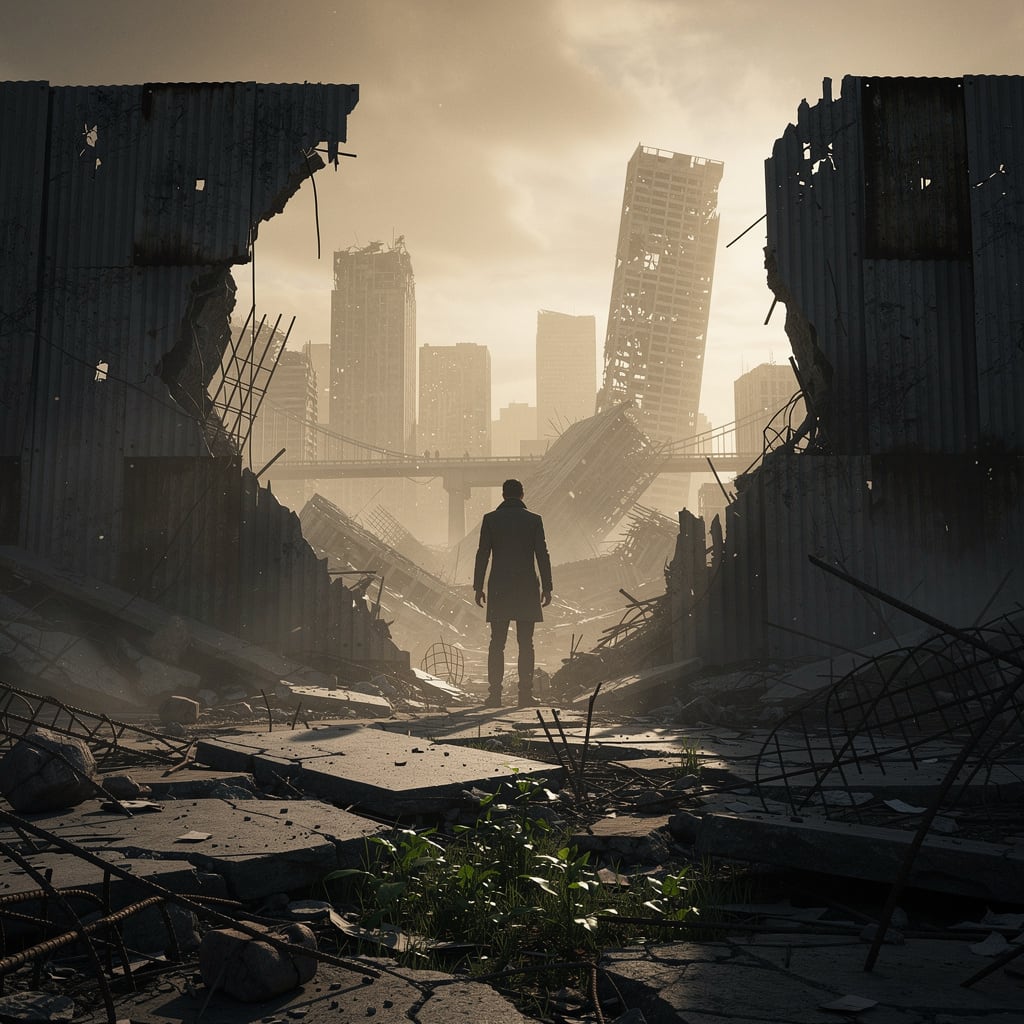
Ananya stood in the gap in the wall and looked out at a landscape she had not seen in a thousand and twelve days. The city’s ruins extended in every direction, softened now by distance and by a low ground haze that caught the light and turned it amber. Somewhere to the north, a structure she could not identify was still standing, its upper floors intact, its windows dark but unbroken. And at the base of the nearest collapsed building, in a crack between two slabs of concrete rubble, something was growing. She could not see what it was from this distance. A plant. Something low and persistent and green.
The implant was quiet.
No pressure behind her ear. No warmth in her sinuses. No show building in the space between her thoughts. Just the cold air and the green smell and the light going slowly amber as the afternoon moved toward evening, and the silence of a world that had not finished deciding what it was going to become.
She did not move toward the plant. She did not retreat back into the bunker. She stood in the gap in the wall with her hand still resting against the door frame, and the condensation from her breath moved in a slight diagonal in the cold air, tracing a path she could not predict, and she watched it go.
Subscribe for more or visit 10min-stories.com
SubscribeAbout the Creator
10min Stories
10min Stories is a collection of short, immersive tales designed to fit into any moment of your day. Find out more on https://10min-stories.com/
Enjoyed the story? Support the Creator.
Subscribe for free to receive all their stories in your feed.
Comments
There are no comments for this story
Be the first to respond and start the conversation.