
A fungus can be found inside a 407 million-year-old plant fossil.
A treasure trove in Scotland

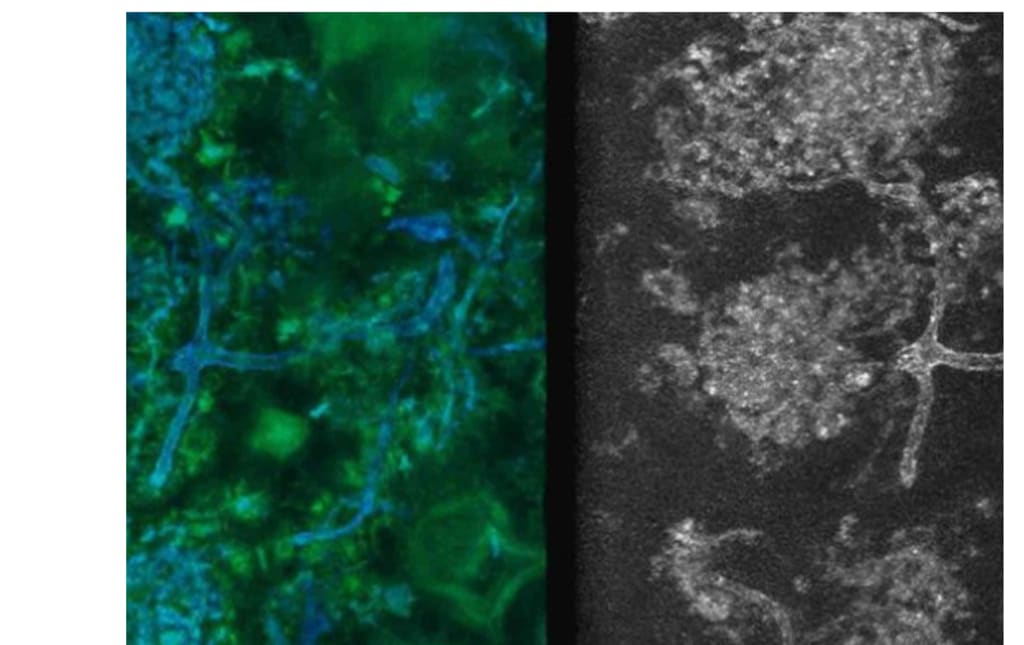
For over a century, researchers have been studying an early terrestrial plant from Scotland. Its stem was known to harbour a type of fungus, and this relationship appeared to be well-established. Something else emerged from a further examination of nearby rock. Researchers looked at a deposit that had never before revealed signs of fungus cooperation.
Then, within the same kind of plant fossil, they discovered a second species of fungus. Its anatomy was unique, its filaments were smaller, and its spores were different. The results showed that this plant also developed a tight relationship with another type of fungus.
A treasure trove in Scotland
The rock originates from the Windyfield chert, a slab rich in fossils from the northeastern Scottish settlement of Rhynie, close to Aberdeen. The wetland was traversed by mineral-rich hot spring water around 407 million years ago, which silicified everything in its path, including bacteria, plants, and insects.
Professor Sebastian Schornack of the University of Cambridge collaborated with Dr. Christine Strullu-Derrien of the Natural History Museum in London. Using sophisticated microscopy, the scientists examined the microstructure within a polished thin sliver of Windyfield granite.
One aerial stem of Aglaophyton majus, a tiny, rootless plant that thrived near hot springs in the area, was their objective. Previous research revealed that this species had at least one mycorrhizal companion. A second unique fungus was discovered in the new fossil.
A novel fungus
The French scientist and scientific artist Marie-Anne Paulze Lavoisier is honoured by the name of the fungus, Rugososporomyces lavoisierae. The species' wrinkled spore surface is mentioned in the first half of its name. The size and shape of those spores distinguish it from its elder cousin, Glomites rhyniensis.
The way the spore wall seals off where it joins the parent strand is different, and its threads are thinner. These are unique fingerprints to a paleobotanist. Within the inner stem of the prehistoric plant, the new fungus was localised in a small area.
It created a ring of arbuscules there, which are tree-shaped structures that manage the interaction of nutrients with plant cells. Spores and vesicles nestled next to the fungal threads that ran between the cells inside.
Evidence in the arbuscules
The arbuscule serves as evidence that this was not an invasion or rot but rather a genuine partnership. The structure develops inside plant cells and branches into tiny tips in contemporary plants that have fungal partners. Here, the fungus absorbs sugars produced by the plant and releases minerals.
According to Strullu-Derrien, "the presence of the arbuscule indicates that there was a symbiotic association rather than the fungus parasitising on the plant or feeding on it after death." The agreement benefited both parties. Because it lacked substantial roots, the plant was unable to independently extract distant minerals.
The fungus was unable to produce food because it lacked the ability to do photosynthesis. When they worked together, they were able to do things that neither could on their own.
Two partners that are fungi
According to the discovery, Aglaophyton majus simultaneously supported at least two mycorrhizal fungi. This arrangement closely resembles what botanists observe in many modern plants, where roots frequently coexist with many fungus species.
The two fungi originated from somewhat different types of rocks. Decades ago, the more well-known Rhynie chert unit provided the first description of Glomites rhyniensis. Rugososporomyces lavoisierae, on the other hand, originated from the neighbouring Windyfield deposit, a distinct slab that has never previously produced evidence of a fungal relationship.
These rocks were created under different conditions, with more debris mixed into the silica and near active hot springs. Discovering the relationship there also implies that it was widespread throughout the old marsh.
Beyond the fossil
It's one thing to find a fungus within an old fossil stem. Another is distinguishing it from the surrounding plant tissue. The group used fluorescence lifetime imaging, which gauges the duration of a material's glow following a laser pulse.
The method is effective because, even when DNA has long since disappeared, leftover carbon in a fossil still leaves a unique visual trace. The light emitted by fungal arbuscules decays differently than that of the surrounding plant. The team combined the imaging with an additional method that determines the fossil's carbon composition.
The imaging work was overseen by Dr. Raymond Wightman, who oversees the Sainsbury Laboratory's microscope facility. It was possible to follow individual fungal threads through the plant's cells using the resulting three-dimensional photographs.
A more comprehensive narrative emerges
The early picture of plant-fungus relationships is altered by the inclusion of Rugososporomyces lavoisierae in the catalogue. Only one type of mycorrhizal fungus had been identified in this plant before our investigation. There are now two in the same old landscape, but in two distinct rock units.
Previous research at Rhynie had established a straightforward, reciprocal link between early plants and fungus. Similar to contemporary roots, several symbiotic species shared the same plant tissues 407 million years ago, as suggested by the new fossil.
The imaging technique creates new study opportunities. Even in cases where no DNA remains, scientists are now able to differentiate between similar-looking but chemically distinct prehistoric species. The lesson is clear for scientists studying the transition of life from water to land. Plants brought partners with them when they pioneered dry land.
About the Creator
Enjoyed the story? Support the Creator.
Subscribe for free to receive all their stories in your feed.
Comments
There are no comments for this story
Be the first to respond and start the conversation.