
The discovery that a blind cave fish was hidden in underground waterways could alter scientists' perceptions of evolution.
A fish without eyes

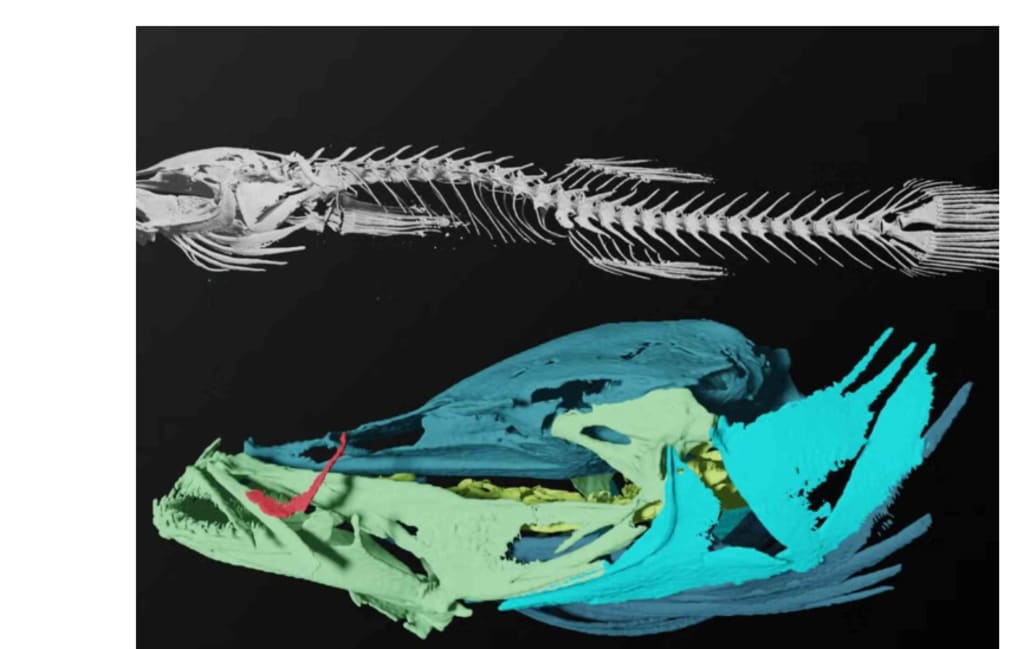
For over 150 years, scientists have thought of the Southern Cavefish as a single species, but a recent genomic study shows that there are actually three kinds. A new species of cavefish that evolved independently for almost eight million years is included in the discovery.
A fish without eyes
For millions of years, a small, pinkish swimmer known as the Southern Cavefish has survived in almost complete darkness beneath the Southeast United States. Its skin has lost pigment, and it hardly ever reaches a length of three inches. Since the late 1800s, researchers have been interested in the fish, although it is still unknown how diverse it is.
Although populations from several cave systems had similar appearances, it was unclear if they belonged to the same species or to multiple species that were mistaken for one. A team led by Yale University evolutionary biologist Chase D. Brownstein eventually solved the puzzle.
After gathering tissue samples from cavefish in the central and southeastern states, they carried out genetic studies that would not have been feasible ten years ago.
Examining the genome
The scientists collected DNA from all around the cavefish's range, which includes karst regions from Tennessee and Alabama to the Ozarks. Karst depicts areas where water has dissolved limestone, leaving behind subsurface rivers, sinkholes, and caverns.
The branches did not fall where anyone had anticipated when the team mapped the family tree using the DNA data. It became revealed that several populations that had been classified under a single species designation were actually more closely linked to a different cave species. This indicated that the taxonomy had been flawed for a long time.
The biology underneath did not correspond with the species name on the books. The fish itself needed to be examined more closely by the researchers. One half of the narrative was revealed by their skeletons, while the other was revealed by their genes.
Novel cave fish
The scientists created three-dimensional reconstructions of the skeletons of many specimens using high-resolution CT images. There were slight yet persistent variations. The forms of the bones in the skull and other body parts did not correspond to any previously identified features.
The skeletal signals, when paired with the genetic information, verified that the fish belonged to an unidentified species. The new species was officially named Typhlichthys styx by the researchers, after the Greek mythological river that traversed the underworld.
It had been decades since a new species of cavefish in this genus was named. T. styx occupies a position in the family tree that challenges a long-held belief.
Born in the shadows
The formation of cave species is explained by a prominent theory. It is generally believed that a surface fish washes into a cave, becomes confined, and gradually loses its colour and eyes over many generations.
According to that belief, every type of cave originated from a separate underground adventure. The new genetic tree, however, presents a different picture. All of the diversification in these cavefish occurred after a single voyage into the dark by their common ancestor.
After the fish went underground, evolution continued to function. The geography was altered by the cave, but the process was not stopped. This was suggested by earlier research on other cavefish, but the present study makes it more evident.
Eight million years apart
About eight million years ago, the new species branched off from its nearest subterranean relative. Even in a setting where surface forces are inaccessible, it is a huge window for evolutionary change. These fish were not divided by a river, an ocean, or even a mountain range.
Large subterranean water channels that run through rock fissures and are separated from one another by solid stone seem to have been created by the aquifers themselves. The rock between them probably served as a barrier when a population ended up in one aquifer and another in a nearby one. Over millions of years, the two groups underwent autonomous evolution to become separate species.
Reconsidering the dead end
The discovery contributes to mounting evidence that cave ecosystems are more dynamic than previously believed. Biological waiting rooms are not subterranean habitats. Rather, they create new species on their own. Cave salamanders from Texas' karst regions have started to exhibit a similar trend, with aquifer networks seemingly driving populations apart over time.
This concept is extended to a much wider geographic range in the latest cavefish work. Although cavefish aren't very well-known creatures, the consequences extend beyond a single tiny swimmer.
If aquifer geology has been dividing cave species throughout North America, it probably does the same on all karst-system-containing continents. The majority of the world would be covered by that.
Changes in the future
The immediate result for scientists is a new perspective on the number of species found in caves worldwide. Although speciation in subterranean environments has historically been thought to be uncommon, if not impossible, the latest study indicates that it has been occurring all along.
Similar karst networks are home to a variety of cave animals, including invertebrate groups, salamanders, and crayfish. Certain species that scientists have identified as a single widespread species may actually be multiple species that are divided by the same type of aquifer barriers. The results have significant conservation implications.
Three far uncommon species, each restricted to a specific aquifer, may be present in a cavefish that was previously believed to be safe due to its spread over several states. The results imply that subterranean ecosystems have the capacity to produce new species over extended periods of time.
About the Creator
Enjoyed the story? Support the Creator.
Subscribe for free to receive all their stories in your feed.
Comments
There are no comments for this story
Be the first to respond and start the conversation.