
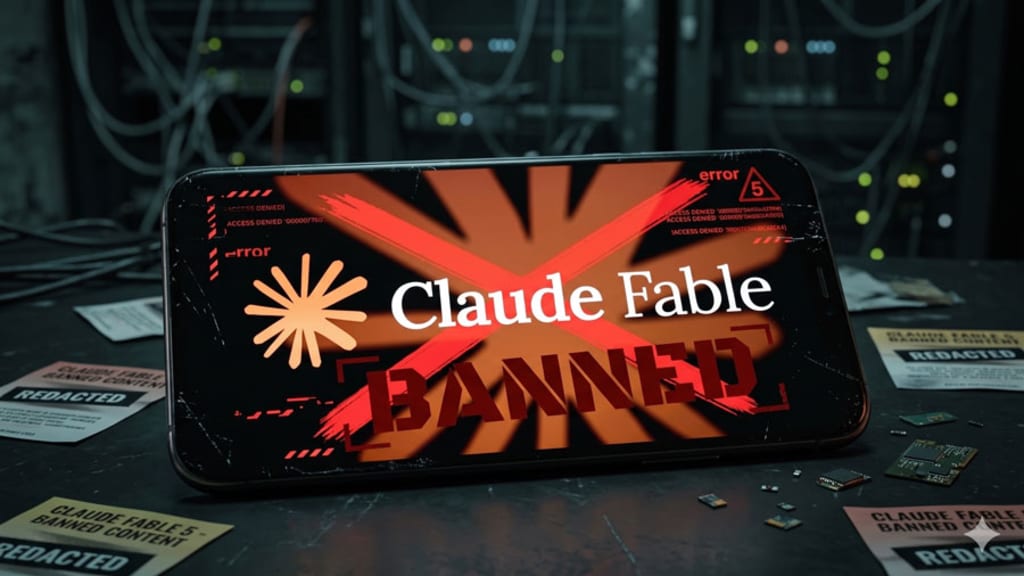
Claude Fable 5 and the New AI Cold War
National Security vs. Global Innovation

A few nights ago, I found myself staring at my laptop long after I should have gone to bed.
The room was quiet.
The kind of quiet where you can hear your refrigerator humming from another room.
I had been reading about AI for hours. New models. New regulations. New warnings from governments. New promises from tech companies.
The usual cycle.
But one phrase kept bouncing around in my head:
AI Cold War.
I don't know why that phrase unsettled me so much.
Maybe because it sounds dramatic.
Or maybe because it doesn't.
Maybe because, for the first time, it doesn't feel like science fiction anymore.
Imagine a model like Claude Fable 5.
Not necessarily the one that exists today. Not even a specific product.
Just imagine the next leap.
The AI system that feels noticeably smarter than the one you're using now.
The one that writes better.
Reasons better.
Researches faster.
Creates things that would have taken entire teams weeks to finish.
The kind of technology that changes expectations overnight.
The kind that makes yesterday's breakthrough look ordinary.
Now imagine every major country looking at that technology and seeing something different.
A student sees opportunity.
A scientist sees discovery.
An entrepreneur sees a company.
A government sees power.
And suddenly we're not all talking about the same thing anymore.
I remember when the internet felt borderless.
Maybe that's a naive memory.
Maybe it never really was.
But there was a sense that technology belonged to everyone.
An idea could start in one country and inspire someone halfway around the world by breakfast.
Knowledge moved.
People connected.
Innovation felt shared.
Now things feel different.
More guarded.
More strategic.
More geopolitical.
The conversation has shifted from "What can we build?" to "Who controls what gets built?"
That's a very different question.
The strange thing is that both sides seem reasonable when you listen closely.
That's what keeps me up.
National security isn't a fake concern.
If an AI system can influence economies, automate cyber operations, accelerate scientific research, or shape military capabilities, governments are obviously going to care.
How could they not?
No country wants to discover that a critical technology slipped entirely beyond its influence.
History doesn't exactly reward nations that ignore strategic advantages.
But innovation doesn't thrive inside locked rooms either.
The internet exploded because ideas moved.
Science advances because researchers build on each other's work.
Progress often comes from collaboration between people who happen to live under different flags.
So what happens when those two instincts collide?
Protection versus openness.
Security versus sharing.
Control versus collaboration.
A few weeks ago, I was talking with a friend who works in technology.
Nothing formal.
Just two people drinking coffee and trying to make sense of things.
At some point he said something that stuck with me.
He said, "Everyone says they want innovation until innovation becomes powerful."
That sentence followed me home.
Because maybe that's the tension underneath all of this.
We love technological breakthroughs when they're exciting.
We become nervous when they're consequential.
I think about researchers working on AI right now.
Some probably see themselves as builders.
Problem solvers.
Engineers.
Scientists.
Then suddenly their work becomes part of national policy discussions, international negotiations, economic competition, and security briefings.
Imagine creating something because you're curious about what's possible and then watching governments debate whether your creation represents a strategic asset.
That has to feel strange.
Maybe exciting.
Maybe terrifying.
Maybe both.
The moment things shifted for me happened during a completely ordinary walk.
I wasn't reading articles.
I wasn't listening to podcasts.
I was just walking through the city.
People were sitting outside restaurants.
Someone was walking a dog.
A couple was arguing quietly near a tram stop.
Life was happening.
Normal life.
And I realized something.
Most people aren't thinking about AI competition between nations.
They're thinking about rent.
Jobs.
Relationships.
Their next doctor's appointment.
Whether they'll have enough time this weekend to finally relax.
Yet decisions being made right now about AI could shape all of those things eventually.
That's the weird part.
The biggest technological debates often feel distant until they suddenly become personal.
Maybe that's why the AI Cold War comparison feels incomplete.
The original Cold War was largely about preventing catastrophe.
This feels different.
There's competition, yes.
But there's also genuine hope woven into it.
The same AI system that raises national security concerns might help discover new medicines.
Improve education.
Accelerate scientific breakthroughs.
Help someone start a business from their kitchen table.
Help a lonely person organize their thoughts at 2 a.m.
Technology rarely arrives carrying only one consequence.
It arrives carrying hundreds.
Good ones.
Bad ones.
Unpredictable ones.
Sometimes I wonder if we're asking the wrong question.
Instead of asking who wins the AI race, maybe we should be asking what winning actually means.
Is it building the most powerful model?
The safest one?
The most widely used?
The most profitable?
The most beneficial?
Those aren't necessarily the same thing.
And history has a habit of surprising people who assume they are.
Late at night, these questions start feeling less political and more human.
Because beneath all the headlines and strategic language, there's something deeply familiar happening.
People are trying to navigate uncertainty.
Countries are doing it.
Companies are doing it.
Individuals are doing it.
Everyone is looking at the future and trying to guess what's coming.
Everyone is afraid of being left behind.
Everyone wants some measure of control.
That's a very human story.
Maybe the most human story there is.
I don't know what the next generation of AI will look like.
Maybe models like Claude Fable 5 will become tools we use every day without thinking twice.
Maybe they'll become symbols of a new technological divide.
Maybe both.
What I do know is that we're entering a period where intelligence itself is becoming infrastructure.
And that's a strange thing to witness in real time.
Some nights it feels exciting.
Other nights it feels unsettling.
Most nights it feels like both.
And maybe that's where I keep landing.
Not on certainty.
Not on optimism or pessimism.
Just curiosity.
Because years from now, when people look back at this moment, I wonder what they'll see.
A race?
A rivalry?
A missed opportunity?
A turning point?
Or maybe they'll see something simpler.
A moment when humanity built something powerful enough to force us to decide not just what kind of technology we wanted—but what kind of future we were actually trying to create.
I'm not sure we know the answer yet.
But I think we're already living inside the question.
About the Creator
John Smith
AI is rewriting the world. I'm here to ask the questions that matter. Tech writer. Deep thinker. Always curious.
Enjoyed the story? Support the Creator.
Subscribe for free to receive all their stories in your feed.
Comments
There are no comments for this story
Be the first to respond and start the conversation.