mature
Mature content from science fiction tales and odysseys.
The Truth About Data Centers
Every time we send a message, stream a movie, ask an AI assistant a question, upload a photo, or buy something online, there is a good chance a data center is involved. Yet these enormous facilities are mostly invisible to us. They sit behind the scenes, quietly processing, storing, and moving the information that powers modern life.
By AnthonyBTV2 months ago in Futurism
THE SENTINEL
Chapter Five: the weight of the known --- They left the keeper’s enclosure before dawn. Lian had not asked for the box’s origin, and the keeper had not offered. The exchange had been concluded—not with words, but with the simple act of Lian placing the box into his pack and turning toward the door. The keeper had not watched them leave. It had already turned back to its shelves, as if the visit had been a brief interruption in a longer task.
By Nier Rossi4 months ago in Futurism
THE SENTINEL
Chapter Four They were three days into the wildlands when the signal arrived. It didn't come through any standard channel. There was no sender ID, no origin stamp, no timestamp. It was just a coordinate, embedded in a single pulse, broadcast on a frequency that should have been long decommissioned.
By Nier Rossi4 months ago in Futurism
THE SENTINEL
Chapter Three --- Lian woke to the sound of breathing that was not his own. --- His eyes opened before his mind caught up. Instinct—the kind that Caius had beaten into him over years of training—told him three things in the span of a single heartbeat:
By Nier Rossi4 months ago in Futurism
THE SENTINEL
Chapter Two --- The road out of the Eastern Alliance was not a road at all. It was a scar—a long, jagged wound cut into the earth by the weight of a hundred years of overpopulation and under-repair. The asphalt had long since crumbled into gravel, and the gravel had long since been swallowed by the dust that never settled in this part of the world.
By Nier Rossi4 months ago in Futurism
THE SENTINEL
“The old man bought a Sentinel because he no longer believed in God, but he still believed in goodbye.” --- Chapter One The delivery arrived at 4:17 AM, which was precisely when Caius Voss had scheduled it. He had always believed that important things should happen when the world was asleep—when there were no witnesses, no questions, no paper trails that could be traced back to a man who was already half-dead and trying to finish his business before the curtain fell.
By Nier Rossi4 months ago in Futurism
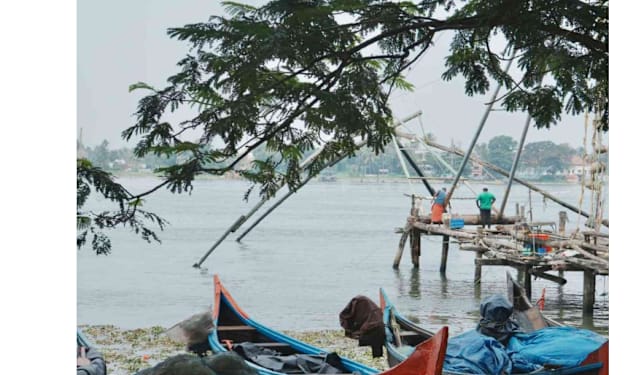
In five countries, coastal communities are safeguarding the environment; this new evaluation demonstrates what truly works.
Without government patrols, fishing communities in the Southwest Indian Ocean have long managed their own reefs. They have accomplished this through collective decisions, established boundaries, and local laws. It has been difficult to ascertain whether those agreements truly protect anything.
By Francis Dami5 months ago in Futurism
Between Light and Sight
When Light Becomes a Question The question did not begin with a fall. It began with something quieter, and far more bewildering: a contradiction lodged in the marrow of the concept itself, in the very name Lucifer, or Satan. Perhaps something in me something I hesitate to call mine could not endure the idea that a being was damned merely for refusing to kneel. As though language itself were carrying, without knowing it, a paradox it has never quite settled. How does the one called bearer of light end in darkness? But perhaps the more disturbing question is not how he fell but why he did not notice he was falling. And this is not a detail. This is the entire problem. The question is not about a devil, nor a myth. It is older than both, and more pressing, because it touches something human beings know from inside themselves without always having a word for it: that moment when one confuses seeing the light with being its source. When one stands at the threshold and begins, slowly, without announcement, to believe that the threshold leads to him. The problem is not the light. The problem is what happens to a being who stands too long before something he does not understand and instead of asking what lies beyond it, begins to believe that it opens onto him. The difference between these two postures is nearly invisible from outside. And that invisibility is precisely what makes it dangerous. Perhaps more dangerous still: the question itself may be part of the trap. That asking about light may be another way of approaching it not in hope of understanding why we remain forever at its threshold, but in secret hope of finally possessing what stands beyond.
By LUCCIAN LAYTH5 months ago in Futurism
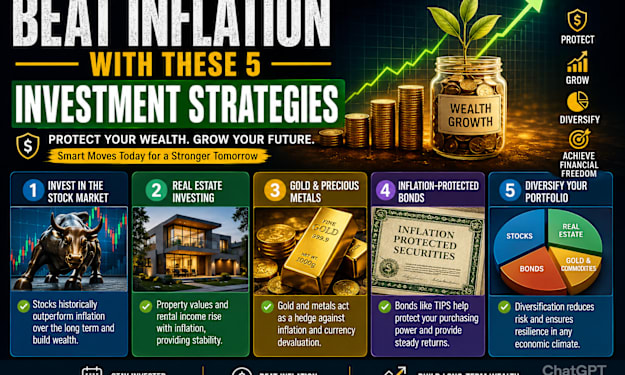
Beat Inflation with These 5 Investment Strategies
Smart Financial Moves to Protect Your Wealth and Grow Your Money in an Uncertain Economy Inflation silently reduces the value of money over time. What you could buy for $100 a few years ago may cost significantly more today. From groceries and fuel to housing and healthcare, rising prices affect almost every part of daily life. While inflation is a natural part of the economy, high inflation can create financial pressure and make it harder for people to preserve their purchasing power.
By Robert Redford5 months ago in Futurism
Cipher News Burst in Pakistan
Cipher News Burst in Pakistan Pakistan has once again entered a period of intense political discussion after the sudden return of the “cipher controversy” in national and international media. The issue, often called the “Cypher Case” or “Cyphergate,” has created strong reactions among political parties, journalists, analysts, and ordinary citizens. The controversy is connected to a diplomatic cable that former Prime Minister Imran Khan claimed contained evidence of foreign pressure and political interference in Pakistan’s internal affairs.
By Wings of Time 5 months ago in Futurism
Authorship vs Refinement
Much of the confusion surrounding artificial intelligence and writing comes from a failure to distinguish between two fundamentally different acts: originating ideas and refining their expression. These acts are often treated as interchangeable, as though whoever touches the final form must also be the source of the thought itself. That assumption does not reflect how writing has ever worked, nor does it reflect how human thinking actually unfolds.
By Peter Thwing - Host of the FST Podcast6 months ago in Futurism