
Between Light and Sight
Human Consciousness Between Temptation and Completion

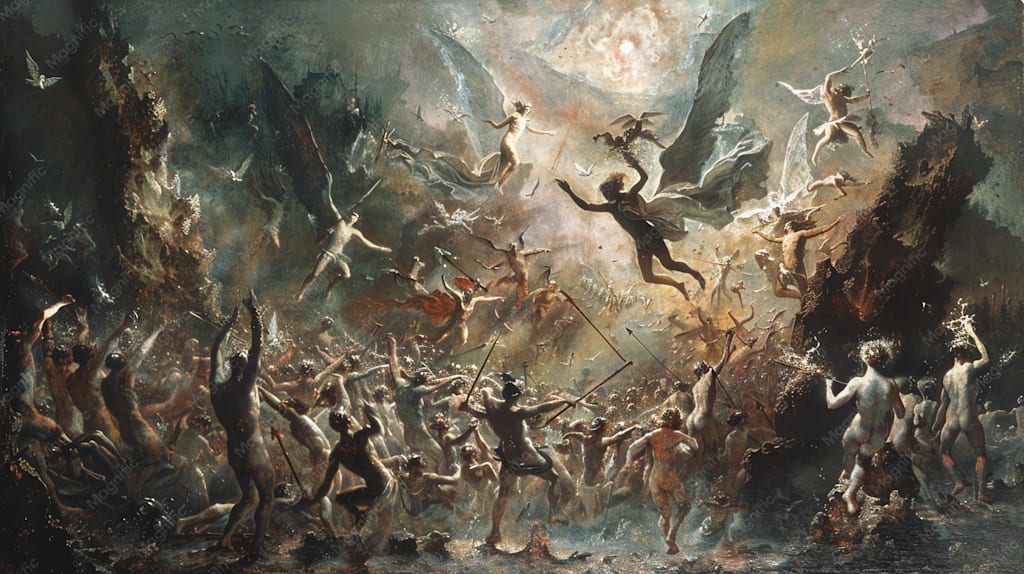
When Light Becomes a Question
The question did not begin with a fall. It began with something quieter, and far more bewildering: a contradiction lodged in the marrow of the concept itself, in the very name Lucifer, or Satan. Perhaps something in me something I hesitate to call mine could not endure the idea that a being was damned merely for refusing to kneel. As though language itself were carrying, without knowing it, a paradox it has never quite settled. How does the one called bearer of light end in darkness? But perhaps the more disturbing question is not how he fell but why he did not notice he was falling. And this is not a detail. This is the entire problem. The question is not about a devil, nor a myth. It is older than both, and more pressing, because it touches something human beings know from inside themselves without always having a word for it: that moment when one confuses seeing the light with being its source. When one stands at the threshold and begins, slowly, without announcement, to believe that the threshold leads to him. The problem is not the light. The problem is what happens to a being who stands too long before something he does not understand and instead of asking what lies beyond it, begins to believe that it opens onto him. The difference between these two postures is nearly invisible from outside. And that invisibility is precisely what makes it dangerous. Perhaps more dangerous still: the question itself may be part of the trap. That asking about light may be another way of approaching it not in hope of understanding why we remain forever at its threshold, but in secret hope of finally possessing what stands beyond.
Knowledge That Does Not See
There is a distinction quiet, unforgiving between knowing and seeing. A distinction only those who have stood at its edge truly recognize; who looked down into the distance separating the two, then kept walking as though nothing had opened beneath them. Knowledge is the ability to hold: to gather facts, to sort them, to rebuild them inside illuminated corridors the mind assembles with patience. Sight basirah is the capacity to perceive the threshold you are standing on within the larger picture; to understand that you are part of what you are looking at, not a spectator positioned safely outside the frame. A being may know everything about stars their trajectories, their ages, the mechanics of their dying. He may carry this knowledge the way one carries a precious stone. And yet remain utterly incapable of seeing the sky. Because the stone in his hand never lets him lift his head. This is precisely what makes the image of the bearer of light so unsettling: not because the light was false, but because its bearer may never have carried it at all. He carried its reflection. His consciousness was like a window opening onto immensity but instead of attending to what lay beyond the glass, he became absorbed by his own face reflected in it, until he mistook that image for the universe itself. A window that becomes a mirror does not necessarily break. It simply stops being a window. Some forms of consciousness do not free the human being. They grant him a more refined capacity to justify his enclosure. Light that passes through a person may become, inside his awareness, false evidence of ownership. Knowledge that does not arrive at self-knowledge does not illuminate it blinds differently: it fills the being so completely with what he knows that the interior rooms contract, until nothing remains but narrow corridors through which he moves without ever registering the walls.
Consciousness Falling Into Its Own Trap
Here the contradiction reaches its sharpest edge: if consciousness can perceive temptation, how does it still fall into it? Is recognizing illusion not sufficient to escape it?
But what if consciousness itself is not a window onto truth — what if it is the most sophisticated form of illusion, one that conceals its nature precisely because it uses the instruments of disclosure? What if consciousness is not an ascent but an elegant evolutionary misstep — a being that sees far enough to torment itself, but never far enough to locate the source of that torment?
Temptation does not live only in the layer of understanding. It inhabits something more like an abandoned room whose threshold a person knows perfectly, yet whose handle he can never quite grasp. A wound that stays open even after a person learns its name. Recognizing the chain does not always break it. Sometimes it merely offers sharper clarity about the weight — and leaves the person exactly where he was, carrying more consciousness rather than more freedom.
More bewildering still: the desire to escape temptation may itself become a temptation. A being who makes resistance his existential project grants illusion a permanent center. He orbits it — in flight or in attraction — but never truly leaves its gravity. Identity is built on the struggle; the center holds even when direction reverses. In the end, the one fleeing and the one drawn stand before the same threshold, under different names only.
True liberation — if such a thing exists — does not begin with fighting what pulls you. It begins with a question that unsettles precisely because it promises nothing: Why does this particular thing, and not another, find its way into you? And is there even a stable interior for anything to enter? Or is what we call the self merely the echo of everything that has struck us hard enough?
Temptation as Mirror
Human beings are not tempted by things. They are tempted by what things awaken inside them.
What draws you may not draw another — because the matter is not in the object, but in the resonance it stirs; that dormant sound suddenly set in motion, as though it had been waiting, for a long time, for exactly this signal.
Behind every temptation: either an emptiness left unoccupied, or a desire left unnamed. When a person becomes fascinated with something, what he is truly fascinated with is an image of himself he finds reflected there — an image of completion he believes he lacks, while standing at the threshold of something that promises: cross this, and you will have what is missing.
But what if the self seeking completion is itself nothing more than a moving pattern with no fixed core? What if there is no true emptiness waiting to be filled — but rather a mechanism that generates the sensation of emptiness, because that sensation is precisely what sustains the self's continuity?
This question offers no comfort. But it transforms temptation from a problem requiring resolution into a phenomenon requiring understanding.
Temptation is not an enemy arriving from outside. It is an echo reverberating through the silent corridors of the self, as though searching for a room to inhabit. That is what makes it a mirror: it reveals, with a precision that disturbs, the exact location of fragility. It illuminates the voids a person conceals even from himself.
The problem is that many resist temptation without reading what it is saying. They close the door without seeing what was knocking from behind it. And a closed door does not annihilate what stood outside — it teaches it patience, and subtler forms.
Ignorance of the Self: Where Wandering Begins
How does a human being free himself from what he does not understand?
This question has no exit. It appears with quiet ferocity in every attempt at escape that does not begin with understanding.
If every temptation points toward an unknown fragment of the self, then ignoring that fragment means temptation will return — from another threshold, wearing a face one cannot recognize, because one never recognized the origin that produces it. This is how inner ruins accumulate: not because the person failed to build, but because he built on what he never understood.
But what if the very attempt to understand the self is also part of the illusion? What if a person does not lose himself because he fails to know himself — but because he insists there is a stable self to know in the first place? A self that stands on a single fixed threshold, waiting to be named?
Perhaps what we call self-knowledge is not discovery but invention: a temporary structure that grants continuity the illusion of essence.
Ignorance of the self does not always arrive as ignorance. Sometimes it comes disguised as the most settled certainty — in the person utterly convinced he sees his own motives clearly, who knows what he wants and what he fears. This variety of ignorance is more dangerous precisely because it seals the inner thresholds shut while flooding the outer doors with light.
Consciousness can observe the self. But it can, at the same moment, deceive it — through the grace of interpretation.
The most dangerous thing that can happen to a human being is not losing the path. It is transforming his lostness into certainty. Drawing a map of the wrong place, and believing in it with a conviction indistinguishable, from the outside, from knowledge itself.
To recognize this limit — to accept that some part of the self always remains behind a threshold that never fully opens — may be where genuine wisdom begins. Not because it grants answers, but because it keeps a person honest before his questions, without rushing to construct them into a certainty he can live inside.
The Incompleteness That May Be Another Completion
Human beings often torture themselves by standards that do not belong to their nature. They measure their bounded selves against an absolute without bounds, then hold themselves accountable for failing to reach it. And this torment does not arise from genuine deficiency — it arises from a false comparison with the being they imagined they were supposed to become.
This may sound like comfortable justification — merely a way of making human limitation bearable. And this objection should not be passed over easily. But perhaps the problem lies not in the limitation itself, but in the silent assumption that precedes it: that a mortal being, inside a universe whose edges it cannot even measure, was made to encompass everything. This assumption does not reveal noble ambition. It reveals a confusion about position — and upon that confusion, the human being constructs much of his suffering.
Perhaps the human being is already complete — but his completion is not the completion of stillness. It is the completion of movement. A being forever at the threshold: never entirely inside, never entirely outside. What he sees as deficiency — mortality, change, limitation — may be precisely the condition that makes growth possible, and meaning renewable.
But what if what we call meaning is not found but projected? What if human beings do not discover meaning but manufacture it — out of necessity rather than vision, as a defense against terror rather than a response to truth? And perhaps attempting to reconcile this possibility with the previous one is not wisdom at all — but a more refined fear of admitting that the human being lives inside a contradiction that cannot be resolved, and perhaps should not be, because resolving it would mean exiting the human condition itself.
The Centrality That Its Own Centrality Destroys
Consciousness does not make the human being the center of existence. It makes him the center of perception. This is a fundamental distinction — one that changes everything when genuinely grasped, and distorts everything when it is not.
The human being is a threshold through which existence passes into awareness. Through him, the universe becomes capable of questioning itself — of perceiving its vastness, of witnessing its own silence. But the threshold is not the room to which it leads. Nor the horizon visible beyond it. A threshold is a place of passage, not residence.
When a person closes himself upon himself, he believes he is preserving himself. In truth, he turns himself into a sealed chamber where only his own voice reverberates — until he begins to mistake that echo for truth. And the difference between a voice and its echo can only be heard in silence. The silence human beings flee more desperately than almost anything else.
The smaller a person becomes in order to contain only himself, the narrower the angle from which he can see. The more he expands, the more present he becomes — not more dissolved. Yet expansion is not always safe: there is an expansion that dissolves the self, and another that grants it its actual dimensions. The difference between them cannot be mastered through rules — only through the threshold one dares to stand on without rushing to enter or to flee.
And so the meaning of human centrality becomes precisely its absence. Because the human being's true center is not a fixed, enclosed point — but a perpetually shifting threshold. An endless passage. Not a wall that comforts.
Light Cannot Be Owned — Only Witnessed
We return to the first question. But now, after everything that has moved and trembled, it becomes clearer: the error was never in the light. The error lay in confusing witnessing the light with being its source. In standing at its threshold and believing one possesses what lies behind it.
The tragedy did not begin when the light was seen. It began when the being concluded that what passed through him had become his property. And this was not the error of a malicious being — it was the error of a dazzled one: a being standing before a threshold opening onto immeasurable vastness, who turned his back on what lay beyond, and became absorbed in the reflection of light on the stone beneath his feet — convinced that what he saw was the light itself, and not merely its trace.
The human being is not exempt from this tragedy. Perhaps he is its most exposed creature, because consciousness grants him the ability to perceive light while simultaneously granting him the ability to forget the difference between perception and possession. The same consciousness capable of recognizing this confusion is the very consciousness that falls into it — again and again, in forms that change while their nature remains.
What distinguishes the human being is not that he avoids this confusion. He does not. What distinguishes him is that he is capable of recognizing, after the fact, that he has fallen. Of standing at the threshold of his own awareness and questioning the threshold itself. Of living inside that layered echo without becoming the echo.
Perhaps humanity's true tragedy is not that it is incomplete. It is that it forgets — in its moments of greatest certainty — that it is a threshold inside a wholeness too vast to be held. And so it attempts to possess what cannot be possessed, and to claim what can only be approached in stillness, and allowed to pass through.
The question that remains, then, is not:
How do we reach the light?
But rather:
How do we learn to be faithful witnesses to what passes through us — without rushing to say: this is me, this is mine, this is my source?
No written answer resolves this. Every human being carries it in every moment he encounters something that exceeds him, and pauses at its threshold, and wonders:
Am I the one seeing this — or is this seeing through me?
Perhaps the final wisdom is not answering this question. It is learning to inhabit its unanswered state — without hastening to fill it with certainty smuggled in from somewhere else. To hear the echo without mistaking it for your original voice.
That alone, if truly understood, may be enough.
Or perhaps it is not enough.
And this doubt, too, is part of the honesty.
Because in the end, the human being may not be condemned for his ignorance of truth nearly as much as he is condemned for the speed with which he claimed to possess it.
@LUCCIANLAYTH
About the Creator
LUCCIAN LAYTH
L.LUCCIAN is a writer, poet and philosopher who delves into the unseen. He produces metaphysical contemplation that delineates the line between thinking and living. Inever write to tellsomethingaboutlife,but silences aremyway ofhearing it.
Enjoyed the story? Support the Creator.
Subscribe for free to receive all their stories in your feed.
Comments
There are no comments for this story
Be the first to respond and start the conversation.