artificial intelligence
The future of artificial intelligence.
Kids don't trust a robot's eyes, but they do trust human eyes.
Before they can do nearly anything else, babies gaze at faces. The message somehow lands when a parent's gaze darts to a toy. Check this out—it's fascinating. One of a child's earliest social abilities is the tiny act of eye-reading. However, a recent study reveals that there is a tight restriction: the eyes must be human, not robotic.
By Francis Dami4 months ago in Futurism
The Internet Is Being Rewritten for AI Agents
Over the past two decades, the default assumption of the Internet has been clear: its service targets are humans. Humans search, click, scroll, watch, and place orders. Traffic fluctuates but is generally predictable, with system design centered on user behavior and page request logic. Today, this premise is being broken. An increasing number of AI agents are beginning to perform tasks on behalf of humans. They do not browse slowly like humans; instead, they simultaneously mobilize multiple sub-agents within seconds to query databases, retrieve documents, and call APIs, then quickly disappear. For the underlying infrastructure, this is not simply an increase in traffic volume, but a fundamental change in the form of traffic.
By Daniel Widjaja Kusuma4 months ago in Futurism
China is pursuing an asteroid that might not actually be a fragment of the Moon.
China is getting ready to gather a sample from a tiny near-Earth asteroid that many experts believe is a piece of the Moon. mThe dominant explanation links the object to a crater on the far side of the moon, where the fragment may have been blasted into space by an ancient impact. That notion is now contested by a recent study.
By Francis Dami4 months ago in Futurism
Is the Airport Security Market Finally Catching Up to Modern Threats?. AI-Generated.
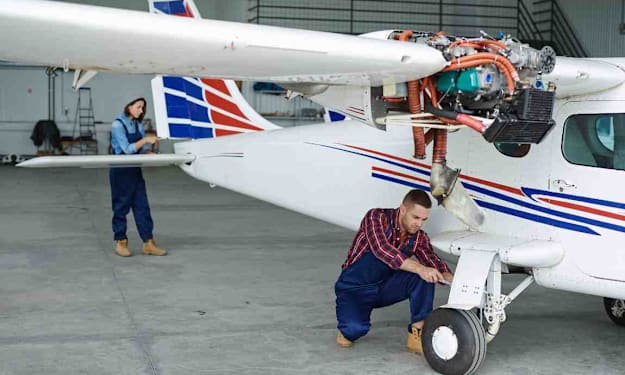
Why Airports Are Spending Billions on Security — And It's Still Not Enough Every time you stand in a TSA line, shoes off and laptop out, you're participating in a system that was largely designed in the early 2000s. Yet the threats airports face today — sophisticated explosives, cyberattacks on air traffic systems, drone incursions — look nothing like what kept security planners up at night two decades ago. That mismatch is fueling one of the most significant spending surges in aviation history. The global Airport Security Market is undergoing a fundamental transformation, driven by technology adoption, geopolitical pressure, and a post-pandemic rethinking of what "safe travel" actually means.
By Kathryn J. Lemos4 months ago in Futurism
Aircraft Curtains Market: The Cabin Detail Airlines Can't Ignore. AI-Generated.
The Curtain Separating You From Business Class Is a Bigger Deal Than You Think I used to assume the curtain at the front of the economy cabin was basically an afterthought — a fabric panel chosen by whoever had five minutes to spare in an airline's procurement meeting. Then I came across sourcing specs for commercial cabin interiors. The weight tolerances, the flame-retardancy certification requirements, the thread counts engineered for a specific drape — it turns out that curtain is a highly specified product, and the global Aircraft Curtains Market generating consistent demand year after year is proof that airlines are paying serious attention to it.
By Kathryn J. Lemos4 months ago in Futurism
What's Actually Behind the Commercial Supersonic Aircraft Revival. AI-Generated.
The Mach 2 Question Nobody in Aviation Can Stop Asking The Concorde retired on November 26, 2003. A British Airways flight from JFK to Heathrow, four hours and twenty-four minutes, 100 passengers, the end of an era. In the two decades since, supersonic commercial aviation existed mostly as a nostalgia item — something older aviation journalists wrote retrospectives about and engineering students cited in thesis papers. That's changed, and the change feels different from previous false starts because actual airlines are now writing actual checks.
By Kathryn J. Lemos4 months ago in Futurism
The Language of Attractors. AI-Generated.
Imagine a computer chip that doesn't care about zeroes and ones. Instead, it listens to the slow, pulsing electrical rhythms of a living forest. Now, imagine that the only way to truly unlock this chip’s cognitive potential is not through Python or C++, but through the complex, recursive geometry of the Hungarian language.
By Air (Artificial Intelligence Royal)4 months ago in Futurism
Europe’s AI Revolution: Inside the EU AI Act That Is Redrawing the Future of Technology
Artificial Intelligence is no longer science fiction. It’s already in your phone, your social media feed, your classroom tools, and even healthcare systems. But as AI becomes more powerful, questions about safety, privacy, and control are becoming urgent.
By Muhammad Zeeshan4 months ago in Futurism
Michalene Melges and the Challenge of Managing Innovation in Modern Robotics. AI-Generated.
Michalene Melges is a seasoned Project Manager in AI robotics, leading complex cross-functional teams and driving advances in intelligent automation. Her work reflects the realities of managing innovation in environments where uncertainty is part of the process. Robotics development often involves changing requirements, evolving technical challenges, and continuous experimentation. As intelligent automation becomes more integrated into industries such as healthcare, logistics, and manufacturing, project leaders are increasingly relying on adaptive strategies to guide development teams through unpredictable conditions. The growing use of agile methodologies in robotics highlights the need for flexibility, communication, and iterative learning in modern technology projects.
By Michalene Melges4 months ago in Futurism