
Europe’s AI Revolution: Inside the EU AI Act That Is Redrawing the Future of Technology
How the European Union is becoming the world’s first major regulator of artificial intelligence — and why it matters for everyone

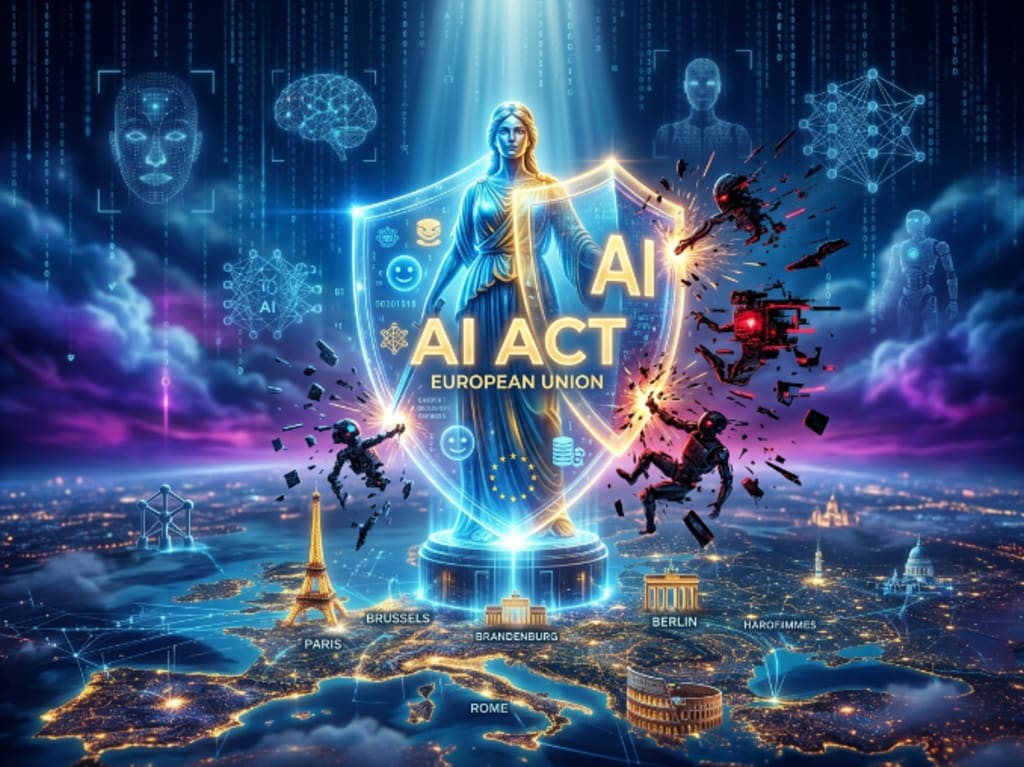
Artificial Intelligence is no longer science fiction. It’s already in your phone, your social media feed, your classroom tools, and even healthcare systems. But as AI becomes more powerful, questions about safety, privacy, and control are becoming urgent.
To answer those questions, the European Union has introduced one of the world’s most ambitious technology laws: the EU Artificial Intelligence Act (AI Act). This landmark legislation is not just another policy update — it is a full framework designed to control how AI is developed and used across Europe and beyond.
What is the EU AI Act?
The EU AI Act is the first comprehensive law in the world that regulates artificial intelligence based on risk. Instead of banning AI altogether or letting it grow without limits, the EU has created a structured system that categorizes AI tools depending on how dangerous they could be to people.
In simple terms, the Act asks:
“How much harm could this AI system cause if it goes wrong?”
Based on this, AI systems are divided into four categories:
Unacceptable Risk (Banned AI)
High Risk AI
Limited Risk AI
Minimal or No Risk AI
This risk-based approach is what makes the law unique and globally influential.
1. Unacceptable Risk: AI That Is Banned
Some AI systems are considered so dangerous that they are completely banned in the EU. These include technologies that manipulate human behavior or violate fundamental rights.
Examples include:
Social scoring systems that rank people based on behavior
AI that exploits vulnerable groups (like children)
Certain types of biometric surveillance in public spaces
The idea is simple: if AI threatens human dignity or freedom, it has no place in society.
2. High-Risk AI: Strict Rules Apply
This is the most heavily regulated category. High-risk AI systems are allowed, but only under strict conditions.
These include AI used in:
Healthcare (diagnosis tools)
Education (grading systems or admissions)
Employment (CV screening software)
Law enforcement
Infrastructure (transport safety systems)
To use high-risk AI, companies must:
Ensure high accuracy and safety
Keep human oversight in decision-making
Provide clear documentation
Test systems before deployment
Monitor performance continuously
This ensures AI does not make life-changing decisions without accountability.
3. Limited Risk AI: Transparency Required
These systems are less dangerous but still need rules. The main requirement here is transparency.
For example:
Chatbots must clearly tell users they are not human
AI-generated content (like deepfakes) must be labeled
This category is important because many people interact with AI daily without even realizing it. The EU wants to make sure users are not misled.
4. Minimal Risk AI: Mostly Free Use
Most AI systems fall into this category. These include:
AI spam filters
Video game AI
Recommendation systems (like Netflix or YouTube suggestions)
These tools are allowed with very few restrictions, as they pose little risk to rights or safety.
Why the EU AI Act Matters Globally
Even though the law is made in Europe, its impact is global. This is known as the “Brussels Effect” — when EU regulations become a worldwide standard because companies prefer to follow one strong rule rather than different rules in every country.
Big tech companies that operate in Europe will have to comply with the AI Act. That means they may apply similar rules globally to avoid confusion.
So, even if you are outside Europe, this law could still affect the AI tools you use.
AI and Fundamental Rights: The Core Idea
At its heart, the EU AI Act is not just about technology — it is about human rights.
The EU is trying to ensure that AI:
Does not discriminate against people
Does not invade privacy without consent
Does not make unfair decisions about jobs, education, or justice
Remains under human control
This reflects Europe’s broader approach to digital governance, where safety and rights are prioritized over rapid innovation without limits.
Challenges and Criticism
Despite its ambition, the AI Act is not perfect. Critics point out several challenges:
1. Innovation Concerns
Some tech companies worry that strict rules may slow down AI innovation in Europe compared to countries with lighter regulations.
2. Implementation Complexity
The law is detailed and complex, making compliance difficult, especially for smaller startups.
3. Rapid AI Evolution
AI is evolving quickly. Some fear that by the time rules are fully enforced, new AI technologies may already outpace them.
A Global Turning Point
Even with these challenges, the EU AI Act is widely seen as a historic step. It is the first serious attempt to legally control artificial intelligence at a large scale.
Other countries — including the United States, Canada, and parts of Asia — are closely watching the EU model. Many may adopt similar frameworks in the future.
Conclusion: A New Era of Controlled Intelligence
The EU AI Act represents a turning point in human history. For the first time, artificial intelligence is not just being developed — it is being governed.
The goal is not to stop innovation, but to ensure that innovation serves people safely and fairly.
As AI continues to grow smarter and more powerful, laws like this will shape how technology fits into our lives. The big question is no longer “What can AI do?” — but rather “What should AI be allowed to do?”
And in answering that question, the European Union has taken the first bold step.
About the Creator
Muhammad Zeeshan
I’m Muhammad Zeeshan, a curious student who loves science, geology, and exploring how the Earth works. I write to share ideas, stories, and knowledge that inspire thinking and discovery.
Enjoyed the story? Support the Creator.
Subscribe for free to receive all their stories in your feed.
Comments
There are no comments for this story
Be the first to respond and start the conversation.