
China is pursuing an asteroid that might not actually be a fragment of the Moon.
Not very uncommon

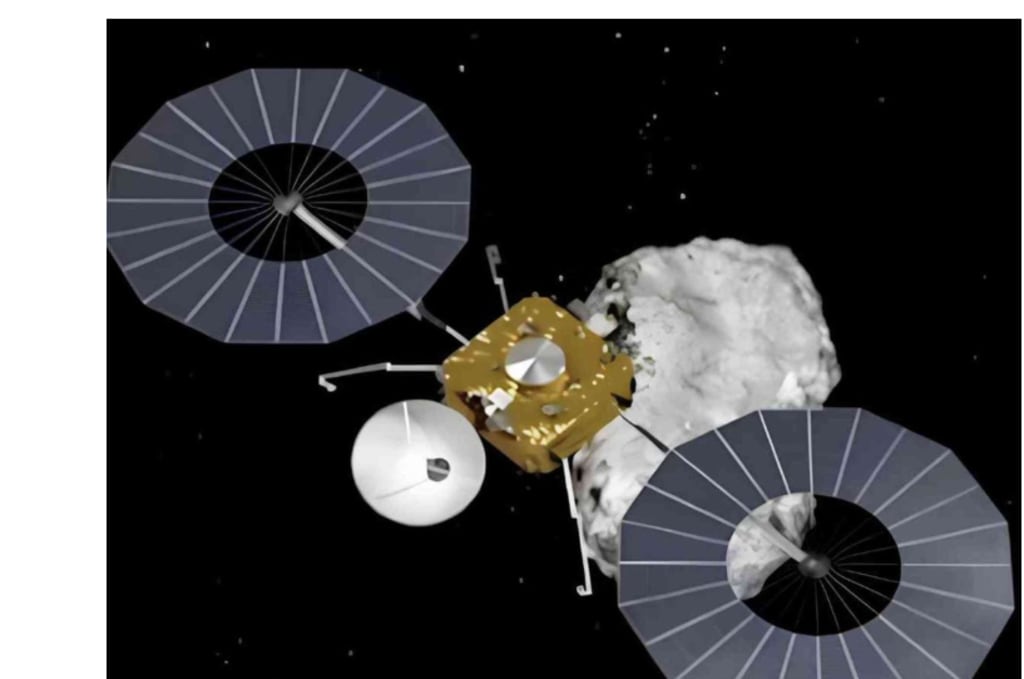
China is getting ready to gather a sample from a tiny near-Earth asteroid that many experts believe is a piece of the Moon. mThe dominant explanation links the object to a crater on the far side of the moon, where the fragment may have been blasted into space by an ancient impact. That notion is now contested by a recent study.
Researchers contend that the asteroid's peculiar red hue, which has long been interpreted as proof of a lunar origin, can be replicated in a lab setting using no Moon material at all.
A rock worth pursuing
Kamoʻoalewa, a near-Earth asteroid that orbits the Sun while staying close to Earth, is the target. It rotates around every 28 minutes and is less than 330 feet (100 meters) broad.
The Tianwen-2 sample-return mission, which China launched in May 2025, is currently on its way to the asteroid with the goal of gathering material and returning it to Earth by the end of 2027.
Kamoʻoalewa may have formed on the Moon because earlier studies had connected it to lunar rock. A team lead by planetary scientist Yang Li of the Chinese Academy of Sciences' Institute of Geochemistry examined the asteroid's reflected light in a novel way.
Observing reflected light
Every mineral has an impact on the light it reflects. Researchers can identify which minerals are present and their approximate abundance by observing where a surface dims at specific wavelengths.
After reanalysing the reflected light, Li's team discovered a distinctive drop in the spectrum. Compared to lunar rock, it more closely resembles LL chondrites, a typical low-iron family of stony meteorites.
However, the hue was peculiar and very red—much redder than raw stone. Because there wasn't much else that matched that colour, earlier experts believed it to be an indication of the Moon.
Using lasers to burn rock
In this case, the group took a step that previous research had not taken. A actual LL chondrite meteorite was used, and a portion of it was crushed into a tiny powder before being struck by a fast-moving laser. The steady beating of an airless surface over millions of years by the solar wind and small meteorite hits was represented by the laser as space weathering.
The powder underwent a significant transformation following that simulated weathering. The brightness of pale grains decreased to roughly a fifth of their initial value, and they became dark. The colour reddened and that mineral dip diminished until it about matched Kamoʻoalewa.
Prior to this experiment, there was no laboratory evidence that regular rocky rock could weather to such a deep red. This was never possible with a solid slab but with loose powder.
Not very uncommon
The asteroid might not be as strange as it first appeared if weathered meteorite dust can resemble Kamoʻoalewa. The researchers responded by searching through extensive measurement catalogues for additional very red, stony bodies. mThey discovered a few equally red, silicate-rich asteroids strewn throughout the main belt and near-Earth space.
A scant catalogue had been the foundation of the prior argument. Now that a lot more asteroids have been measured, the argument for a weathered rock is stronger and the argument for a single lunar fragment is weaker.
Finding its way home
Only half of the problem is composed. The rock must have originated somewhere if it isn't lunar. The youthful crater Giordano Bruno on the Moon's far side was designated as a launch site in a previous model.
The group conducted orbital simulations on its own. One model made no compositional assumptions. The boulder had around a seven-out-of-ten probability of escaping through the inner belt's gravitational gap, which directs things toward Earth.
A second version focused even more after being instructed to assume LL chondrite. The rock most likely originated from the Flora family, an ancient cluster located deep within the inner main belt. The team is cautious because neither run gave the Moon a chance. They are merely demonstrating that a main-belt birthplace suits just as well; they are not proclaiming the lunar idea dead.
Itokawa's cousin
One name kept coming up. Japan's Hayabusa spacecraft encountered and examined the rocky asteroid Itokawa in 2010. Itokawa was strongly linked to LL chondrites by laboratory study of the returning grains.
Itokawa's reflected light appears to be more severe than Kamoʻoalewa's. The recipe is the same, except the dip is shallower and the colour is redder.
According to the scientists, it was the same rock, but it had weathered more severely and over a longer period of time. Kamoʻoalewa shares a fundamental composition with seven items from the Flora family.
Rocks that travel near Earth age more quickly than those that remain farther away. By that reasoning, Kamoʻoalewa is a bruised older sibling of rocks that is still seated.
The sample determines
Up until now, the appearance of the asteroid's light was the deciding factor between the Moon and the meteori. In addition to orbital footprints that go back to the asteroid belt, this work provides laboratory evidence that weathered stony rock can imitate that appearance.
The question is not limited to a single rock. The most common near-Earth objects are small, rapidly rotating asteroids like this one, yet scientists hardly understand how their surfaces age.
When the capsule touches down in 2027, it will contain material from a body this small and spinning so quickly that no mission has ever returned it before. Whether it is a part of the moon or worn rock from the asteroid belt, whatever is inside provides a straight answer to the issue.
About the Creator
Enjoyed the story? Support the Creator.
Subscribe for free to receive all their stories in your feed.
Comments
There are no comments for this story
Be the first to respond and start the conversation.