Historical
The Well of Secrets
I. The Village of Mirabad The village of Mirabad had no secrets — or so the elders claimed. Nestled between two hills like a sleeping child between its parents' arms, it was the kind of place where the smell of bread from one household drifted to another, where every birth was celebrated by the whole street, and every death was mourned by every soul who could walk to the graveyard. People believed that here, under the open sky, nothing could stay tv hidden for long. But there was the well. It stood at the very center of the village square, older than anyone could remember. The stone walls were dark with age, the rope that hung over it had been replaced a hundred times, and the water that rose from its depths was the coldest, clearest water in the entire valley. Children drank from it. Women washed vegetables beside it. Old men sat on its edge and told stories that had no endings. Everyone used the well. But no one — not even the oldest elder — knew how deep it truly went. It was beside this well that the trouble began, on the last Tuesday of October, when the body of Tariq the miller was found. ⸻ ✦ ⸻ II. The Morning After Rukhsana was the one who found him. She had come before dawn, as she always did, to draw water before her mother-in-law woke and demanded tea. The lantern in her hand threw a pale circle of light onto the cobblestones — and there he was, Tariq, slumped against the base of the well, his eyes wide open, staring at nothing. She did not scream. Rukhsana had grown up in this village and she had seen death before — her father, a drought that killed their crops and then their animals, two children buried before they could learn to speak. She set down her lantern. She pressed two fingers to Tariq's neck. Cold. Long gone. Then she noticed something. His right hand was clenched tight around a piece of cloth — torn, dark blue, the kind of fabric the wealthy men of the village wore. Rukhsana stared at it for a long moment. Then she looked up, into the dark mouths of the houses surrounding the square, the shuttered windows, the closed doors. She felt the village watching her, even in its sleep. She left the cloth where it was and went to wake the headman. "In a village this small, a secret is not something you keep. It is something you bury — and pray the rains do not come." III. The Questions Begin By midmorning, the square was full. The headman, old Bismillah Khan, sat on a wooden chair that had been brought out from his house, and one by one the men of the village came to stand before him. The women watched from a distance, gathered in tight clusters, their voices low. The constable from the district town had been sent for, but the road was muddy from the night's rain and it would be hours before he arrived. In the meantime, Bismillah Khan asked the questions himself. Who had seen Tariq last? His wife, Zainab, said he had left after the evening prayer, saying he needed to check on his mill wheel. He had not returned. She had assumed he stayed there, as he sometimes did when the work ran long. She had gone to sleep. Who had been in the square after dark? No one admitted to it. And the cloth in Tariq's hand? Bismillah Khan held it up. The crowd went very quiet. It was good fabric, fine weave, the colour of deep water. Several eyes shifted — briefly, involuntarily — toward the house of Saleem the merchant, the richest man in Mirabad, whose long coat was made of exactly that kind of cloth. Saleem stood at the edge of the crowd, arms folded, his face as smooth and unreadable as river stone. ⸻ ✦ ⸻ IV. What Rukhsana Knew It was Rukhsana who held the real secret, though she had not yet decided what to do with it. Three weeks ago, she had been drawing water late at night — her mother-in-law had been feverish, and she needed water for the medicine. The square had been empty, the village asleep. But as she pulled up the bucket, she had heard voices from the alley beside the merchant's storehouse. Tariq's voice and another — hushed, urgent, arguing. She had caught only fragments. "You promised. The land was to be mine—" "Keep your voice down. Things have changed." "I have the papers. I have proof of what you did." Then silence, and footsteps fading, and she had gone home and told herself it was none of her business. Village men argued about land constantly. It meant nothing. Now Tariq was dead and Rukhsana stood in the crowd with the weight of those words pressing against her ribs like a stone. She looked at Saleem. He was already looking at her. Their eyes met for just a second — and in that second, something passed between them. An acknowledgment. A warning. Rukhsana looked away first. ⸻ ✦ ⸻ V. The Well Gives Nothing Back That afternoon, one of the boys threw a stone into the well to measure its depth. They waited for the sound. And waited. And waited. There was no splash. The boys went pale and ran home and told their mothers, who told their husbands, and by evening everyone in Mirabad was talking about the well — about how deep it truly was, what was really at the bottom, whether it had always been so silent or whether something had changed. The constable arrived at dusk, a tired young man with mud on his boots and no patience for village superstitions. He examined Tariq's body, took the cloth as evidence, wrote in his notebook, and told Bismillah Khan that the cause of death appeared to be a blow to the back of the head. Murder. He would return in three days with an investigator from the city. Three days. The village settled into an uneasy silence. That night, Rukhsana lay awake listening to her mother-in-law snore. She thought about Tariq's wife, Zainab, who had wept all afternoon with a grief that looked genuine. She thought about the papers Tariq had mentioned — proof of what Saleem had done. Where were those papers now? Had Saleem found them? Had he been searching Tariq's mill, even now, in the dark? She rose before her husband could stir, wrapped her shawl around her shoulders, and slipped out into the night. ⸻ ✦ ⸻ VI. The Mill The mill sat at the edge of the village where the stream ran fast over smooth rocks. The door was ajar. Rukhsana pushed it open and stepped inside. A figure was already there, crouched by the far wall, holding a lantern. He stood when he heard her — and the light fell on his face. It was not Saleem. It was Zainab. Tariq's wife looked at Rukhsana with red, swollen eyes and clutched something to her chest — a folded bundle of papers, tied with string. "I knew he kept them here," Zainab said. Her voice was very calm, in the way that voices go calm when all the fear has already passed through them. "He told me once, when he was drunk. He said: if anything ever happens to me, go to the loose stone behind the millstone. He knew this day might come." Rukhsana stepped forward. "Are those—" "Land records. Forged signatures. Saleem has been stealing land from the families of this village for fifteen years. Tariq found out six months ago. He was going to give these to the investigator from the city." Zainab's jaw tightened. "He waited too long." Outside, the stream rushed over its stones. Somewhere in the village, a dog barked twice and went quiet. "What will you do?" Rukhsana asked. Zainab looked down at the papers. Then she looked up, and in her eyes was something that Rukhsana recognized — the look of a woman who has nothing left to lose and has therefore become the most dangerous kind of person in the world. "I will not wait," Zainab said. ⸻ ✦ ⸻ Epilogue When the investigator arrived from the city three days later, Zainab was waiting for him at the entrance to Mirabad, the papers in her hands. Saleem the merchant was arrested before the afternoon prayer. The stolen land was the subject of a case that would take two years to resolve but would, in the end, return what had been taken. No one ever determined exactly how deep the old well was. But the morning after Saleem was taken away, the boys threw another stone into it — and this time, faint and far below, there was a sound. Small. Distant. Real. A splash. The village of Mirabad breathed again. — The End —
By Ikram Ullah5 months ago in Fiction
Adolf Hitler Eternal Therapy Session 669
Lucifer Morningstar sits behind a black mahogany desk, typing away in a sleek grey Google Chromebook. He has moon-shaped spectacles over his red eyes, the blacks of his stained white with exhaustion. A large counter over his head continuously ticks up in number to larger and larger numbers.
By Hope Martin5 months ago in Fiction
VOID. Content Warning.
What if everything you know exists inside a boundary you cannot see? Not a wall. Not a limit you can touch. But a condition. An invisible frame that defines what is real, what is possible, and what is allowed to be understood.What if?
By Kelly Munala Brookes5 months ago in Fiction
The Day I Realized I Was the Problem
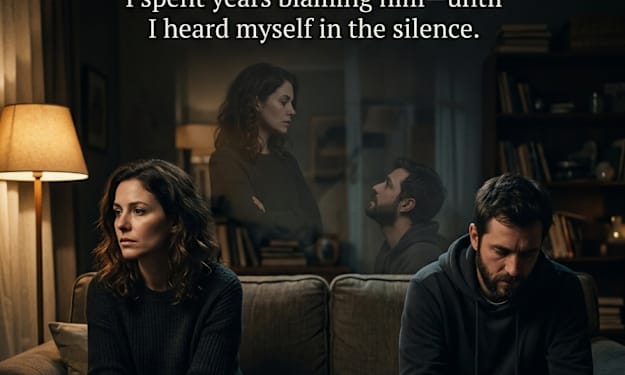
The Day I Realized I Was the Problem I used to think my husband didn’t listen. That was the story I told myself. The one I repeated to friends over tea, to my sister over late-night calls, even to myself in the quiet moments when the house finally settled. He didn’t listen. He didn’t care. He didn’t try. It sounded clean. Simple. Easy to believe. “Men are like that,” my friend Nadia would say, shaking her head. “You have to accept it.” I nodded every time, feeling understood, justified. Because it wasn’t just one thing. It was everything. The way he checked his phone when I was talking. The way he answered with “hmm” instead of real words. The way he forgot things I told him—important things, like the appointment I had been nervous about, or the story I had repeated twice already. It felt like I was invisible in my own home. And the worst part? I kept trying. I tried to talk more. Explain better. Choose the right time. The right tone. The right words. Nothing worked. So eventually, I stopped trying. Silence is not quiet. Not really. It’s loud in ways people don’t notice at first. It shows up in the way you put plates on the table without looking at each other. In the way you sit on opposite sides of the room, both pretending you’re just tired. In the way small questions—“Did you eat?” “Are you coming home early?”—replace real conversations. That’s where we were. Living together, but not really living with each other. And in my mind, it was his fault. The day it changed wasn’t dramatic. There was no shouting. No breaking point. Just a small moment. I was in the kitchen, cutting vegetables, when he walked in. He looked tired. More tired than usual. “I had a long day,” he said. I didn’t respond. Not because I didn’t hear him. I heard every word. I just didn’t feel like answering. He waited for a second, maybe two. Then he said, “They’re making changes at work.” Again, I stayed quiet. I told myself he didn’t deserve my attention. Not after all the times he had ignored me. So I kept cutting, the knife hitting the board a little harder than necessary. “I might lose my position,” he added, his voice lower now. I paused for a fraction of a second. Then continued. He stood there a little longer. I could feel it, even without looking at him. The waiting. The hesitation. And then he left. Just like that. That night, he didn’t say much. He ate quietly. Sat quietly. Slept early. I noticed it, of course. But I didn’t react. Part of me felt satisfied. Now he knows what it feels like. That’s what I told myself. The next morning, I found his message. Not a dramatic one. Not emotional. Just a simple line: “I tried to talk to you yesterday.” That was it. No accusation. No anger. Just… a fact. I read it once. Then again. Something about it felt different. Not because of what it said—but because of what it didn’t. There was no blame in it. No “you never listen.” No “you don’t care.” Just a quiet observation. And for the first time, I didn’t feel defensive. I felt… uncomfortable. I started replaying the moment in my head. Him standing in the kitchen. His voice, slightly uncertain. “I had a long day.” “They’re making changes at work.” “I might lose my position.” I had heard every word. And I had chosen silence. It’s easy to ignore someone when you believe you’re right. It’s harder when you start to question that belief. I sat there, holding my phone, and realized something I hadn’t allowed myself to see before. He had been trying to talk. And I had done exactly what I accused him of doing. The thought didn’t settle immediately. I resisted it. It’s not the same, I told myself. He does it all the time. But the more I thought about it, the weaker that argument became. Because the truth was, I had stopped listening long before that day. Not just with my ears—but with my attention, my patience, my willingness to understand. I had built a story where he was always wrong. And once you believe a story like that, you stop seeing anything that doesn’t fit it. I remembered all the times he had tried, in small ways. Asking how my day was, even if I answered shortly. Sitting next to me, even when I stayed distant. Bringing things home he thought I might like. I had dismissed all of it. Because it wasn’t enough. Or maybe because it wasn’t the way I wanted it. That realization didn’t feel empowering. It felt heavy. Because blaming someone else is easy. Taking responsibility is not. That evening, I did something I hadn’t done in a long time. I waited for him. Not just physically—but mentally. When he walked in, I didn’t stay in the kitchen. I didn’t pretend to be busy. I sat in the living room and looked up. He seemed surprised. “Hi,” he said. “Hi,” I replied. There was a pause. A familiar one. But this time, I didn’t let it stretch. “How was your day?” I asked. Simple words. Nothing special. But I meant them. He hesitated, like he wasn’t sure if this was real. Then he said, “It was… complicated.” I nodded. “Do you want to talk about it?” Another pause. Then he sat down. He didn’t say everything at once. It came slowly. In pieces. Work stress. Uncertainty. Fear he hadn’t voiced before. And for once, I didn’t interrupt. I didn’t prepare my response while he was speaking. I just listened. At some point, I realized something quietly unsettling. This wasn’t new. He had always been this person. I had just stopped seeing him. Later that night, after the conversation had ended and the house was quiet again, I sat alone and thought about everything. Not just that day. But all the days before it. All the moments I had ignored. All the times I had chosen silence over understanding. I had spent so long believing I was reacting to him. That I hadn’t noticed how much I was shaping what we had become. The truth wasn’t comfortable. It didn’t make me feel strong or justified. It made me feel responsible. And maybe that was the point. Because for the first time, I understood something clearly. If I had the power to make things worse… Then maybe, just maybe, I had the power to make them better too.
By Abdul Muhammad 5 months ago in Fiction
A Tent in Agony
Four men once came to a wet place in the roadless forest to fish. They pitched their tent fair upon the brow of a pine-clothed ridge of riven rocks whence a bowlder could be made to crash through the brush and whirl past the trees to the lake below. On fragrant hemlock boughs they slept the sleep of unsuccessful fishermen, for upon the lake alternately the sun made them lazy and the rain made them wet. Finally they ate the last bit of bacon and smoked and burned the last fearful and wonderful hoecake.
By helsing Riddick5 months ago in Fiction
Andreas Szakacs on Michael: An Actor’s Reflection on Legacy, Performance, and Emotion
As an actor, I didn’t approach this film as a historian or critic. I approached it as someone trying to understand performance, emotion, and the weight of becoming a legend. And in that sense, the film offers more questions than answers.
By Andreas szakacs5 months ago in Fiction