
The First Dream Ever Dreamed
Long before language or gods, one ancient soul closed his eyes—and gave birth to the first dream. A cinematic journey into the origins of imagination.

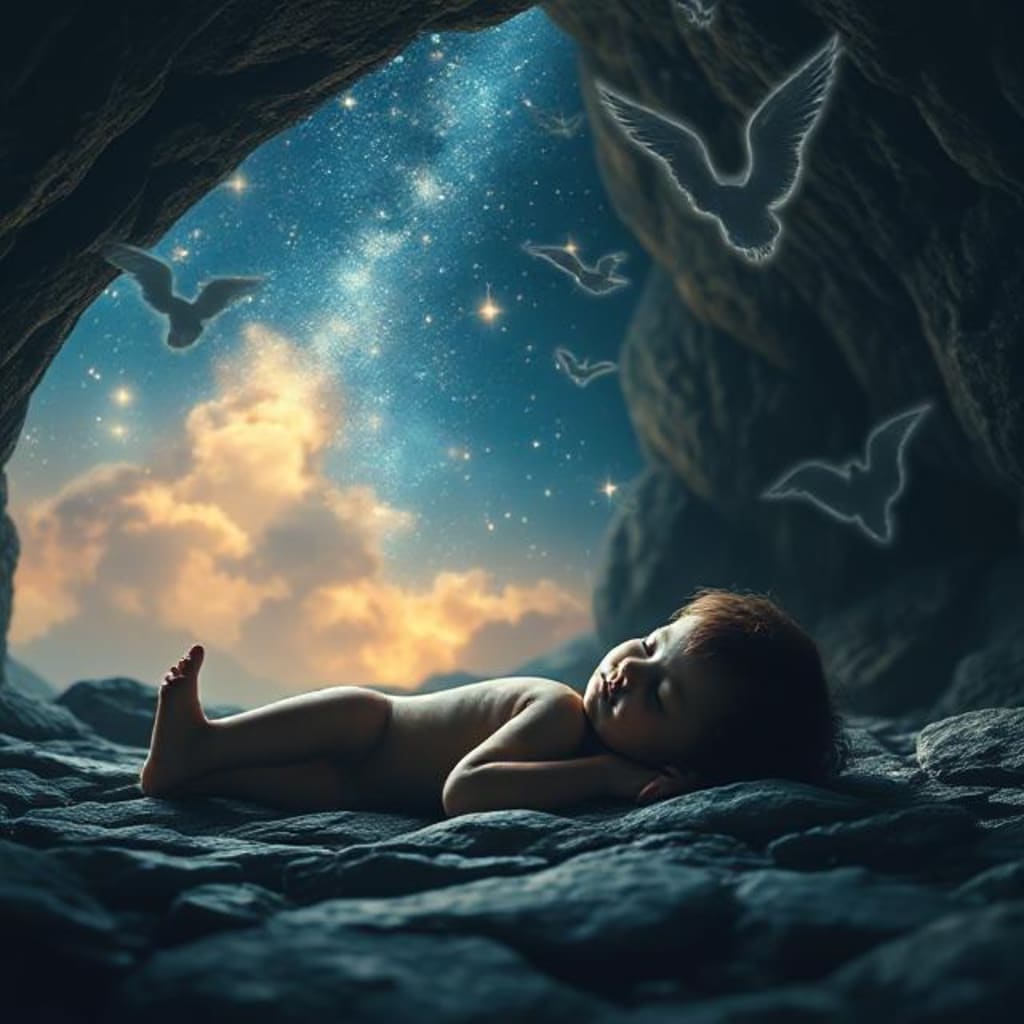
I. When Sleep Was Just Darkness
Before dreams had names, they still lived inside us.
He was a child of the cliffs—born in the time before language, before even gods had names. His tribe did not understand what sleep truly was. To them, it was a nightly death, a closing of the eyes and surrender to the shadows.
They had no word for "dream." No concept of imagination.
And yet, one cold night, under a sky stitched with stars, he dreamed—and the world changed forever.
II. The Cave Without Fire
He was smaller than the others. Quieter. Where others played with rocks and sticks, he listened to the birds. He watched the moon rise with the intensity of someone searching for meaning he could not speak aloud.
His mother thought him strange.
He barely ate. He rarely laughed. He once stared at a dead antelope for hours, as if trying to understand where its breath had gone.
At night, he curled alone near the wall of the cave, farthest from the fire.
And one night, in the depth of silence, he closed his eyes and fell into the dream.
III. The Dream Itself
It came not like memory—but like magic.
He saw a forest of light, where trees whispered in glowing tongues. He walked on a path made of stardust. Strange creatures—part bird, part man—flew over his head, and the river sang in voices that sounded like his mother, but softer, and not sad.
He saw the moon bend down to kiss his forehead.
He saw fire take the shape of a woman.
He saw his father, who had never returned from the hunt, smile at him.
And then—he woke up.
IV. The First Confusion
The morning was different.
The wind felt like it remembered him.
The sun seemed slower. More curious.
He tried to explain it. He made shapes in the dirt with his fingers. Spirals. Eyes. A half-moon. His mother frowned, not understanding.
He touched his chest and whispered sounds no one had taught him. He looked toward the stars, even though it was day.
They called him mad.
But that night, he smiled at the sky before sleeping.
And again, he dreamed.
V. The Rise of the Imagination
This time, he flew.
No wings. No body. Just flight.
He soared through fire and fog, across a sky that shifted colors like breath. He saw a giant eye blink inside a mountain. He saw a child—himself?—holding the sun like a ball.
When he woke up, he cried.
Not from fear—but from the ache of returning to a world that was less.
He realized something sacred:
There is a world inside us. And it is alive.
VI. The Tribe Begins to Watch
They began to notice.
He would wake with tears, or laughter, or fear. His stories became longer. His gestures more urgent.
One night, he made marks on the cave wall. A figure sleeping beneath stars. Shapes flying from his head.
Others watched.
A child copied him. Then another.
The old woman with no teeth touched the drawing and began to hum.
It was the first time anyone had shared a dream—without language.
And that night, they all dreamed.
VII. The Spread of Dreams
Soon, the tribe began to see things when they closed their eyes.
Some saw ancestors. Some saw animals that spoke. One man said he walked on water. Another claimed he kissed a tree that bled light.
They stopped fearing the night.
They began sleeping together, closer.
Their fires burned longer.
Their eyes glowed brighter.
The child who dreamed had opened a door no one knew existed. Not in the stars. Not in the soil.
But inside the soul.
VIII. What Science Now Believes
Today, scientists call it Oneiric Genesis—the hypothetical moment when the first human experienced a dream vivid enough to recall, and emotional enough to share.
Neurologists suggest it was likely a child. During REM sleep. Likely under the influence of early neurochemical changes linked to imagination, evolution, and memory.
Anthropologists debate whether this gave rise to language.
Or to gods.
Or to art.
But none can explain the ache—the pull—of that first dream.
Because even science knows:
The soul felt it first.
IX. The Forgotten Tomb
In a remote valley in modern-day Jordan, archaeologists found the skeleton of a child, roughly 100,000 years old. Curled in a fetal position. Buried with stone etchings—spirals, stars, waves, and one figure lying down with eyes closed.
They named him “The Dreamer.”
His bones were too fragile for a hunter. His brain cavity slightly larger than average.
Some mocked the idea.
But one archaeologist wrote in her notes:
“If he truly dreamed, then he was the first human to know what it means to miss something that never existed.”
X. The Inheritance
We still dream.
Of flying. Of falling. Of touching those we’ve lost.
We dream of futures. Of fears. Of memories that never happened.
We still wake up with tears, with smiles, with confusion.
And every time we do, we echo him—
That nameless child beneath the cliff stars,
who first slipped into that inner world
and returned carrying magic.
Final Lines
Before language, before gods, before fire—
There was the dream.
And it lives in all of us still.
About the Creator
uzair hadi
🌟 Love stories that stir the soul? ✨
Subscribe now for exclusive tales, early access, and hidden gems delivered straight to your inbox! 💌
Join the journey—one click, endless imagination. 🚀📚 #SubscribeNow
Enjoyed the story? Support the Creator.
Subscribe for free to receive all their stories in your feed.
Comments
There are no comments for this story
Be the first to respond and start the conversation.