
Blood Between Brotherhoods
A father and son torn apart by war, loyalty, and the painful truth that understanding sometimes comes too late.

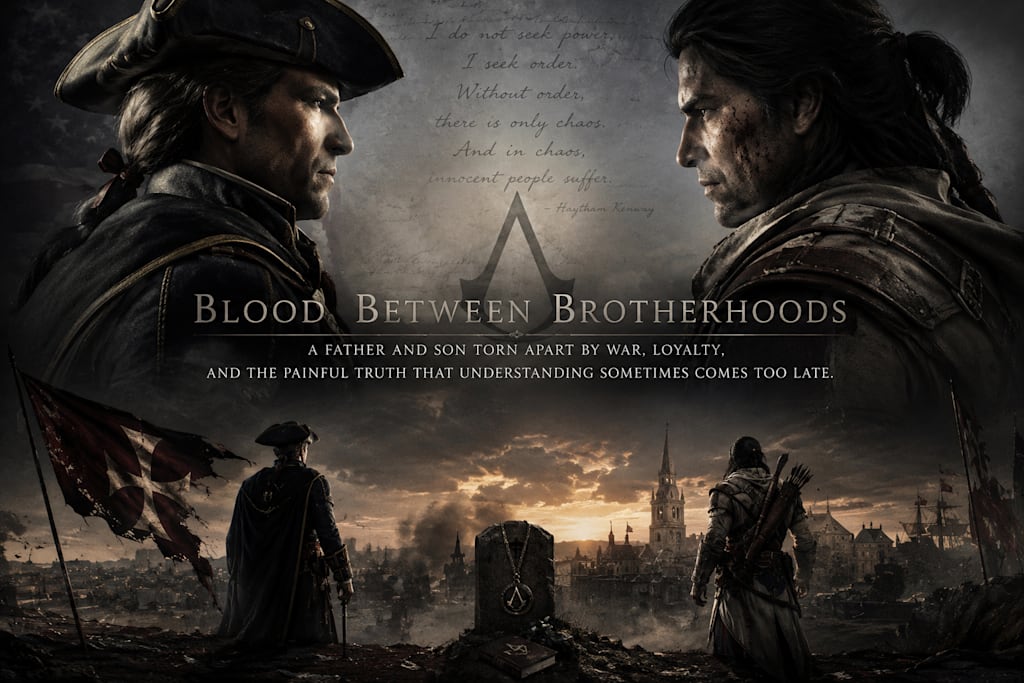
The ending of Assassin’s Creed: Forsaken isn’t just about Assassins and Templars anymore. By the end of the story, it becomes something much more painful — a story about a father and son who were never truly able to understand each other until it was too late. Haytham Kenway had spent most of his life believing he was fighting for order. Ever since he was a child, his world had been shaped by violence, betrayal, and manipulation. After losing his father and being raised by the wrong people, he grew into a man who trusted control more than freedom. To him, chaos destroyed lives. Order protected them. Connor, however, believed the opposite. Connor saw what the Templars had done to innocent people, especially to his own village and his people. He believed freedom mattered more than control, even if the world was imperfect. And because of that, father and son slowly became enemies standing on opposite sides of the same war. But deep down, neither of them truly hated the other. Throughout the story, there are moments where Haytham tries to connect with Connor. He fights beside him at times, saves his life once, and even tries to explain that the world is not divided into simple heroes and villains. Connor listens, but he cannot forget the pain caused by the Templars. As the war reaches its end, the final confrontation happens at Fort George. Haytham stands in Connor’s way while Charles Lee escapes. Their fight feels less like two enemies battling and more like two broken people forced into a tragedy neither wanted. Haytham knows Connor has become strong. Connor knows his father is not completely evil. Yet both believe they are right. The fight ends with Connor stabbing Haytham using the Hidden Blade. For a moment, everything becomes quiet. Haytham’s final words carry anger, regret, and sadness all at once. It feels like a father realizing he lost his son long before this battle ever began. After Haytham dies, Connor finds and reads his father’s journal — the very journal that tells the story of Forsaken. And for the first time, Connor truly understands him. He learns about Haytham’s childhood. About the murder of Edward Kenway. About the manipulation by Reginald Birch. About the years of pain and loneliness that shaped the man he became. Connor finally realizes his father was never simply a monster. He was a damaged man trying to create a better world in the only way he knew how. That realization hurts Connor deeply because now understanding comes too late. The man he wanted answers from is already gone. Later, Connor hunts down Charles Lee, the last major enemy left. But even that moment feels empty. There is no satisfaction in revenge anymore. Connor kills him quietly, almost without emotion, as if he already knows revenge cannot repair what has been lost. Then comes the most heartbreaking part of the ending. Connor returns to his village hoping to see his people safe again… only to discover the village abandoned. The new American government forced the natives away from their land despite all the promises of freedom made during the Revolution. Connor watches people being sold as slaves in the streets and finally understands a painful truth: The world did not become better just because the war ended. Freedom existed for some people, but suffering still remained for many others. In the final moments, Connor buries Haytham’s amulet and reflects on everything he lost — his mother, his people, and finally his father. He realizes the world is far more complicated than he once believed. And that is what makes Forsaken unforgettable. It is not really a story about winning. It is a story about loss, misunderstanding, and the tragedy of two people who loved each other but could never stand on the same side.
About the Creator
M Uzair Khan (UK)
I am new on this website please support for more stories, poems, and novels
Enjoyed the story? Support the Creator.
Subscribe for free to receive all their stories in your feed.
Comments
There are no comments for this story
Be the first to respond and start the conversation.