Historical
Patience and Time. Honorable Mention in They Shouldn’t Have Come Here Challenge. Top Story - June 2026.
The shock registered on the faces in front of her was understandable. She was just opening her mouth to speak, when a woman somewhere in the crowd screamed, “WITCH!” Over the next few seconds, the cry was repeated, reverberating throughout village. Patience found her arms in the clutch of powerful hands before she could react. The crowd, now turned mob, had her surrounded just as quickly.
By Dana Crandell6 months ago in Fiction
The Guns Of May. Top Story - June 2026.
Thunder rolled in stark contrast to the deep blue sky above with its gently billowing clouds. Hirschel knew instinctively it was not thunder, but he did not know what else to describe the cannons drumming their tattoo beyond the horizon, so close and yet still so very far away.
By Matthew J. Fromm6 months ago in Fiction
The Day the World Held Its Breath: How the US–Iran War Finally Ended
1. The Beginning of Fear It didn’t start quietly. The first strike came like thunder in a clear sky, shocking the world into instant awareness. Within hours, headlines exploded across every screen, carrying images of fire, destruction, and panic. What had once been political tension suddenly turned into something much darker—a full-scale conflict. People everywhere felt it, even thousands of miles away. Fear had no borders, and now, neither did war.
By Muhammad Zeeshan6 months ago in Fiction
The Advantages and Disadvantages of Religion in Our Society II
The Advantages and Disadvantages of Religion in Our Society 2 Religion has influenced human civilization for thousands of years. It has shaped cultures, laws, traditions, art, education, and the way people understand life itself. For many, religion is more than a set of beliefs—it is identity, comfort, guidance, and community. For others, religion is viewed more critically because of the conflicts, divisions, or restrictions sometimes associated with it. Like many powerful forces in society, religion carries both advantages and disadvantages depending on how it is practiced, interpreted, and experienced. The Advantages of Religion 1. Building Community and Belonging One of religion’s greatest strengths is its ability to bring people together. Religious gatherings, shared rituals, celebrations, and places of worship create spaces where people connect and support one another. In many communities, religion becomes a source of friendship, encouragement, and social support during difficult times. 2. Providing Moral and Ethical Guidance Many religious traditions encourage values such as honesty, kindness, forgiveness, generosity, patience, and responsibility. For some people, religious teachings serve as a moral compass that helps guide decisions and behavior. 3. Offering Comfort During Hard Times Life often brings uncertainty, loss, disappointment, and fear. Religion can provide hope and emotional strength. Belief in something greater than oneself can help people endure difficult seasons and find meaning in suffering. 4. Encouraging Charity and Service Religious organizations have historically played roles in helping the poor, supporting education, providing healthcare, and responding to disasters. Many acts of volunteering and generosity around the world are connected to faith communities. 5. Preserving Culture and Identity Religion often becomes deeply connected to traditions, language, ceremonies, and family values. Festivals, music, stories, and customs frequently pass from generation to generation through religious practice. --- The Disadvantages of Religion 1. Risk of Division and Conflict While religion unites many people, differences in belief have sometimes contributed to tension and conflict. When people treat differences as threats instead of opportunities for understanding, religion can become a source of division. 2. Resistance to Change Some religious communities may strongly resist social, scientific, or cultural changes. This can create tension when traditional beliefs and modern developments appear to disagree. 3. Misuse of Religious Authority Religion itself is not automatically harmful, but people in positions of influence can misuse faith for personal gain, control, fear, or manipulation. History and modern society both show examples where authority was abused. 4. Pressure and Exclusion Some individuals experience pressure to conform to religious expectations. People who question beliefs, leave a faith, or live differently may sometimes face judgment or rejection. 5. Conflict Between Freedom and Rules Religious teachings often include standards and boundaries. For some, these create structure and meaning. For others, they may feel restrictive if imposed without room for personal choice or discussion. --- The Balance: Religion and Society The impact of religion is rarely simple. For one person, religion may represent peace, healing, and purpose. For another, it may represent painful experiences or limitation. Much depends on interpretation, leadership, culture, and personal experience. Society often benefits when religion contributes positively while respecting diversity, freedom of thought, and human dignity. At its best, religion can inspire people to serve, love, build, and seek truth. At its worst, religion can become fear, division, or power without compassion. The question is not always whether religion exists in society— but what people choose to do with the influence it carries.
By Samson E. Gifted6 months ago in Fiction
Families Who Rule the World II. Content Warning.
Families Who Rule the World History remembers kings, presidents, generals, inventors, and billionaires. But behind many powerful names sits something older, quieter, and harder to see— families. Not always royal families. Not always political families. Not always famous. Some rise through money. Some through influence. Some through ideas. Some through generations of connection, ambition, and inherited opportunity. The world often looks like it is shaped by individuals. But beneath the surface, families leave fingerprints across decades. This is not a story of one family. It is a story of a hidden question: What if power was less about one person becoming great— and more about people building greatness together across generations? Long ago, in a city nobody agreed how to pronounce, there lived a merchant family called the Varels. They owned no army. No throne. No kingdom. They sold fabrics. Simple business. Nothing impressive. Yet every generation of Varels asked the same question: “What do people need before they realize they need it?” One generation built trade routes. Another learned politics. Another invested in schools. Another entered finance. Nobody became famous overnight. But over time— doors opened. Relationships formed. Trust accumulated. Resources multiplied. Eventually, people noticed something strange. Whenever important decisions happened— someone connected to the Varels seemed nearby. Not because they controlled everything. But because they had spent generations learning how systems worked. People called it luck. The family called it preparation. Then there were families that ruled differently. The Alvins ruled through stories. Every child grew up hearing tales of sacrifice, discipline, and courage. They produced teachers. Writers. Leaders. Artists. They rarely held formal power. Yet generations later— people still repeated their ideas. A family does not always rule through laws. Sometimes it rules through values. Through the things it teaches at dinner tables. Through habits. Through what it celebrates. Through what it refuses to tolerate. Then came the families of invention. No inheritance of gold. Only notebooks. Curiosity. Argument. Questioning. One generation asked: “What if?” Another asked: “Why not?” Their descendants changed industries. Not because intelligence appeared suddenly— but because curiosity became normal. The world sees a breakthrough. Families see years nobody noticed. Late nights. Failures. Encouragement. Lessons passed quietly. But there is another side. Not every powerful family stays powerful. Some become trapped protecting old status. Some confuse authority with wisdom. Some forget that influence without service eventually collapses. Power can become fragile. Legacy can become a cage. A family that once shaped nations can disappear in one generation if values vanish. Meanwhile— someone with no advantage begins building something new. A new idea. A new habit. A new relationship. A new future. History keeps reminding people of this: No throne stays forever. No dynasty is eternal. But families who adapt— families who build— families who invest in people— often outlast monuments. And perhaps that is the secret. The world is not only ruled by those with the loudest names. Sometimes it is shaped by ordinary people who quietly teach discipline. Who help one another. Who sacrifice today so tomorrow has more options. Who build not for attention— but because someone must begin. Every powerful family once started as someone making one decision. One trade. One lesson. One conversation. One generation deciding: “We want better.” And somewhere right now— in an apartment, a village, a crowded city, or a quiet home— another family is beginning. Not with wealth. Not with fame. But with intention. And one day people may look back and wonder: How did they become so influential? The answer may be simpler than they think. They started long before anyone noticed.
By Samson E. Gifted6 months ago in Fiction
Sunday School, 1948
Note: this photograph has haunted me for a very long time, and I wrote this piece to imagine what her life might have been like...and to guess at what she may have been staring at... I suspect that some of you may be able to fill in the blank at the centre of the story. For those of you who might be confused, please watch the video at the end of this piece, and dig a little deeper.
By Kendall Defoe 6 months ago in Fiction
A Man For All Seasons
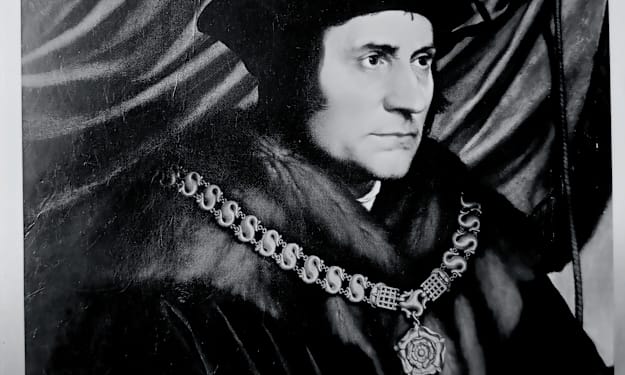
''By Robert Bolt'' Early Childhood Robert Bolt was born in 1924 in Manchester. He was the son of a small shopkeeper; his father kept a furniture shop. He had one elder brother. He was brought up as a Methodist. He says that he still has a rather Puritan outlook on enjoyment, needing a moral reason for it to obtain peace of mind.
By M Uzair Khan (UK)6 months ago in Fiction
In Another Life- Chapter 5
It’s been days since her preparation and today’s the day she’ll seek her revenge and attempt to reunite with Marzen. Currently Lissana is sitting down with her mother at their family home's garden. Her younger brother and sister who had not yet debuted into society were playing around. Guards and maids kept an eye on them as they chased after butterflies and rabbits.
By Hazel Rivers6 months ago in Fiction
Thrice Damned
I drove my horses like a man possessed. We would be able to escape if the good Lord was with us. The wagon bounced and jolted over the rutted track through the prairie. I couldn't help the compulsion to look back through the tunnel created by the wagon’s cover.
By Scott Roche6 months ago in Fiction