
The Sardinian Cheese That Comes With Live Maggots
Why shepherds on an Italian island still make a banned cheese, and why some people say the danger is part of the point

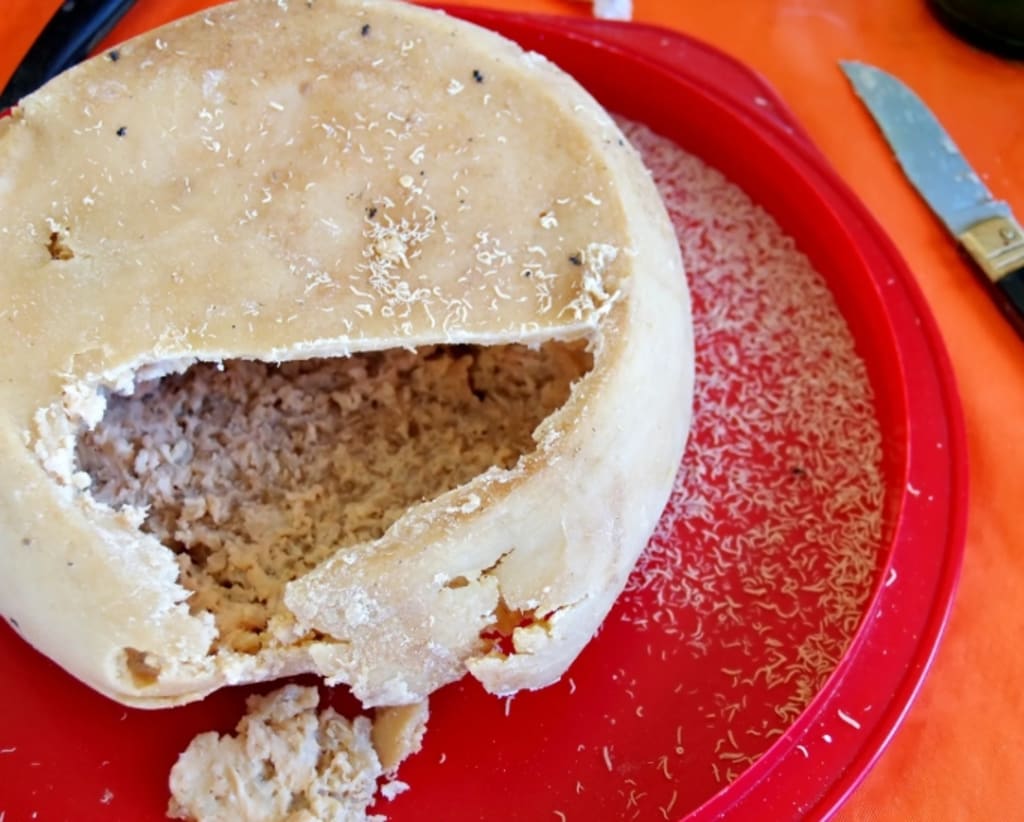
Most cheese lovers know the feeling of opening a package and wondering if it is still good. With casu marzu, the question is the other way around. This cheese is only considered ready when it is full of life.
Yes, I mean maggots. Thousands of them, wriggling through a soft, creamy cheese from the Italian island of Sardinia. It has been called the most dangerous cheese in the world, it is banned from sale, and it is still made in secret by shepherds who say it is the best thing they have ever eaten.
If you liked the story of Iceland's fermented shark, this one is its Mediterranean cousin. Let's get into it.
What is casu marzu?
The name comes from Sardinian and means "rotten cheese." You will also see it spelled casu martzu, and locals use other names too, such as casu modde, which means soft cheese.
At its heart it is a sheep's milk cheese, an offshoot of pecorino sardo, the well-known hard cheese of the island. What makes it different is what happens afterward. The cheese is deliberately left open to a certain kind of fly, and the fly's larvae move in and do the aging. The finished cheese is soft, spreadable and strong, and it is eaten with the larvae still inside.
That last part is what makes people's eyes widen. Most food traditions work hard to keep insects out. This one invites them in.
A cheese born from shepherd life
Sardinia is a rugged island with a long pastoral tradition. For centuries, shepherds have lived with their flocks, milked sheep by hand and made cheese from the milk. In that world, nothing was wasted, and food was a matter of patience and know-how.
Nobody can say exactly when casu marzu began. One local food historian links the eating of insect-aged foods on the island to Roman times, citing ancient writers. What we do know is that it grew out of everyday rural life. It is considered a symbol of Sardinian pastoral culture, something families made and shared at gatherings, weddings and celebrations.
There is even a folk belief that the cheese acts as an aphrodisiac, which tells you how much myth has grown up around it.
How it is made
The process starts the way many Sardinian cheeses do. Sheep's milk, which is raw and unpasteurized, is turned into a wheel of pecorino. The cheese is aged for a few weeks to a few months, until it has a firm rind.
Then comes the unusual step. Part of the rind is cut away, or small cuts are made, and the cheese is left in a place where flies can reach it. In some traditions the cheeses are set out in spring or early summer, and milk from late June is said to be especially prized. Some makers believe a warm wind helps the process along.
The flies lay their eggs in the exposed cheese. The eggs hatch into tiny larvae, and the larvae start to eat. As they feed, their digestive process breaks down the fats and proteins in the cheese. The hard paste becomes soft and creamy, the flavor gets sharper, and a liquid starts to seep out. Sardinians call it làgrima, which means "teardrop."
After a few months, a single cheese can hold thousands of larvae. At that point it is ready.
Meet the fly
The fly behind all this is called Piophila casei, known as the cheese skipper. It is a small, shiny, dark fly, about half the size of a house fly. A single female can lay hundreds of eggs.
It is called a skipper for a reason. The larvae can leap. They hook their mouthparts into the surface, bend their bodies and snap forward, launching themselves several inches through the air. That detail matters a lot when it is time to eat the cheese, as you will see in a moment.
Cheese skippers are not picky eaters in general. They are attracted to aged cheese and also to salted or smoked meats and other things that have been left out for a while. Casu marzu simply takes a natural habit and turns it into a recipe.
How it is eaten
Here is where it gets dramatic.
Traditionally, casu marzu is spread thinly on pane carasau, a crisp, paper-thin Sardinian flatbread that is often dampened a little first. It is served with a strong red wine, usually cannonau, a local favorite.
The larvae are less than a centimeter long, and they are alive. When people disturb the cheese, the larvae jump. So diners often cover the bread with a hand while they eat, to keep the jumpers from escaping. Some people say the whole table gets a little busy.
Here is the part that surprises most people. Many aficionados say the larvae must be alive when you eat the cheese. If the maggots have died, they consider the cheese unsafe, because it has probably spoiled in a way that is not part of the tradition. Others take a different approach and remove the larvae before eating, or seal the cheese in a paper bag so the larvae run out of air and die first. Some simply cool the cheese in a fridge, which also kills them.
So even the lovers of the cheese disagree about the best way to eat it.
What does it taste like?
Descriptions of the flavor are all over the place, which is what you would expect.
Most people agree it is intense. The texture is soft and creamy, often compared to a very ripe blue cheese such as Gorgonzola. Some talk about a peppery, spicy bite and a rich, earthy, almost grassy flavor that reminds them of the countryside. The aftertaste is the thing people mention again and again. One source says it can linger for hours after a single serving.
As for the smell, accounts say it is pungent, as you might guess. Fans do not seem to mind. As with surströmming and hákarl, the people who grew up with the taste often love it fiercely, while visitors are often too busy looking at the bread to notice.
Is it really dangerous?
This is the big question, so let's take it slowly and honestly.
In 2009, Guinness World Records named casu marzu the most dangerous cheese in the world. The main concern is the larvae. If some of them survive being swallowed, they may pass through the stomach and into the intestines. That can cause a condition called intestinal pseudomyiasis, with symptoms such as nausea, vomiting, stomach pain and diarrhea, sometimes with blood.
There are other worries too. The larvae could carry unwanted bacteria. And because the cheese is made from raw milk and deliberately left to decompose, there is no way to be sure how safe an individual cheese is.
To be fair, here is the other side. Cases of the condition linked to the fly are documented in medical literature, but at least one major news report said it found no recorded cases tied directly to this cheese. Locals who eat it say they have done so all their lives without trouble. Still, that is not the same as proof that it is safe. The honest answer is that it carries real risks, and it is a food you should treat with great caution, especially if you are pregnant, elderly, very young or have a weak immune system.
Why is it banned?
Italy has banned the commercial sale of casu marzu in its traditional form. European Union food safety rules say that food on sale must be safe to eat, and cheese full of live insect larvae does not fit. Authorities began challenging the cheese as far back as 1962, under laws against selling infested food. The cheese is also not legal to import into countries such as the United States.
You might expect that to have ended it. It did not.
The black market and the fight to save it
Because the ban is hard to enforce in remote areas, casu marzu is still made, and it is mostly passed along quietly. Shepherds make small amounts for their own families and for friends and customers who ask. Fines exist and can be heavy, but enforcement has often been described as relaxed.
One report estimated that around 100 tonnes of the cheese were being produced illegally each year as of 2019, worth a few million euros. Illicit casu marzu can sell for around double the price of ordinary pecorino. That tells you how much people want it.
Meanwhile, many Sardinians have argued that the cheese is part of their heritage and should be protected, not punished. Researchers at the University of Sassari worked with producers in 2005 on a hygienic production method intended to allow legal sales, and efforts have continued to have the cheese recognized as a traditional food. Some local food experts also hope that growing interest in insects as a source of protein could change the way regulators see it.
So the debate goes on, with food safety on one side and cultural heritage on the other.
Cheese with bugs: not only a Sardinian idea
Here is a fun fact. Sardinia is not alone. Insect-aged cheeses show up in other parts of Italy and Europe, often with local names. Corsica has casgiu merzu. Piedmont has a cheese called Brös(ch)'a marcia. Other regions of Italy have versions too, such as Marcetto in Abruzzo and Salterello in Friuli. Some are even made with goat's milk, aged in white wine with grapes and honey.
Closer to what you might find in a shop, other cheeses are aged with tiny cheese mites. German Milbenkäse and French Mimolette are examples. An English writer in the early 1700s even described Stilton served with mites or maggots.
So casu marzu is an extreme case of an old idea: let tiny creatures do some of the work, and a plain cheese can turn into something remarkable.
A few myths and facts
Myth: The maggots are the whole point. Fact: Not exactly. They are the tool that makes the cheese soft, creamy and strong. Plenty of people try to avoid eating them.
Myth: It is just spoiled cheese. Fact: It starts as a normal pecorino, and the fly is introduced on purpose. Makers see it as a controlled process, not accidental spoilage, even if food safety officials disagree.
Myth: You can order it online. Fact: Be careful. The traditional version is not legally sold, and anything advertised under the name may not be the real thing.
Myth: It is the only banned cheese. Fact: Several raw milk and unusual cheeses face rules in different countries, though casu marzu is probably the most famous case.
Should you try it?
I will be honest with you. If I saw casu marzu on a table in Sardinia, I would be very curious, and I would also be very careful.
The cheese is a real piece of cultural heritage, and there is something moving about shepherds who keep an old craft alive in spite of the rules. But it is also a food with genuine health risks, and it is not legal to buy in most places. My advice is simple. Enjoy the story. If you are ever on the island, ask locals about it, visit a dairy, and try the many excellent legal Sardinian cheeses. Pecorino sardo is wonderful, and you will not need a hand over your bread.
If you do decide to go further, please talk to a doctor first, and never buy from a stranger or from an unclear source.
Why this strange cheese matters
Casu marzu makes people laugh, wince and talk. But underneath, it says something about how people live. In a place where resources were limited, shepherds learned to work with nature instead of against it, and they turned a fly into a flavor.
Whether or not you would ever take a bite, it is a reminder that what looks disgusting to one person can be a treasure to another. Food is memory, identity and pride, sometimes all in one piece of bread.
Your turn
Would you try casu marzu, or does it go too far? And what is the strangest food tradition you have ever heard of? Tell me in the comments. I would love to read your stories.
About the Creator
zenGaze
A person with a new idea is a crank until the idea succe!eds
Enjoyed the story? Support the Creator.
Subscribe for free to receive all their stories in your feed. You could also become a paid subscriber, letting them know you appreciate their work.
Comments
There are no comments for this story
Be the first to respond and start the conversation.