
The Cake That Flips Itself And Carries 500 Years of History With It
A Filipino custard cake is one of the most satisfying things you can pull out of an oven. But the science and the story behind it are even better than the dessert.

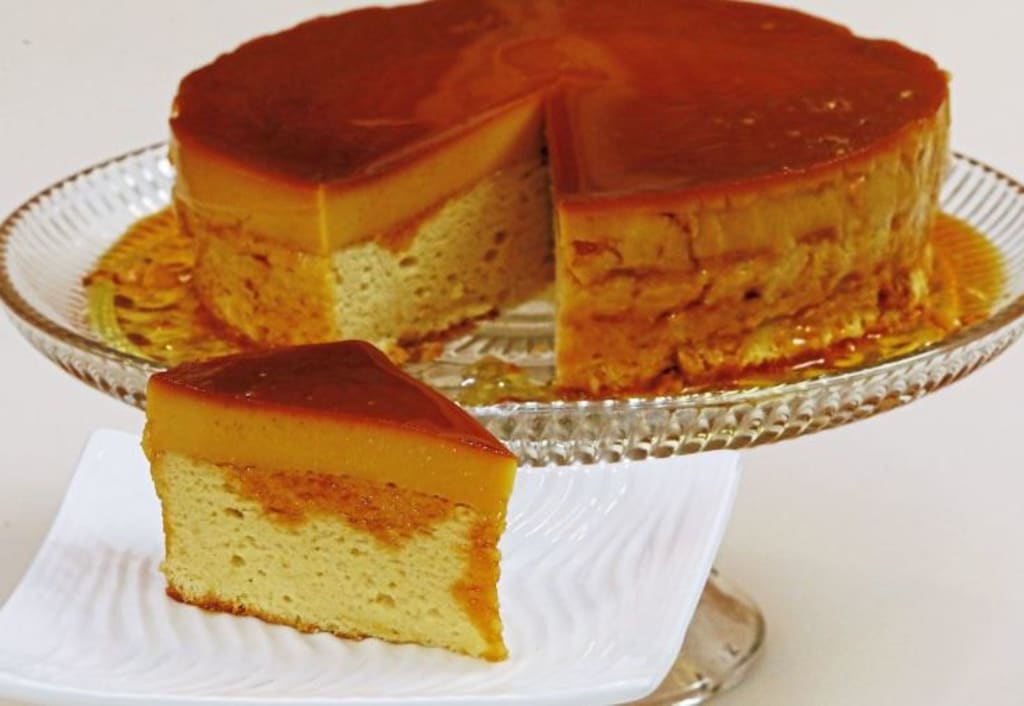
There is a moment, after you have let the cake cool completely and worked up the nerve to flip it, where you hold your breath. You place the serving platter face down over the pan. You invert. You tap. You jiggle. And then if everything has gone right, you lift the pan away to reveal something genuinely beautiful: a glossy, amber caramel crown sitting atop a cloud-soft sponge, with a perfectly set custard layer in between.
It looks like it should not work. The custard and the cake batter go into the pan in the wrong order. They bake together in a water bath. And somewhere in that oven, without any intervention from you, they swap places. The cake rises. The custard sinks. When you invert it, the layers are exactly where you want them.
This is a Filipino custard cake. And it has been delighting people, and quietly baffling them, for generations.
The Science of the Swap
The reason the layers switch during baking comes down to basic food science, and understanding it makes the whole thing feel slightly magical rather than accidentally lucky.
The chiffon sponge batter contains baking powder and egg whites whipped to stiff peaks. As the oven heat builds, the leavening agents produce carbon dioxide, and the egg white foam expands, making the batter progressively lighter and more buoyant. It rises, as cake batter is supposed to do.
The custard, by contrast, is dense. It is made from eggs, condensed milk, and evaporated milk, heavy, liquid, and with no leavening at all. As the cake batter rises around and beneath it, the custard is effectively displaced downward, settling toward the base of the pan where it sets into a smooth, silky layer.
When you invert the finished cake, the custard now at the top is crowned with the caramel you poured in first, which has been gently cooking against the base of the pan the whole time. The result is a glossy, golden surface that you did not have to create. The physics created it for you.
Where This Cake Actually Comes From
Filipino custard cake did not emerge in isolation. Its origins connect it to one of the most significant trade routes in history and to a desert from the other side of the world that most people would never think to link it to.
The Mexican chocoflan, also known as pastel imposible or impossible cake, works on the same principle: a layer of caramel, a layer of custard flan, and a layer of cake batter, assembled in the wrong order and allowed to rearrange themselves during baking. In the Mexican version, the cake layer is rich chocolate. In the Filipino version, it is a lighter chiffon sponge. But the structure caramelised egg custard fused to a soft sponge cake — is essentially identical.
This is not a coincidence. It is a direct consequence of the Manila-Acapulco Galleon Trade, which ran from 1565 to 1815. For 250 years, Spanish ships crossed the Pacific regularly between Acapulco in Mexico and Manila in the Philippines, carrying goods, people, ingredients, and culinary knowledge in both directions. During much of this period, the Philippines was administered not directly from Spain but through the Spanish Viceroyalty of New Spain, which was, in effect, Mexico. The two cuisines developed in parallel, shaped by the same Spanish culinary foundations and adapted to local ingredients and tastes.
The modern versions of both desserts were further shaped by American influence in the 20th century, when canned evaporated milk and sweetened condensed milk became widely available across both regions. Fresh milk gave way to these shelf-stable alternatives, producing the rich, dense, velvety custard texture that both desserts are now known for. Every time you open a can of condensed milk to make this cake, you are participating in a culinary history that spans centuries and oceans.
Why It Is Worth Making
There are simpler desserts. There are faster ones. But there are very few that reward patience and care the way this cake does, and very few where the process itself is as satisfying as the result.
The water bath is not optional. It is what allows the custard to set slowly and evenly, producing that smooth, trembling texture rather than a rubbery or curdled one. The folding of the meringue into the chiffon batter requires a gentle hand; aggressive stirring will deflate the egg whites, and the cake will not rise properly. The cooling time, which feels excessive when you are eager to eat it, is what allows everything to set firmly enough to survive the inversion.
None of these steps is difficult. They just require attention. And the moment you flip the pan and lift it away to reveal the finished cake underneath, all of that attention feels completely justified.
The Recipe
Makes one 22cm cake
Caramel layer
¾ cup granulated sugar
¼ cup water
Custard layer
3 egg yolks
1 whole egg
300ml condensed milk
195ml evaporated milk
1 tsp vanilla extract
Chiffon sponge
3 egg yolks
½ cup melted butter
½ cup granulated sugar
½ cup milk
195ml evaporated milk
1 tsp vanilla extract
1 cup all-purpose flour
1 tsp baking powder
¼ tsp salt
Meringue
6 egg whites
½ cup caster sugar
Start with the caramel. Heat the sugar and water together in a saucepan over medium heat, without stirring, until a deep golden caramel forms. Pour it immediately into a 22cm baking pan and swirl to coat the base evenly. Set it aside to harden while you prepare the rest.
Whisk all the custard ingredients together until smooth and well combined. Pour this mixture gently over the hardened caramel layer and set aside.
For the chiffon batter, whisk together the egg yolks, melted butter, sugar, milk, evaporated milk, and vanilla extract. Sift in the flour, baking powder, and salt, then mix until no streaks remain.
In a separate large bowl, whisk the egg whites with the caster sugar until stiff peaks form. Fold one-third of this meringue into the chiffon batter to loosen it, then pour the batter back into the remaining meringue and fold gently until fully incorporated. You want to keep as much air in the mixture as possible.
Carefully spoon the chiffon batter over the custard layer. It will float on top. Do not stir or combine the layers.
Place the cake pan inside a larger roasting pan and pour boiling water into the outer pan to create a water bath. Bake at 160°C for 50 minutes to one hour, until the cake is set and a skewer inserted into the sponge layer comes out clean.
Remove from the water bath and allow to cool completely at room temperature for about an hour. Then run a knife around the edge of the pan to loosen the sides.
Place a serving platter face down over the pan. Take a breath. Invert. Tap and jiggle gently until the cake releases. Lift the pan away.
Scrape any remaining caramel from the pan and drizzle it over the top of the cake. Slice and serve.
This cake is a small piece of culinary history on a plate, the product of trade routes, colonial exchange, food science, and generations of cooks on opposite sides of the Pacific working with the same basic idea. It is also just genuinely delicious.
Make it for the Philippines Independence Day on June 12, or any other day that calls for something worth the effort.
About the Creator
Mark Lim
Hi I am mark an automotive student and a car, tech and food enthusiast ! Im gonna try and post daily & hope you enjoy what I write and do share my page with people you know. I would gladly appreciate it! Cheers
Enjoyed the story? Support the Creator.
Subscribe for free to receive all their stories in your feed.
Comments
There are no comments for this story
Be the first to respond and start the conversation.