
Pork Butt and the Christmas Tea Incident
A true story about ambition, romance, and the importance of reading the whole recipe.


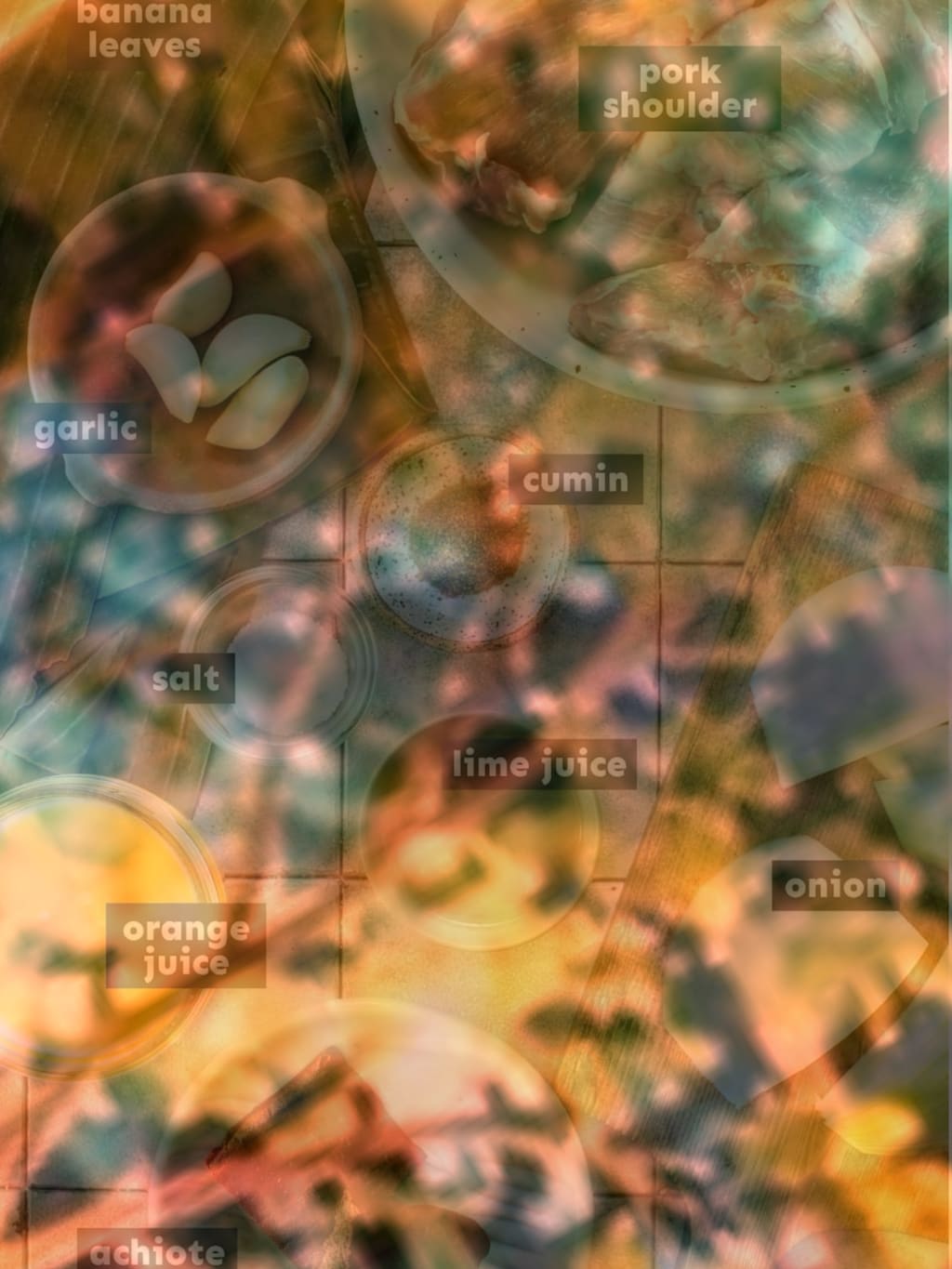
I arrive in Montana with a movie fresh in my mind and a plan that involves five pounds of pork.
The movie: Once Upon a Time in Mexico, Robert Rodriguez's gloriously over-the-top 2003 action film starring Antonio Banderas and Johnny Depp. I love it. Guns, guitars, revenge, beautiful people, and enough cinematic mayhem to make an ordinary afternoon feel underdressed.
One detail I don't entirely understand: Johnny Depp plays a corrupt, eccentric CIA operative who orders puerco pibil at a local cantina, tastes it, and declares it so good that it "ruins the balance" and must therefore “restore the balance to this country.” Then, after finishing the dish, he pays his bill, and shoots the cook on his way out.
I mean, I understand that it's a movie. I understand that the character is dangerous, unpredictable, and probably not someone you'd invite to a neighborhood potluck. Still, killing the chef seems like an extreme response to an excellent meal, especially, say, if he wanted to eat it again from the same place. Surely a generous tip would suffice.
But the dish stays with me.
At the end of the DVD, Rodriguez appears in a cooking segment and demonstrates how to make puerco pibil. He explains that he keeps the ingredients for a handful of dishes (with a short menu) on hand so he can feed unexpected visitors a dish of their choice without breaking a sweat. He's a filmmaker, a musician, and apparently the sort of person who can turn a casual dinner into a culinary event.
Fun fact: Rodriguez also directed the Spy Kids movies, which help finance his more personal filmmaking projects. I find this delightful. The man makes movies about children saving the world so he can make movies about grown men shooting chefs.
And now he's teaching me how to cook pork.
I watch the segment carefully. The dish is Yucatán-inspired, rich with citrus, garlic, warm spices, and a vivid red-orange marinade. The meat cooks slowly, wrapped in banana leaves, until it becomes tender and fragrant.
I decide I must make it. Not eventually. Not someday when I have more experience. Now. Because I'm visiting my family in Montana, and there is a girl I want to impress.
This is how the evening begins: With romance. With ambition. With a five-pound pork butt.
And with absolutely no understanding of what I'm about to do.
The first challenge is finding the ingredients.
Montana is beautiful. The mountains are spectacular, the air is crisp, and the landscape makes you feel as though the natural world has personally invited you to reconsider your priorities.
Banana leaves, however, are not a local priority.
I head to the food co-op, determined to gather everything fresh. I need annatto seeds, cumin seeds, black peppercorns, allspice, whole cloves, habanero peppers, oranges, lemons, garlic, vinegar, salt, tequila, and banana leaves.
The pork, spices, citrus, and tequila are the easy part.
The banana leaves are another matter. I search, ask questions, and eventually locate them at a nearby international store. I feel a small surge of triumph. I have overcome the first obstacle in my quest to recreate a dish demonstrated by a Hollywood director. I am basically a culinary adventurer now.
At home, I lay everything out on the counter: five pounds of pork, cut into two-inch cubes. The meat is generous, substantial, and forgiving-looking.
It has no idea what's coming.
The annatto seeds are tiny, hard, brick-red things. They give the dish its characteristic color and a subtle, earthy flavor. They look like something a botanist might collect during an expedition into an unexplored cloud forest.
The cumin seeds are familiar, warm, and slightly smoky; black peppercorns promise a clean, sharp bite; allspice brings layered notes of cinnamon and nutmeg; garlic stands ready to do what garlic does best: make everything smell like something wonderful.
The citrus is bright and fresh: orange juice adds sweetness, while lemon juice adds acidity to cut through the pork's richness. White vinegar adds another sharp edge, helping to balance the fat and spices.
The habaneros provide heat. Yum. I remove their seeds and membranes as directed, because I am following a recipe, not attempting to establish a new branch of military research.
Then there's the tequila. One tablespoon. A modest contribution from the spirits department, but a welcome one.
And finally, the cloves.
They sit in their little jar, dark brown and vaguely nail-shaped, looking innocent enough. Cloves are extraordinary. Used in small amounts, they lend food a deep, warming fragrance, a sweetness that isn't really sweet, and a complexity that makes you wonder what else might be happening in a dish. I love the smell. I love the promise.
I am about to love it considerably less, but I don't know that yet.
The preparation is straightforward: I place the annatto seeds, cumin seeds, peppercorns, allspice, and cloves into a clean coffee grinder. The recipe specifies grinding them very fine, so I hold the button until the mixture becomes a fragrant, dusty powder.
The aroma: earthy, peppery, and wonderfully warm. The spices seem to belong together, each contributing something distinct to the whole. I transfer the powder with the orange juice, vinegar, diced habaneros, salt, garlic, lemon juice, and tequila to the blender, and whir everything to life.
Inside, the ingredients tumble together, transforming into a thick, brilliantly colored marinade. The citrus sharpens the fragrance. The garlic rises above it. The spices weave through everything, and the habaneros add a faint warning that I interpret as sophistication.
I pour the marinade over the pork in a large zip-top bag, submerging it beneath the red-orange liquid. I turn the bag over, making sure every cube is coated. The instructions call for an hour of marinating, so I give it an hour.
I am methodical. I am attentive. I am someone who takes his responsibilities seriously. I have a girl coming over.
My mother and stepdad, Larry, are there. My brother, Jeremy, wants to join us, too, which I consider a good sign. A family dinner with a special guest! A chance to demonstrate that I can do more than heat leftovers and confidently mispronounce the names of foreign dishes.
I line a nine-by-thirteen-inch baking pan with banana leaves. The leaves are broad, glossy, and dramatic. They transform any ordinary dish into something that looks as though it belongs in a jungle kitchen presided over by a high priest of an epicurean order.
I pour the meat and marinade onto the leaves, then cover everything with more banana leaves.
Foil goes over the top, edges crimped tight. There--sealed. I slide the pan inside a preheated oven, set to 325 degrees. The recipe calls for four hours. I have a timer. I have a plan. I have the confidence of a man who has watched someone cook something successfully and mistaken that experience for a transferable skill.
For the next four hours, I go about preparing the side dishes: corn tortillas, black beans in sauce, and a bright green cabbage slaw with apple cider vinegar and lemon oil—strong supporting characters to the main attraction.
The pork cooks slowly in its fragrant little sauna. The banana leaves hold in moisture, softening the meat. The spices mingle. Citrus and vinegar work their way in, while garlic sends its aroma into the kitchen. At first, I don't think much about it.
Then I begin to smell the cloves. The scent is remarkable.
Warm, sweet, rich, almost festive. It drifts through the house and settles into the outer rooms. Every so often, I catch another wave of it and think, my goodness, this is going to be good.
Cloves often come to mind with holiday cooking, and the fragrance reminds me of winter evenings, steaming mugs, and spice cabinets opened in December.
But this isn't December. This is Montana in July, and I'm preparing an elaborate Mexican-inspired pork dish for someone I'd like to impress.
The fragrance seems to announce that something extraordinary is happening in the oven. My mother notices it. Larry notices it. Jeremy notices it. Nobody objects. Why would they? The smell is deliciously inviting—the kind that makes people wander into the kitchen, asking when dinner will be ready.
I feel my confidence growing. The banana leaves are doing their job. The oven is doing its job. The spices are doing their job. And I am doing my job.
The evening is proceeding beautifully.
I imagine the moment the pan emerges from the oven, the leaves peel back, and the steam rises in a cloud of fragrant glory. I imagine tender pork falling apart under a fork. I imagine the girl taking her first bite and looking at me with the expression people reserve for men who know their way around a kitchen. Perhaps she'll ask me how I learned to make it.
I'll explain that I watched Robert Rodriguez's DVD… and try to make that sound sophisticated. I'll probably leave out the part where Depp shoots the chef.
Soon, the girl--Tristin--arrives. We set the table. Drinks are poured. Conversation begins. Everyone is in good spirits, and the kitchen smells as though a holiday feast took a sharp turn somewhere on the way to the ancient lands of the Maya.
The cloves are not unpleasant, I tell myself. Just prominent. This must be what Rodriguez intended.
Anticipation builds. Someone comments on the aroma. Someone else remarks that it must be nearly ready. I smile, pretending this is exactly what I intended (inside, I am conducting a private celebration of my own competence).
The timer rings. We gather in the kitchen.
I remove the pan from the oven and set it on the counter. The foil comes away with a satisfying crinkle. Steam escapes from beneath the banana leaves, carrying the full force of the fragrance into the room.
It's magnificent.
I peel back the leaves. The pork is tender, marinade-darkened, and surrounded by rich cooking juices. The meat looks succulent and inviting, deepened by the red-orange color.
I let it rest, then plate it. I am careful with the portions. I want everyone to get a good piece--a proper representation. I arrange the pork with black beans, warm corn tortillas, and the slaw, then deliver everything to the table.
We sit. Forks rise. And we take the first bite. Then,
Silence. Not the good kind of people so overwhelmed by a delicious meal that speech temporarily becomes impossible. This is a different silence. A silence with paperwork. A silence that usually convenes an emergency committee.
My mother chews. Larry chews. Jeremy chews. Tristin and I chew.
Something is wrong.
The pork is tender. The texture is good. The citrus is... present… somewhere in the background. The garlic has… made an appearance--more like a wisp than a cameo.
But the cloves. They are not in the background.
They have taken over the building--they have seized the controls, locked the doors, and issued a statement on behalf of the entire spice cabinet.
Every bite tastes like a holiday potpourri steeped in a mug and poured over a roast.
I look around the table. Nobody says anything. The expressions are polite-- much worse than honest criticism. Honest criticism would give me something to work with. Politeness leaves everyone alone with their own tongue.
Jeremy takes another bite, chewing with growing impatience. He looks at his plate, then at me.
"This f***ing tastes like Christmas tea!"
There it is. The first honest assessment of the evening. He has said what everyone is thinking, and the table relaxes slightly. My mother laughs. Larry nods. Tristin looks at me in bewildered sympathy, a smile creeping at the corner of her mouth.
I want to explain that this is not how the dish is supposed to taste, that the recipe comes from Robert Rodriguez’s cooking segment on a DVD, and that I followed his instructions with the precision of a scientist launching a spacecraft. I want to explain that the cloves are supposed to add warmth, depth, and complexity.
Instead, I say, “Impossible." It's not my strongest argument.
"I followed the recipe exactly," I continue. "Every spice and measurement. Just like Rodriguez did. Annatto seeds, cumin, cloves, garlic, tequila. Everything in order."
My mother gives me a look. "Are you sure?"
A son can answer many questions confidently in front of his mother. This is not one of them.
"I'll just check the recipe.” I rise from the table and return to the kitchen. The others follow because there is no way they will let me investigate this disaster alone.
I retrieve the recipe and read the ingredients:
Pork butt. Five pounds. Correct.
Annatto seeds. Five tablespoons. Correct.
Cumin. Two teaspoons. Correct.
Black peppercorns. One tablespoon. Correct.
Allspice. Eight whole pieces. Correct.
Garlic. Eight cloves. Correct.
Lemon juice. Five lemons. Correct.
Orange juice. Vinegar. Salt. Habaneros. Tequila--everything accounted for.
I recheck the directions: grind spices, blend marinade, marinate pork, wrap in banana leaves, bake at three-hundred-twenty-five for four hours.
I have done all of this.
I am beginning to feel vindicated. Perhaps the dish is simply an acquired taste? Perhaps the clove flavor is designed to be more pronounced? Perhaps the recipe has been adapted from the movie in a way that makes the spices unusually assertive!
Then I reach the cloves.
1⁄2 a teaspoon.
I stare at the words.
1⁄2 a teaspoon.
I read them again.
Half.
A.
Teaspoon.
I feel the room shift around me. My mother leans over my shoulder. Larry takes the recipe and reads it. Jeremy looks from the page to the counter. He smirks at me. Tristin’s face is a cross between stunned and a smoldering laugh. Nobody speaks.
The kitchen's true story is revealing itself without a single word: the measuring cups are where I left them; the coffee grinder sits beside the spice jars; the blender sits in the sink. The banana leaves are stacked near the baking pan. Everything is exactly where it last landed.
And next to the grinder, closest to the jar of cloves, sits a tablespoon.
A tablespoon.
I look at the jar of cloves, then at the spoon. I look at the recipe again.
Half (1/2) a teaspoon.
The arithmetic is not complicated. Except I remember using two spoonfuls, because my memory simply remembers "2."
Forgivably, I realize that I have read past the “1" and the "/“, seeing only the “2"; unforgivably, I completely missed the spoon proportion.
Proportions are important. Especially with cloves.
The smoking gun points at an incriminating fact that I used two tablespoons full of cloves.
Not twice as much. Not a generous pinch. Not a little extra because I happen to enjoy the flavor. Nada.
Twelve times. Twelve. Times. The. Specified. Quantity.
Of cloves.
My face goes through several stages of emotional evolution in rapid succession--confusion, denial, recognition, horror, mortification--my mother and Larry watch this transformation with the quiet fascination of someone witnessing a rare wildlife event. Jeremy laughs. Tristin joins him.
I would like to disappear into the banana leaves.
I would like to return to the beginning of the evening, before the oven, before the table, before the cloves. Before I decided to cook international cuisine for romantic purposes.
I would like to find the version of myself who knows the hard difference between a teaspoon and a tablespoon and ask him to take over. But that man is nowhere to be found. A bloke (me) has replaced him, and he just made five pounds of pork taste like an entire high-holiday season. I turn to the others.
"I must have missed the 'one-slash.'"
"And the 'teaspoon,'" Larry chortles.
Nobody disagrees. I examine the spoon again, as though it might offer an appeal. It does not.
We return to the table, but the meal isn't over. We have five pounds of pork. We have a family. We have the girl I want to impress. And we have no intention of letting a major measurement discrepancy defeat us entirely.
So we improvise: we rinse the meat, removing some of the intense holiday flavor. We shred it, add vegetables, onion, and peppers, working to quickly build a new dish from the remains of the old one.
The result: no longer puerco pibil. The clove flavor is suppressed, tempered now. The meat is still tender. The vegetables help.
It's approximately delicious. Not enough for eager seconds, but enough to finish dinner enjoyably without calling an ambulance for our taste buds.
The evening recovers. The side dishes still do their work, and we create something not on any menu. Conversation resumes. Tristin survives the meal. My family survives the meal.
And the story survives everything.
In the years that follow, the incident becomes part of family history. The details are occasionally embellished, as family stories do. In every new version, the pork becomes more fragrant; cloves become more numerous. The Christmas tea, so potent you can pour it into a diffuser.
I am reminded of it whenever 'warm' spices come out of the cupboard, or whenever someone asks me to cook, and especially whenever I reach for a measuring spoon.
For a long time, I am not allowed near the cloves without supervision. And I don't blame anyone. After all, I've demonstrated that there is a fine line between seasoning a dish and turning it into a seasonal pomander.
I still want to redeem myself and make pibil again—to return to that recipe, ingredients, spices... wrapping it all in banana leaves, and do it properly. I want to taste it as Robert Rodriguez made it, with the citrus, garlic, annatto, cumin, and cloves, working together in an ensemble cast that really delivers.
And next time, I will check every ingredient and verify every measurement.
I will also use the correct spoon.
My important lesson about cooking: a little clove can make a dish extraordinary, but too much can make a family legend.
And twelve times too much?
That's how you turn a pork butt into Christmas Tea.
🍖 🌰 🌶️
About the Creator
E. Brooksie
Puppeteer, musician, story creator. I try to tell stories that connect us and help us believe that anything is possible.
Story Dreamer • Motion Photos
Character Creator • Songwriter
Enjoyed the story? Support the Creator.
Subscribe for free to receive all their stories in your feed. You could also become a paid subscriber, letting them know you appreciate their work.
Comments
There are no comments for this story
Be the first to respond and start the conversation.