Latest Stories
Most recently published stories in Feast.
Fire and Ice
Table’s set. Sterling cutlery – Spanish Provincial. Delicately ornate dessert fork, horizontal over Wedgewood bone China plates, adorned in baby blue flowers. Baccarat claret glasses placed two inches behind Waterford water goblets. Egg-shell hued Damask linens dress the lustrous Chippendale table, revealing curved legs of rich Mahogany as Acanthus leaves swirl seductively upwards, begging for a peek.
By Cathy Schieffelin3 years ago in Feast
What would happen if you stop eating sugar for a month?
Meet Amy, an adept graphic designer with a penchant for sweetness that could rival the confectionary wonders of Willy Wonka’s chocolate factory. She possesses an insatiable craving for sugar, which manifests itself in her daily rituals, be it adding saccharine delights to her morning coffee, indulging in decadent desserts, or satisfying her snack cravings with sugary treats. Emily’s lifestyle and culinary preferences epitomize the quintessential modern-day diet, heavily influenced by convenience and an unabashed love for all things sweet.
By Lucas Fazzini3 years ago in Feast
Split Pea Soup. Top Story - March 2024.
It is winter and I require all things cozy around my house. One of my favorite cozy comfort food is homemade soup. Split Pea soup is one of my favorites and definitely meats the comfy, cozy benchmark. Here is my simple recipe for this delightful homemade soup.
By Dawn Beauchamp3 years ago in Feast
A Trifling We Go...
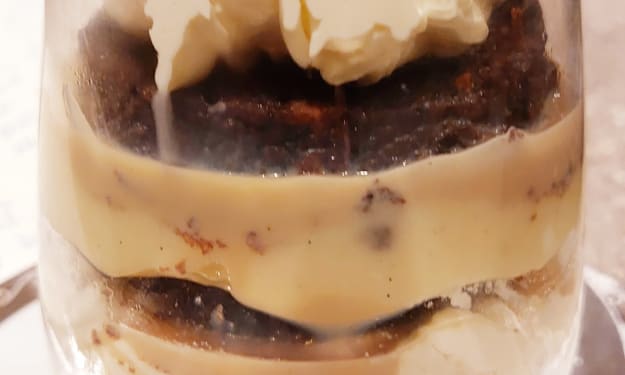
Cards on the table, I am a BIG trifle fan. It seems to me to be the dessert that has everything. Cream, cake, custard, alcohol, fruit, jelly... whatever you have in, bang it in a bowl in layers and celebrate something! It especially appeals because it is traditionally made to make use of stale cake. No leftovers in the bin will always be a win in my book. Team trifle all the way, and I stand by that even as I discovered today that the recipe for "trifle" was first published in a 1585 British Recipe book by Thomas Dawson called The Good Huswifes Jewell. Sounds a class read. Not. Still, times move, and trifle has with it...
By Caroline Jane3 years ago in Feast
DR MAX: This is why ultra-processed foods are addictive in the same way as cocaine
Pull back from the Coco Pops! Put down that spoon! Set aside that bowl! Last week creator and academic administrator Dr Chris van Tulleken held up a bundle of the previously mentioned oat to the Place of Masters select panel on food, diet and heftiness, and contended that it, and other 'hurtful' low quality food, ought to be deprived of wellbeing claims and prohibited from publicizing.
By prashant soni3 years ago in Feast
"The Art of Crafting Iruttu Kadai Halwa: A Culinary Tradition from Tamil Nadu
Iruttu Kadai Halwa is a popular sweet delicacy in Tamil Nadu, India. It is a traditional treat made with wheat, sugar, and ghee (clarified butter), which is often flavored with saffron or cardamom. It is well-known for its distinct flavor and texture, and is frequently sold in landmark stores such as Iruttu Kadai Halwa in Tirunelveli. Iruttu Kadai Halwa is well known for its luscious, melt-in-your-mouth texture and distinct flavor profile. Slow-cooking wheat, ghee, and sugar yields a rich, caramelized consistency. This slow-cooking procedure is thought to be the secret of its particular flavor. Halwa is typically served warm and eaten as a dessert or snack, particularly at festivals and special events in Tamil Nadu. The traditional method of preparing Iruttu Kadai Halwa consists of numerous phases. Here's a simplified version of the procedure: Preparation of wheat flour : Whole wheat grains are steeped in water for many hours or even overnight. Then they are mashed into a fine paste to produce wheat flour. Cooking Wheat Paste: The wheat flour paste is carefully cooked over a low heat in a big vessel, usually a heavy-bottomed pan or kadai. Ghee (clarified butter) is gradually added and well combined. Adding Sugar and Flavorings: To add sugar and flavorings, add little amounts as the wheat paste thickens and changes color. The mixture is constantly stirred to promote even cooking and avoid scorching. Flavorings like as saffron or cardamom powder can also be used at this point to enhance the aroma and taste. Continuous cooking: It involves stirring the liquid for several hours until it thickens to a sticky consistency. This slow-cooking method is essential for producing the desired texture and flavor in the halwa. Finishing touches: To improve the richness of the halwa, add additional ghee near the end of cooking. When the mixture reaches the correct consistency and color, it is taken off the heat. Serving: Iruttu Kadai Halwa is normally served warm and decorated with nuts like almonds or cashews. It can also be drizzled with ghee for extra enjoyment. This procedure involves patience and skill because the halwa must be cooked gently over a lengthy period of time to acquire its distinct flavor and texture. Traditional establishments, such as Iruttu Kadai Halwa in Tirunelveli, are well-known for their expertise in creating this delectable sweet dessert.
By Mahalakshmi R3 years ago in Feast
Around the world in 50 states
Dalle Generated As you’ve probably come to realize us at ViM are over sharers! Community is in our collective hearts and what better way to connect and learn more about the world we inhabit that through food. Sharing cuisine is at the heart of family occasions, traditional celebrations feature in our memories as we grow into our lives and create new ones. A fondness for a grandmother’s dish. A moment of realisation. Love. Food represents us. Across cultures, the power of chicken soup to soothe the soul sums up the concept of togetherness for us. A metaphorical ladle of hope in a world that can be both confusing and chaotic.
By River and Celia in Underland3 years ago in Feast