
I Thought This Was a Knockoff Burger Shop. Then I Learned It Has 3,000 Locations.
In small-town China, a 9.9-yuan burger is not a cheaper KFC. It’s an entirely different business model, run by two people, a freezer, and a school gate.
In Small Towns, the 9.9-Yuan Burger Has Its Own Way of Surviving
Last month, I went to a small town on business. It was hot. A friend said, “Come on, I’ll take you somewhere cool to eat something.”
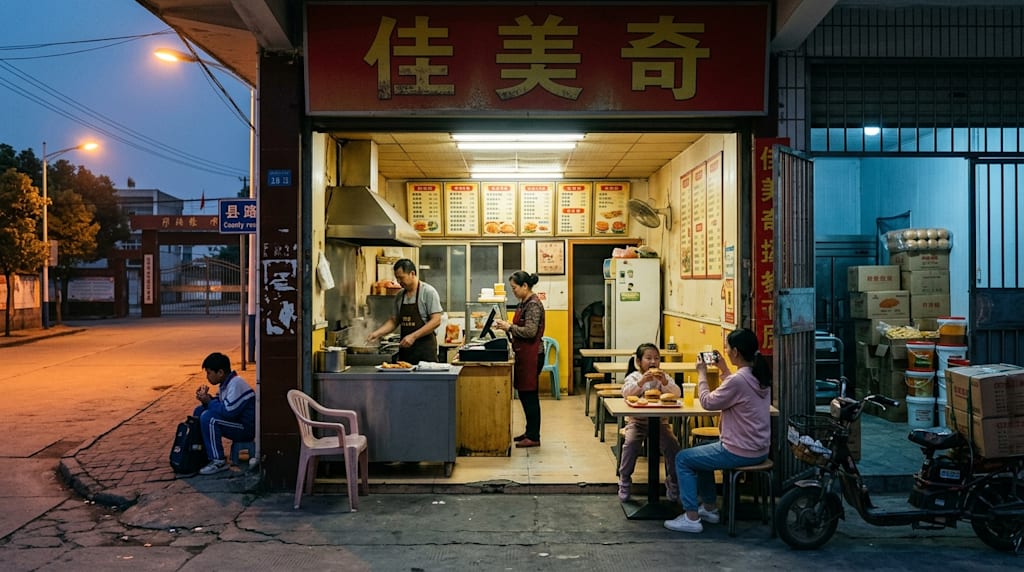
He took me to a shop called Jiameiqi. Red background, yellow letters. It sold burgers, fried chicken, pizza, drinks, and also potato noodles and rice bowls. There were six tables; half were occupied. At the next table, a young mother was holding her phone, taking pictures of her daughter. Burger, egg tart, lemonade spread across the table. The little girl was a bit shy and covered her face with her hand. The mother said, “Don’t cover your face. Smile.”
At first I thought it was an off-brand burger shop. My friend said, “Don’t underestimate it. It’s a national chain, more than three thousand stores, mostly in small towns.”
I was a little shocked.
Everyone says the restaurant business is saturated, cutthroat, the boom is gone. Yet in this inconspicuous small town, a burger shop that looks off-brand has opened thousands of stores.
Later I slowly understood: there is room left in the restaurant business. The problem is that the eyes we use to look at the market are fixed only on places we know.
One
The town has no KFC, no McDonald’s, not even a Wallace. The nearest KFC is in the county seat, a forty-minute drive.
Big brands don’t come because they can’t. A town only has so many people, and spending power is limited. For KFC to open a store, it has to evaluate foot traffic, purchase frequency, average ticket, payback period. The math doesn’t work. But a mom-and-pop shop has a small investment, no wages to pay, cheap rent. It can survive on two or three hundred yuan in sales a day.
Chen Li is the owner of Jiameiqi, in his thirties. He used to deliver food in the city. Three years ago he came back to town and opened this shop. He said, “KFC sells a burger for over twenty. I sell for 9.9. The people who go to KFC and the people who come to me are not the same group.”
He had done the math: the town’s per capita spending is only so much. If a burger sells for 9.9 and uses a pure beef patty, the patty alone costs more than four yuan. Add the bun, sauce, lettuce, packaging, then rent, water, electricity. There’s no profit at all. But with a reconstituted meat patty, beef mixed with chicken and soy protein, the cost can be pressed down to one and a half yuan. A burger still has more than six yuan of gross margin.
“What people in town want is the word ‘burger,’ not beef,” he said.
Two
The first time Chen Li went to the frozen food market in the city, he went with a fellow townsman who ran a fried chicken shop. The frozen food market was on the outskirts, a stretch of tin-roofed sheds full of cold storage. Push open the door, and cold air hits your face. Shelves were piled with boxes of burger buns, frozen chicken cutlets, beef patties, fries, egg tart shells. On the floor were large buckets of salad dressing, ketchup, cola syrup.
The boss showed him around: “You want to open a burger shop? Simple. Burger buns, how many per box; chicken cutlets, how many slices per box; fries, how many pounds per bag; sauce, how many grams per bucket. Add it up, a burger costs less than three yuan.”
Chen Li asked, “What about the beef patty?”
The boss smiled and took two packages from the freezer: “This one is pure beef. Expensive. This one is a reconstituted meat patty, beef, chicken, soy protein. Half the price. You’re opening in a small town. Use this one.”
Chen Li didn’t say anything. Later, he used the reconstituted meat patty.
Big brands deliver by the truckload. Their warehouses are bigger than a small shop’s storefront. A small shop? Today it’s short on burger buns, so it rides an electric bike to the frozen food market and picks up a box. Tomorrow the chicken cutlets aren’t enough, so it restocks another box. Buy as much as you use, restock whenever you need. No need to pile up inventory in bulk. If something doesn’t sell, you don’t have to grit your teeth and hoard it.
A chain like Jiameiqi, with more than three thousand stores, most likely gets supplied by headquarters. Headquarters makes money on franchise fees, equipment, seasoning packets, frozen food distribution. Whether an individual store makes money may not be headquarters’ biggest concern. As long as the store stays open, the supply chain keeps shipping.
This is the classic “selling shovels” business. The people panning for gold don’t necessarily get rich. The people selling shovels get rich first.
Three
When I passed the kitchen door of Jiameiqi, I saw them cooking potato noodles in a small pot and pouring in a seasoning packet. The packet was like an instant noodle seasoning packet. One packet for one serving of potato noodles.
From that I guessed the rice bowls were probably also premade packets. The shop had only two people. More than a dozen kinds of rice bowls. There was no way to stir-fry them to order. With premade meal packs, you heat it up, pour it over rice, and it’s out in a few minutes. The taste may not be amazing, but it’s stable, fast, and cheap.
Burgers are the same. Big brands use pure beef patties; small shops use composite reconstituted meat patties. Chicken cutlets are frozen semi-finished products. Fries are frozen fries. Egg tart shells are ready-made. Egg tart liquid is pre-mixed. Cola is syrup plus sparkling water. Lemonade is concentrated juice plus ice.
This is no secret. It is the product of China’s mature restaurant supply chain.
KFC’s beef burger is delicious. If you make it at home, not only is it not as good, but the cost might be higher than KFC’s selling price. Big brands have scale, craft, equipment, and standards. Small shops don’t compete with them on that. What small shops compete on is: in a small town, for around ten yuan, can you let a child eat a burger, let a student eat their fill, let a young mother take a photo?
It doesn’t need to taste better than KFC. It only needs to be more attractive than the other things you can eat in town for ten yuan.
Four
Jiameiqi is run by Chen Li and Zhou Min. The husband fries chicken, the wife works the register. In the morning they sell hand-grab pancakes; at noon, rice bowls; in the afternoon, burgers and fried chicken; at night, grilled sausages. No employee wages, no social insurance, no shift scheduling, no management costs.
The storefront is not large, the location is not as good as a big brand’s, so the rent is naturally cheaper. Even though the per-item gross margin is low, the actual net profit may be higher than a brand store’s.
A big-brand store manager has to consider: how much revenue this month, whether labor went over budget, whether waste is high, whether headquarters tasks are done, whether the delivery rating dropped. A mom-and-pop shop doesn’t have to think about so much. Sell an extra hundred yuan today, that’s an extra hundred yuan earned.
They take root in small towns, at middle school gates, in old communities, targeting students, low-income people, and parents with children. Set meals are 9.9, 12.9 yuan, pursuing extreme low prices. These customers were never going to spend at KFC anyway.
KFC cannot run this business. That is why it survives.
Five
On Jiameiqi’s menu, besides burgers and fried chicken, there are potato noodles, rice bowls, and hand-grab pancakes. At noon, students come and can eat a rice bowl; after school in the afternoon, they can eat a hand-grab pancake; at night, they can eat a burger.
Later, two more burger shops opened in town: one called Lebao, one called Paile Burger. Lebao only sold burgers and fried chicken. Paile only sold burgers and fries. Fewer categories, narrower customer base.
Chen Li later added grilled sausages and oden. In winter, students come in the morning and buy a grilled sausage for five yuan to warm their hands. After school at night, they buy two skewers of oden for three yuan to fill their stomachs. These things don’t make money, but they keep people coming. Once people come, they’ll buy a burger along the way.
Try letting KFC change its menu however it wants. Impossible. Big brands need standardization, supply chain matching, national uniformity, layer after layer of testing. Behind a new product is a whole system: R&D, procurement, production, logistics, training, marketing. Small boats turn easily; big ships turn slowly.
Six
Of course, we can’t only talk about the good side.
These small shops have unstable ingredient quality, fluctuating taste, and a high closure rate. They have no brand premium, so they can only compete on low prices. Once another new shop opens nearby, it’s easy to fall into cutthroat competition. You sell 9.9, he sells 8.8; you give away cola, he gives away egg tarts. In the end, nobody makes a profit.
Food safety risk is also high. Frozen food sources, storage conditions, oil changes, operation hygiene: all depend on the owner’s self-discipline. If a big brand has a problem, the whole country pays attention; if a small shop has a problem, maybe it’s just a “for transfer” sign on the door.
Franchisees are also easily fleeced by headquarters. They pay the franchise fee, buy the equipment, stock the ingredients, then find that headquarters’ follow-up support is limited, and they can only tough it out alone. If they can hold on, they keep going. If they can’t, they close.
The restaurant business is just opening and closing. But as long as there are low-income consumer groups, as long as there are small towns, communities, and school gates, as long as there are people who want to eat a “Western fast food” meal for ten yuan, small independent shops will keep emerging.
Seven
We often look at China through the eyes of a first-tier city. We look at shopping malls, office buildings, delivery platforms, internet-famous shops queuing up. So we think the restaurant business is saturated, there’s no way to do business, ordinary people have no chance.
But if you walk around a small town, stand at a middle school gate, wander through a frozen food market, eat a 9.9-yuan burger set in an old community, you’ll find another logic.
Big brands win on scale. Small independent shops win by not needing scale.
Big brands sell standards, trust, brand, stability. Small independent shops sell convenience, low prices, substitutes, flexibility.
Big brands provide certainty. Small shops provide a small treat within reach.
That day at Jiameiqi, the young mother at the next table took seven or eight photos of her daughter, picked one, and posted it on WeChat Moments. The little girl took a bite of the burger and smiled.
Chen Li stood behind the register, watching them, and said nothing.
He remembered when he was a child, there was no burger shop in town. The first time he ate a burger was at his aunt’s house in the county seat. His aunt took him to KFC. He held the burger and didn’t know where to start. His aunt taught him. He took a bite and thought it didn’t taste good, but he didn’t dare say so.
Now, the town had one.
His daughter is five this year, in the town kindergarten. One day after school, his daughter told him, “Dad, a classmate said you sell fake burgers.”
Chen Li asked, “What fake burger?”
“She said her mom said Jiameiqi isn’t KFC, so it’s fake.”
Chen Li was stunned for a moment, then laughed. He squatted down and looked at his daughter: “What do you think?”
The daughter thought for a moment: “I think it’s delicious.”
Chen Li didn’t say anything more. He stood up, put the calculator in the drawer, turned off the light. Walked out, pulled down the rolling shutter, locked it. There was almost no one on the street. The streetlights stretched his shadow long. He looked up at the sign, red background, yellow letters, a little dim in the night.
He got on his electric bike and headed home. Passing the middle school gate, he saw a boy under the streetlight eating a burger, schoolbag at his feet, eating fast, as if he had been hungry for a long time.
Chen Li slowed down, glanced, then sped up and rode away.
He said nothing.
He didn’t know what to say.
He just felt that this town needed a burger shop.
About the Creator
Jin
Writer of reamstories
https://reamstories.com/jin
Enjoyed the story? Support the Creator.
Subscribe for free to receive all their stories in your feed. You could also become a paid subscriber, letting them know you appreciate their work.
Comments
There are no comments for this story
Be the first to respond and start the conversation.