
I Broke Every Fish I Pan-Fried Until I Fixed Four Things
The skin tears because of pan temperature, moisture, oil film, and your hand. Here is the method that finally worked.
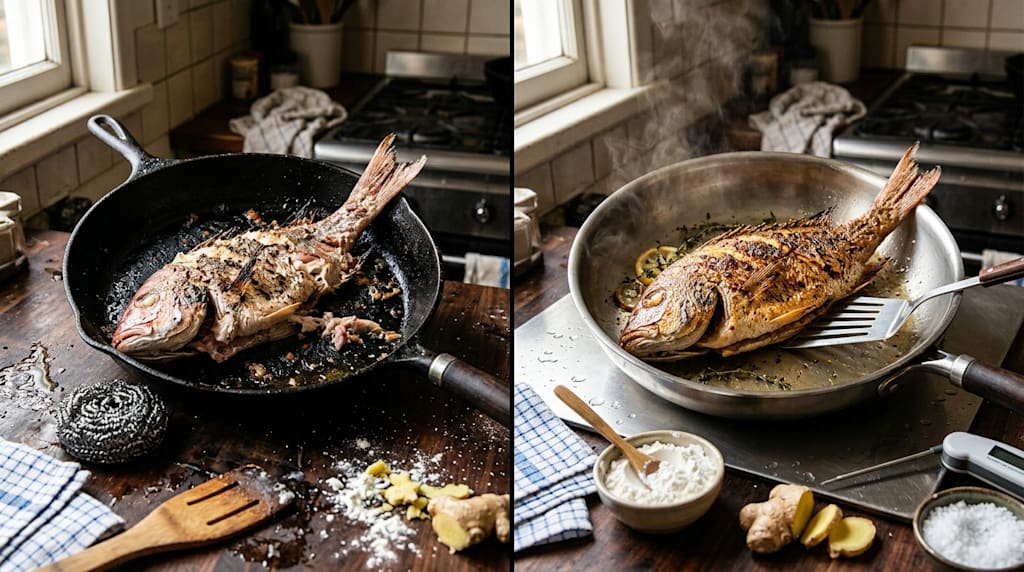
The fish hits the pan. It sizzles. You touch it with a spatula. The skin stays stuck. The flesh breaks. The pan gets a black layer. You scrub for ten minutes. Next time you dry the fish, rub ginger on the pan, and salt the oil. The skin still tears.
Seasoning does not cause this. Four variables do: pan temperature, moisture, oil film, and how you move the fish.
1. Why skin breaks
Fish skin is protein and collagen. High heat makes protein coagulate and denature, forming a crisp shell. Once that shell forms, the skin releases from the pan.
Two conditions must hold: the pan surface must be hot enough, and it must not have much moisture.
Water on the fish evaporates in the hot pan and pulls heat away. The pan cools fast. Before protein can sear, it sticks to metal. Move the spatula and the skin tears.
Oil creates a barrier. When oil is cold, the barrier is weak. Hot oil holds a stable film and lets the skin heat evenly.
Three conditions must hold at the same time:
The fish surface is dry enough.
The pan is hot enough.
The oil film is stable enough.
If one fails, success drops.
2. The five tricks you tried
Drying with paper towels: right start. Paper towels remove surface water. They do not stop water inside the skin from seeping out. Heat pulls that water out. It hits the pan, evaporates, and drops the temperature. Then the skin sticks. After towel drying, air-dry the fish for 10 to 30 minutes. If you are in a hurry, dust on a thin layer of cornstarch. It locks in remaining moisture and forms a crisp shell.
Rubbing the pan with ginger: it leaves a thin layer of ginger juice and oil. If the pan is not hot enough, the juice burns and the skin sticks. If the pan is hot enough, you can fry without ginger. Ginger helps only when the pan is already hot. It cannot save a cold pan.
Hot pan, cold oil: this phrase causes trouble. It does not mean heat the pan, pour in cold oil, and add the fish. Heat the pan, add oil, bring the oil to temperature, then add the fish. Cold oil means low oil temperature, and the skin sticks. For an iron wok: heat it until it smokes, pour in oil and swirl, pour that oil out, add a fresh ladle of oil. A nonstick pan does not need smoke. Preheat over medium heat. The oil should feel hot before the fish goes in.
Ginger slices underneath: they stick to the pan. The skin can stick to them. They create uneven heat and uneven force when you flip. They can burn and taste bitter. Use ginger for aroma, not as a nonstick mat.
Salt in the oil: salt grains sink, stick to the pan, and stick to the skin. They also create hot spots. Put salt on the fish. Wipe off the water that seeps out before frying.
3. Step-by-step
Step 1: Choose and thaw the fish
Use fresh fish or thaw it completely. Ice crystals inside a frozen fish mean the outside cooks while the inside releases water. The skin breaks. Thaw in the refrigerator. Do not soak in hot water.
Pomfret, yellow croaker, ribbonfish, crucian carp, and yellow catfish work well. Salmon and cod are tender. Flip them carefully.
Step 2: Prep the fish
Scale it, gut it, remove the gills. Remove the black membrane inside the belly. It tastes fishy and releases water. Score both sides. Seasoning penetrates, and heat spreads evenly.
Rinse. Press dry inside and out with paper towels. Press, do not rub. Rubbing tears the skin.
Step 3: Dry, salt, dust, air-dry
Sprinkle a thin layer of salt on both sides. Salt tightens the surface protein and adds base flavor. Salting draws water out. Wipe that water off before frying.
For a stronger seal, dust on a thin layer of cornstarch or flour. Shake off the extra. Leave only a thin coat. It forms a crisp shell in the pan.
Let the fish rest and air-dry for 10 to 30 minutes. In summer, put it in the refrigerator. In winter, leave it in a ventilated spot.
Step 4: Heat the pan
A nonstick pan is safest for beginners. Preheat over medium heat for 1 to 2 minutes. Your hand above the pan should feel clear heat. Do not dry-heat until it smokes. That damages the coating.
For an iron or stainless steel pan, heat it enough. Drop in a little water. If the water rolls like mercury instead of evaporating at once, the temperature is right. If the pan starts to give off white smoke, heat for about 10 more seconds.
Turn the heat to low.
Step 5: Add oil
Pour in oil. Swirl to coat the bottom. Do not use too little. The oil should cover the bottom. For an iron wok, heat oil to coat the pan, pour it out, then add a fresh ladle of oil. This gives a more even film.
Judging oil temperature: put chopsticks in the oil. Small bubbles should form around them. Or drop in a piece of shredded ginger. If bubbles form around it at once, the oil is hot enough.
Step 6: Add the fish
Skin side down. Slide it in gently from the edge. Do not drop it from high up. Oil splatters, and the skin tears.
Do not touch it for the first minute. You can tilt the pan gently so oil reaches the head and tail. Do not touch the fish with a spatula.
Step 7: Swirl and flip
After about 1 to 2 minutes, swirl the pan gently. If the fish slides as a whole, the skin has set and released. Flip then.
Use two spatulas, or cover the fish with a plate, invert the pan, and slide the fish back. Do not use chopsticks. The contact point is small, and the fish breaks.
One flip is best. Frequent flipping tears the skin.
Step 8: Heat and time
Fry over medium-low heat. Do not blast it over high heat. High heat burns the outside, leaves the inside raw, and makes the oil smoke.
Small pomfret: 2 to 3 minutes per side. Crucian carp: 4 to 5 minutes per side. For thick fish, cover and steam for a bit. Exact time depends on size and thickness.
Step 9: When to season
Salt can go on before frying or before serving. Do not add soy sauce, vinegar, or cooking wine early. Do not add them right after the fish goes in. Liquid seasonings lower the pan temperature. The skin softens and sticks.
If you braise, sear both sides first. Then make the sauce in another pan, or push the fish aside and make the sauce at the edge of the pan.
4. Common failures
The fish is already stuck: do not scrape hard. Turn off the heat. Wait 30 seconds. Or add a little oil along the edge and let it seep in. Once the skin sears, it often releases. If it still sticks, push slowly from the edge with a spatula. Do not scrape from the center.
The skin tore a little: keep frying. A small tear does not affect taste. If you braise, it is less noticeable.
Fish too big, pan too small: cut the fish into pieces or use a bigger pan. Crowded fish heats unevenly and is hard to flip.
Induction cooker: induction heats unevenly and creates hot spots. Use a heavy-bottomed pan. Preheat longer. Fry over medium-low heat.
Nonstick coating: do not dry-heat a nonstick pan until it smokes. Do not use a metal spatula. Do not scrub with steel wool. Once the coating is ruined, the nonstick effect is gone.
5. Cookware
Nonstick is best for beginners. Preheat over medium heat. Add fish when the oil is hot. Do not move it for the first minute. Flip when it slides.
An iron wok needs seasoning. Heat it until it smokes. Coat with hot oil. Pour the oil out and add fresh oil. A seasoned oil film fries fish well. If the pan is not hot enough, it still sticks.
Stainless steel conducts heat quickly and sticks easily. Heat it enough, until water forms beads, then add oil. After adding fish, wait for it to release.
Cast iron holds heat well. It works for thick fish. Preheat longer. Fry over medium-low heat. Nudge with a spatula. Flip when it slides.
6. Fish types
Pomfret has thin skin and tears easily. Dry it, dust it, and fry over medium-low heat for 2 to 3 minutes per side.
Ribbonfish: cut into sections, dry, and dust lightly. Use a slightly higher oil temperature. Flip after it sets.
Crucian carp: score the body, dry it, and fry slowly over medium-low heat. It works well for braising.
Yellow catfish is very slimy. Dry it and dust it. Move it as little as possible.
Salmon has oil, so use less oil. Skin side down, medium heat. Flip when the skin is crisp.
Cod is tender. Flip gently. A nonstick pan works well.
7. Washing the pan
After frying, add hot water while the pan is still hot. Let it soak. Do not rinse with cold water right away. Thermal shock can warp the pan and damage the coating. Wait until the water cools. Wash with a soft sponge.
If fish skin is stuck to the bottom, do not scrub hard with steel wool. Soak in hot water with dish soap for 10 minutes. Most of it softens.
8. Next time
Dry the fish. Heat the pan. Heat the oil. Put the fish in skin side down. Wait one minute. Swirl the pan. If it slides, flip. If it does not, wait. Turn off the heat. Plate it. Soak the pan while it is hot.
About the Creator
Jin
Writer of reamstories
https://reamstories.com/jin
Enjoyed the story? Support the Creator.
Subscribe for free to receive all their stories in your feed. You could also become a paid subscriber, letting them know you appreciate their work.
Comments
There are no comments for this story
Be the first to respond and start the conversation.