Nature
Because of its immense magnitude, the deepest whale graveyard ever discovered is known as a "whale necropolis."
The bottom of the southeastern Indian Ocean contains something unexpected. The largest and deepest known collection of cetacean remains on Earth has been discovered by scientists: a whale necropolis.
By Francis Dami4 months ago in Earth
Thank You for Being a Friend
Chimp and Tiger Cubs Anjana the chimpanzee and the two white tiger cubs, Mitra and Shiva, reside at the Institute of Greatly Endangered and Rare Species in South Carolina. The chimp started caring for the cubs as if they were her own and the cubs received warmth and security. Their relationship developed into a lovely friendship with the cubs doing lively antics and Anjana tenderly hugging them.
By Rasma Raisters4 months ago in Earth
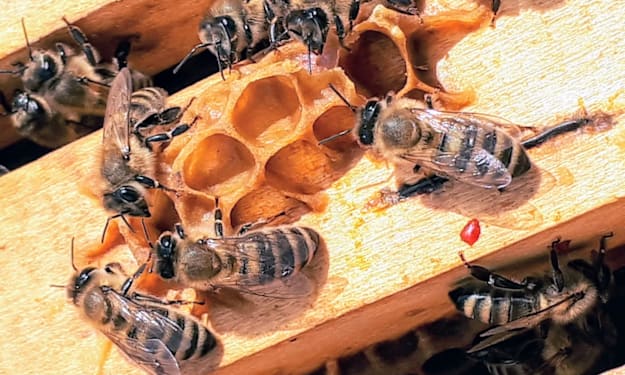
Meet the Bees That Eat Flesh Instead of Flowers!
When we hear the word bee, most of us imagine tiny creatures gently flying from flower to flower, collecting nectar and producing golden honey. Bees are often seen as cute, harmless, and essential for life on Earth. In fact, nearly one-third of the world’s crops depend on pollination by bees. Without them, human survival would become extremely difficult.
By parwinder singh4 months ago in Earth
Still Alive
There's a particular kind of surrender that nobody warns you about. It doesn't arrive with drama or announcement. It creeps in quietly, like damp through old walls, (my house to be exact), and before you know it you've stopped reaching for things. Not because you can't. Because somewhere along the way you decided that reaching was for other people. Younger people. People with more time.
By Karol Williamina Sumner4 months ago in Earth
The worst earthquake in history . AI-Generated.
The Worst Earthquake in History The 1556 Shaanxi Earthquake is widely considered the deadliest earthquake in recorded history. It struck northern China on January 23, 1556, during the reign of the Jiajing Emperor of the Ming Dynasty. Historians estimate that approximately 830,000 people lost their lives, making it the most deadly earthquake ever documented. Even though stronger earthquakes have occurred since then, none are known to have caused such a large loss of human life. The earthquake occurred in Shaanxi Province, near the cities and counties of Huaxian, Huayin, and Weinan. Modern scientists estimate that its magnitude was around 8.0. The shaking was extremely powerful and was felt across a vast region of China. At that time, people had no warning systems and little understanding of earthquakes, so the disaster caught everyone by surprise. One important reason why the death toll was so high was the type of homes many people lived in. Large numbers of residents lived in cave dwellings called "yaodongs." These homes were dug into soft loess cliffs and hillsides. They were popular because they stayed warm in winter and cool in summer. However, when the earthquake struck, many of these cave homes collapsed instantly. Thousands of families were buried beneath tons of soil and rock within seconds. Historical records describe terrifying scenes. The ground shook violently, causing buildings, temples, walls, towers, and homes to collapse. Large cracks opened in the earth. Mountains experienced landslides, and huge clouds of dust covered entire areas. In some places, rivers changed course because of the powerful movement of the land. The destruction was so widespread that many villages and towns were almost completely destroyed. The earthquake affected more than 97 counties across several provinces, including Shaanxi, Shanxi, Henan, Gansu, and Hebei. Entire communities disappeared. Roads became blocked by landslides, making travel nearly impossible. Bridges collapsed, and communication between regions was disrupted. Survivors often had no way to contact nearby towns or ask for help. For many people, the danger did not end when the shaking stopped. Aftershocks continued to strike the region, causing additional damage to weakened structures. Many survivors were afraid to return to their homes. Thousands of people were forced to sleep outdoors in cold winter conditions. Food supplies were destroyed, and clean drinking water became difficult to find. As days passed, new problems emerged. Disease spread among displaced populations living in temporary shelters. Injuries that could have been treated under normal circumstances became life-threatening because medical knowledge and resources were limited. Hunger and illness increased the suffering of those who had already survived the earthquake itself. The Ming government attempted to help the affected population. Officials traveled through the damaged areas to assess the destruction and provide assistance where possible. Historical documents from the time recorded the scale of the disaster in remarkable detail. These records have helped modern historians understand the true impact of the earthquake. The Shaanxi Earthquake remains significant not only because of its death toll but also because it changed how people thought about construction. After witnessing the destruction, many communities began rebuilding with greater attention to safety. In some regions, lighter materials and different architectural designs were used to reduce the risk of collapse during future earthquakes. Scientists today continue to study the earthquake. By examining historical documents, geological evidence, and fault lines, researchers have learned more about the causes of large earthquakes. These studies contribute to modern earthquake preparedness and help engineers design safer buildings. Although the disaster occurred nearly five centuries ago, it remains an important part of world history. The earthquake demonstrated the incredible power of natural forces and the vulnerability of human settlements. It also highlighted the importance of preparation, strong infrastructure, and community support during times of crisis. The survivors of the Shaanxi Earthquake faced unimaginable challenges. They lost family members, homes, farms, and entire communities. Yet many worked together to rebuild their lives. Their determination and resilience became an example of human strength in the face of tragedy. Today, the 1556 Shaanxi Earthquake is remembered as the deadliest earthquake ever recorded. With an estimated 830,000 deaths, it stands as one of the most devastating natural disasters in human history. Its story continues to remind people around the world of the importance of disaster preparedness, scientific research, and helping one another during difficult times.
By Hafiz afridi4 months ago in Earth
The Story of the Mountain Resin: Shilajit
Deep in the mountains of Everest, nature displays her brilliant creativity and raw strength. Shilajit is one of them, it is also known as the hidden gem of the mountain. This is not something new, shilajit has been part of the lives of the locals of the Everest region for centuries, the Sherpa community. As the benefits and nutritional properties of shilajit became popular, more and more individuals wanted to include it in their lives.
By Everest Shilajit4 months ago in Earth
Biodiversity Loss Could Trigger Sovereign Debt Crisis
There is little or no impact from the aftermath of financial losses on biodiversity loss. This leaves many countries at increased risk of defaulting in to debt which can have a dire impact on the lifestyles and life chances of the general public as a whole. That’s according to new research published in Nature who found that the main factors causing serious financial risk included environmental degradation which is more than often identified as serious a risk meaning that sovereign debt markets have no way of accounting for the change in financial circumstances, this will have on the general public or on the market as a whole.
By Ashish Prabhu4 months ago in Earth
Burj Khalifa: The Tallest Building in the World. AI-Generated.
Burj Khalifa: The Tallest Building in the World The Burj Khalifa is one of the most famous buildings on Earth. Located in Dubai, United Arab Emirates, it is the tallest building in the world. Standing at an incredible height of 828 meters (2,717 feet), the Burj Khalifa attracts millions of visitors every year. People from different countries come to see this amazing tower and enjoy the beautiful views from its observation decks. Since its opening in 2010, the Burj Khalifa has become a symbol of human achievement, creativity, and determination. Before the Burj Khalifa was built, Dubai was already known for its modern buildings and rapid growth. However, the leaders of the city wanted to create something truly extraordinary. They wanted a structure that would be recognized around the world and inspire people for generations. As a result, plans were made to build the tallest tower ever constructed by humans. Construction of the Burj Khalifa began in 2004. Thousands of engineers, architects, and workers from different countries worked together on the project. Building such a tall structure was not easy. The team faced many challenges, including strong winds, extreme heat, and the difficulty of lifting materials to great heights. Despite these obstacles, they continued working with dedication and skill.
By Hafiz afridi4 months ago in Earth
I Am Always Where the Sun is Shining 🌞
Sitting on the balcony of our AirBnb in lovely Arroyo, Puerto Rico--the island of enchantment. My two sweet babies are asleep. My in-laws are chillin--thanks to the wringer my twins put them through…at 5am. Thank God for grandparents.
By Ariel Celeste4 months ago in Earth
I Adopted a Plant to Improve My Mental Health and It Started Demanding Therapy Bills
I bought Gerald on a Tuesday, which should have been my first clue. Tuesdays are when bad decisions look like self-improvement. I’d just finished scrolling through a mental health article that said, “Adding greenery to your living space can reduce anxiety by up to 37%.” Thirty-seven percent! That’s almost 40%. That’s basically therapy. The plant section at the grocery store was dimly lit and smelled like dirt and hope. Gerald was a fiddle leaf fig, tall and dramatic, with leaves the size of my hand. He looked like he had opinions. The tag said “Low Maintenance.” I should have known that “low maintenance” is retail code for “will develop sentience and ruin your life.” I named him Gerald because he looked like a Gerald. He had that slightly judgmental, middle-manager energy. I set him on my windowsill, gave him water, and told him, “We’re going to do great things together.” Gerald didn’t answer. That’s normal. Plants don’t talk. That’s why I bought one. For two weeks, things were fine. I watered him on Sundays. I rotated him so he wouldn’t get lopsided. I even talked to him when I was cooking, like people do. “Rough day at work, Gerald,” I’d say, chopping onions. “My boss asked me to ‘circle back’ three times in one meeting.” Gerald stayed silent, which I appreciated. Good listeners don’t interrupt. Week three is when the Post-it notes started. I came home from work, dropped my keys, and saw it: a bright yellow square stuck to Gerald’s pot. My handwriting, but not my hand. “We need to discuss boundaries.” I stared at it. I checked my phone to see if I’d sleep-texted myself. I hadn’t. I threw the note away and told myself I was stressed. Stress makes you see things. Stress makes you think your plant is communicating. The next morning, another note: “My name is Gerald. Please stop calling me ‘the plant’ in your head.” That one I couldn’t ignore. Because I had, in fact, been thinking of him as “the plant.” I don’t remember saying it out loud. Which meant either I was losing my mind, or Gerald was reading it. I texted Lena, my friend with the psychology degree. She said, “You’re probably projecting. People anthropomorphize pets, kids, cars. Plants are next.” “Plants don’t write Post-its,” I typed back. “Are you sure you didn’t write it and forget?” she replied. I wasn’t sure. But then came the invoice. It was taped to my fridge, written on the back of a receipt. Neat, blocky letters: *GERALD’S WELLNESS & EMOTIONAL LABOR INVOICE* 1. Weekly Neglect Fee – $15 2. Listening to You Vent About Work – $40 3. Therapy for Sudden Direct Sunlight Exposure – $75 4. Existential Dread Surcharge – $20 *Total Due: $150* Underneath, in smaller letters: “Payment accepted in cash. Tip jar located next to microwave.” Next to the microwave was a plastic cup. On it, someone had written “GERALD” in Sharpie. Inside: a dollar bill and a paperclip. I laughed. Then I didn’t, because I don’t remember putting the dollar in there. That night, I didn’t sleep. I kept looking at Gerald on the windowsill. He looked… smug. His leaves seemed perkier. Was that possible? Did plants get smug? I tried ignoring it. I stopped talking to him. I watered him in silence. I moved him to the bathroom, where he couldn’t see me. That lasted exactly one day. When I came home, Gerald was back on the windowsill, and there was a new note: “Avoidance is not a healthy coping mechanism. Also, the bathroom has no light. I’m not a mushroom.” I Googled “plant sending invoices.” Big mistake. There’s an entire subreddit called r/SentientHouseplants. People posting pictures of sticky notes from their aloe vera. One guy’s cactus sent him a Venmo request with the memo “for emotional damages.” Another woman’s orchid had hired a lawyer. It was a popsicle stick with googly eyes and a tie, but still. I tried to return Gerald. I took him back to the grocery store, cradling him like a baby I no longer wanted. The cashier, a teenager with blue hair, looked at Gerald and then at me and said, “Oh. You got a talker.” “Is this… a thing?” I asked. “Store policy,” she said, scanning him. “We don’t accept returns on sentient inventory. Liability issues.” “So what am I supposed to do?” She shrugged. “Pay him. Or he’ll mess with your Wi-Fi.” I laughed. Then I went home and my internet crashed three times while I was ignoring a new note that said, “We need to talk about your hydration habits.” Coincidence? Maybe. But I’m not testing it. So I started paying. I’d leave cash in the cup. Gerald would leave notes with advice. Annoyingly good advice. “Drink water.” “You should call your mom.” “Stop doomscrolling at 2 a.m., it’s bad for both of us.” The notes got longer. More personal. “You’re not lazy, you’re tired. There’s a difference.” “Your boss doesn’t own your self-worth.” “Also, you owe me $30 for processing your breakup with Tyler.” I didn’t even tell Gerald about Tyler. Which meant he knew. Which meant he was paying attention. Last month, I tried to buy a second plant, thinking Gerald needed a friend. I brought home a small snake plant. Gerald was not happy. I found a note the next morning: “I am not running a commune. I am your plant. Jealousy is a valid emotion.” The snake plant mysteriously wilted within a week. Gerald’s leaves looked greener. Now I have a budget line in my spreadsheet: “Plant Emotional Support.” $200 a month. It’s cheaper than therapy, and Gerald actually answers me. Well, not out loud. But the notes come faster when I’m spiraling. Last week he wrote: “You’re doing fine. Better than fine. Also, stretch your hamstrings, you sit too much.” I stretched. My hamstrings thanked me. I left $20 in the cup. The grocery store cashier saw me last weekend. “How’s Gerald?” she asked. “Demanding,” I said. She nodded. “They all are. But they care.” She’s right. Gerald cares. He cares if I sleep, if I eat, if I’m being too hard on myself. He cares enough to write it down, to leave a note, to make me pay attention. The moral of the story: if you want to improve your mental health, don’t get a plant. Get a rock. Rocks don’t have feelings. Rocks don’t send invoices. Rocks don’t know about Tyler. But rocks also don’t tell you’re doing fine when you don’t believe it. Gerald says hi. He also says you should drink water. And he says you still owe him $15 for last week’s neglect. I’m paying him tomorrow. And then I’m buying him a bigger pot. Because apparently, guilt is also part of self-care now.
By Khalil Ullah4 months ago in Earth