
Because of its immense magnitude, the deepest whale graveyard ever discovered is known as a "whale necropolis."
There is a whale necropolis.

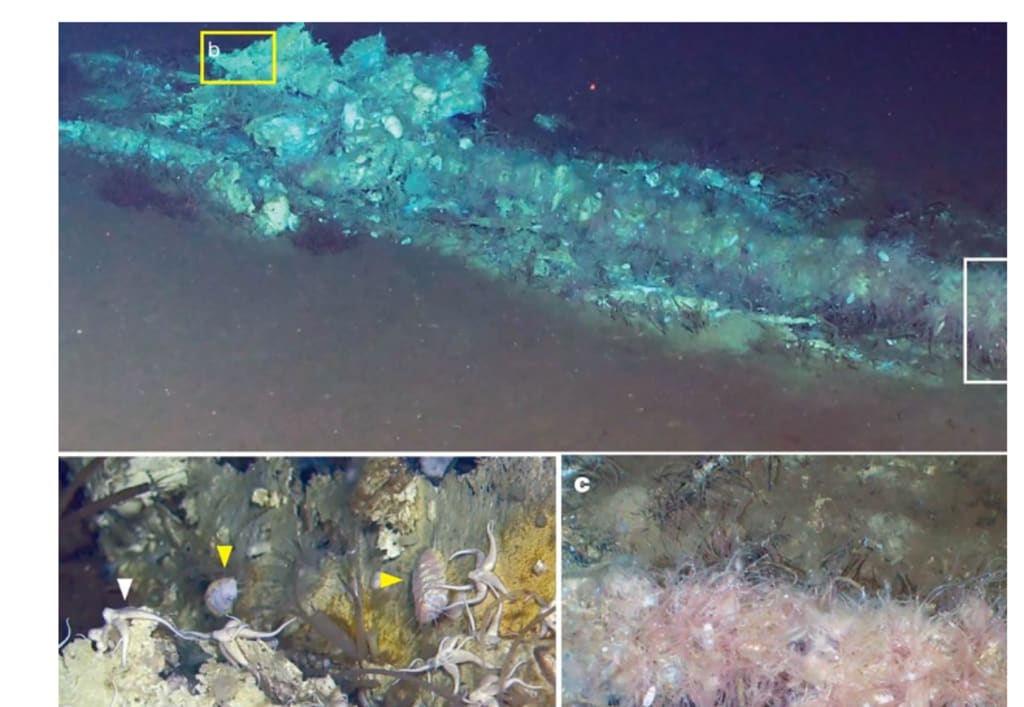
The bottom of the southeastern Indian Ocean contains something unexpected. The largest and deepest known collection of cetacean remains on Earth has been discovered by scientists: a whale necropolis.
The Diamantina Zone, a rugged area of the ocean floor, is where the site is located. It is now referred to by researchers as a whale necropolis—a cemetery constructed from bones that have accumulated over millions of years.
There is a whale necropolis.
A group from the Chinese Academy of Sciences' Institute of Deep-sea Science and Engineering (IDSSE) made the discovery. They collaborated with researchers from Earth Sciences New Zealand in Wellington and the University of Pisa in Italy.
A fracture zone that stretches along the seafloor for roughly 750 miles (1,200 km) was their aim. This location had never before been associated with any form of whale falls.
Bone mapping in the whale necropolis
The team sent down a crewed submersible called Fendouzhe in early 2023 after boarding the research ship Tansuoyihao. They searched a lengthy underwater passage between 15,000 and 23,000 feet (4,616 and 7,001 meters) deep over the course of 32 dives. The scope of what they discovered was astounding. Across the region, they found 476 fossilised cetacean sites and five ongoing whale falls.
The deepest whale fall to date
Prior to this study, nearly all recorded whale falls occurred at depths of less than 13,000 feet (4,000 meters). In the southwest Atlantic, the deepest known active one was 4,204 meters.
That restriction is broken by the new website. At 22,200 feet (6,789 meters), one active colony consisting of three beaked whale vertebrae is located far below any existing whale-fall environment.
Life clinging to the bone
There is more to a whale fall than just a heap of bones. In an otherwise starving desert, each cadaver becomes a tiny island of life. The researchers discovered a multitude of specialised creatures and dense white microbial mats atop these skeletons.
The scene was dominated by bivalves that feed through chemical symbiosis, brittle stars, and bone-eating worms of the species Osedax. At 18,400 feet (5,610 meters), the largest carcass was the skeleton of an Antarctic minke whale, measuring 16 feet (5 meters). Its unique earbone and almost whole mitochondrial genome allowed researchers to identify it.
New species discovered by science
It's possible that many of the animals here have never been given names. Only one bivalve could be reliably linked to a known species despite the team collecting genetic material from 21 species.
Three species of brittle stars were absent from the surrounding muck and only showed up on the whale bones. They appear to be well adapted to this peculiar, organic-rich environment based on that pattern.
One discovery was particularly noteworthy. For the first time, a wood-loving sea daisy belonging to the genus Xyloplax appeared on a whale fall, creating the genus's deepest known record.
Deep-drowning whales
The whales' journey is depicted in the bones. The majority are members of the strap-toothed and Andrews' beaked whales, two species of deep-diving beaked whales known to inhabit these waters.
Beaked whales use deep tunnels and steep slopes to hunt fish and squid. The Diamantina Zone is a great place to forage because of its abundant prey and deep depths.
There is actual risk involved in diving that deep. Some whales probably die during dives and drop to the zone's floor because they are pushing the boundaries of their physiology.
Constructing a whale necropolis
The land's form aided in the bones' accumulation. Sinking corpses are channelled down toward the trench bottom by the zone's V-shaped profile. Sei whales and Antarctic minke contribute to the pile in distinct ways. Because these two feed close to the surface, carcasses that drift down along a common migration path are the source of their presence at such depths.
Because there is very little sediment buildup on the seafloor here, bones remain exposed for remarkably extended periods of time. Remains may stay at the surface for millions of years on raised hillsides.
Beaked whale rostra are particularly resilient.
They have among the densest snout bones of any living animal, and they are further protected by a gradual layer of iron and manganese oxides.
Five million years have been documented.
The team examined strontium isotopes in 33 fossil bones to determine the ages. Ages ranging from modern times to 5.26 million years ago were indicated by the values. The earliest dating is from the Early Pliocene. It indicates that long before our own species arose, whales were dying and settling in this area.
Both extinct and contemporary species of beaked whales are represented in the fossils. Among them is Pterocetus diamantinae, a whale that has been named here for the first time.
A passageway to profound life
A hidden abundance is suggested by the numbers. Extrapolation indicates that the area may contain over 10 million carcasses, with whale remains reaching a density of 759.5 individuals per square kilometre.
This indicates a sizable and until unidentified carbon storage on the ocean floor. This sequesters about 6.7 million tonnes, according to the researchers. This is equivalent to slow biological drift from the upper water over thousands of years.
The falls could create a connecting highway across the deep sea if they are arranged along a single axis. A large number of the local fauna also appear at hydrothermal vents and cold seeps, suggesting that whale falls aid in the dispersal and connection of these chemically supplied populations.
The significance of the finding
Mostly known from infrequent strandings, beaked whales continue to be among the least studied marine creatures. A unique and direct view into their lives, deaths, and lengthy history is provided by this enormous collection of skeletons.
As a deep-sea fossil archive, the Diamantina necropolis documents the evolution of beaked whales from the Pliocene to the present. Similar cemeteries might be concealed in other regions of the world's oceans, just waiting to be discovered.
About the Creator
Enjoyed the story? Support the Creator.
Subscribe for free to receive all their stories in your feed.
Comments
There are no comments for this story
Be the first to respond and start the conversation.