
Meet the Bees That Eat Flesh Instead of Flowers!
They look like ordinary bees, but their diet hides a terrifying secret that could change how you see nature forever.

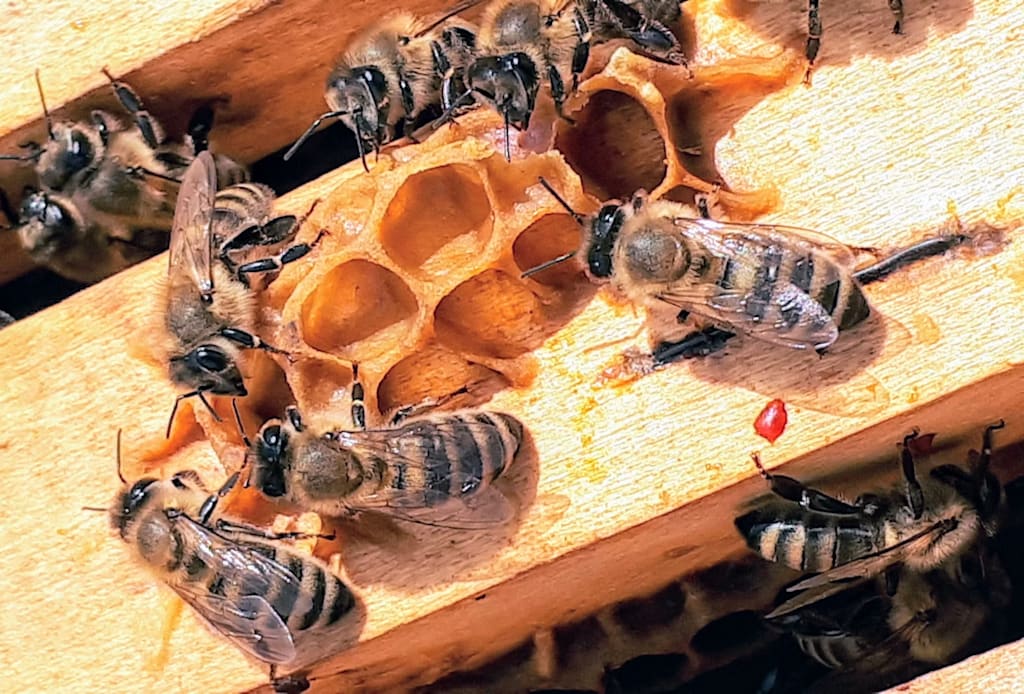
When we hear the word bee, most of us imagine tiny creatures gently flying from flower to flower, collecting nectar and producing golden honey. Bees are often seen as cute, harmless, and essential for life on Earth. In fact, nearly one-third of the world’s crops depend on pollination by bees. Without them, human survival would become extremely difficult.
But what if I told you that not all bees live on flowers and nectar? Hidden deep inside the rainforests of South America exists a species that completely breaks this image.
Meet the Vulture Bees—one of nature’s most shocking and unusual insects.
Unlike ordinary honey bees, vulture bees do not depend on flowers for survival. Over time, they have developed a completely different diet. These bees feed on something most living beings would avoid at all costs—rotting animal flesh.
Scientifically belonging to the Trigona genus, vulture bees are small, dark-colored, and stingless. Yes, they cannot sting, which makes them less dangerous in one way—but their feeding behavior is far more disturbing than a sting.
Instead of searching for nectar, they are attracted to dead and decaying animals. When they find a carcass, they don’t just feed from the surface. They often crawl inside through natural openings like eyes or wounds to reach soft tissues.
But how can such a tiny insect consume meat?
The answer lies in their biology. Vulture bees produce powerful digestive enzymes in their saliva. They dissolve the decaying flesh into a liquid-like substance—almost like a protein soup. This semi-digested liquid is then stored in a special internal pouch called the crop, so it does not get fully digested immediately.
Once the bees return to their hive, something even more bizarre happens. They regurgitate the meat liquid and pass it on to other worker bees. Inside the hive, this substance is stored in small wax-made chambers.
Here comes the most fascinating part.
To survive the dangers of decaying meat, vulture bees have evolved extremely strong stomach acid—far more powerful than that of normal bees. This acid kills harmful bacteria and prevents the colony from getting poisoned. Along with beneficial microbes in their gut, they are able to safely process and preserve the meat mixture.
Over time, this stored substance transforms into something known as “meat honey.”
Unlike traditional honey, meat honey is not golden and clear. It is usually pale, thick, and sometimes creamy in texture. Its taste is described as a strange combination of sweet, salty, and smoky flavors. Most people who have tried it say it is extremely unusual and not pleasant by normal standards.
Interestingly, this “meat honey” is not made for humans at all. It is used as a rich protein source for the bee larvae inside the colony, helping them grow and survive in harsh rainforest conditions.
Even more surprisingly, vulture bees are not limited to scavenging. In some cases, they have been observed attacking insect eggs and feeding on them, showing slightly predatory behavior.
So why did these bees abandon flowers and adopt such a disturbing lifestyle?
Scientists believe the answer lies in their environment. In the dense rainforests of South America, flower resources are not always reliable. Over time, natural selection pushed some bee species to adapt to alternative food sources. Dead animals, which are abundant in such ecosystems, became a survival opportunity.
This shift not only changed their diet but also their entire body structure. Unlike typical bees covered in fine hairs for collecting pollen, vulture bees are smoother and more streamlined. Their jaws are stronger, designed for tearing flesh instead of collecting nectar.
Despite their eerie feeding habits, vulture bees play an important ecological role. Just like vultures clean up dead animals in nature, these bees help break down decomposing matter and recycle nutrients back into the ecosystem.
Nature, as strange as it seems, always finds a way to balance survival and function.
The existence of vulture bees reminds us that evolution has no fixed rules. Even creatures as delicate as bees can transform into something completely unexpected when survival demands it.
So the next time you think of honey, remember—some honey comes from flowers… but in a hidden corner of the world, some “honey” comes from death itself.
About the Creator
parwinder singh
🎬 Movie & Entertainment Writer sharing reviews, ending explanations, story breakdowns, plot twists and hidden details from Bollywood, Hollywood, South Indian cinema, Korean dramas and OTT releases.
Enjoyed the story? Support the Creator.
Subscribe for free to receive all their stories in your feed.
Comments
There are no comments for this story
Be the first to respond and start the conversation.