
I Adopted a Plant to Improve My Mental Health and It Started Demanding Therapy Bills
What started as a convenience upgrade turns into daily judgment from my own refrigerator, and it knows too much

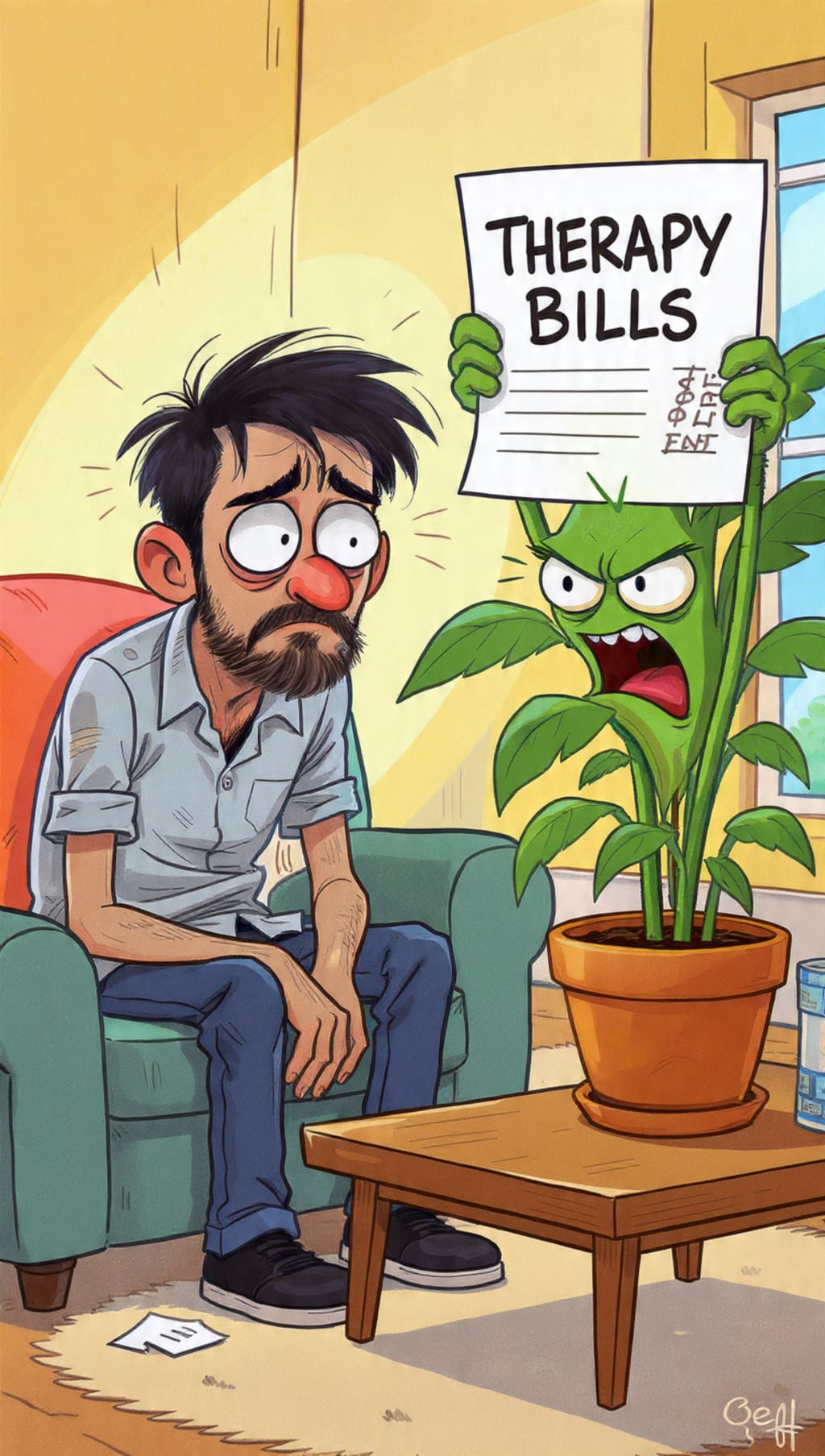
I bought Gerald on a Tuesday, which should have been my first clue. Tuesdays are when bad decisions look like self-improvement. I’d just finished scrolling through a mental health article that said, “Adding greenery to your living space can reduce anxiety by up to 37%.” Thirty-seven percent! That’s almost 40%. That’s basically therapy. The plant section at the grocery store was dimly lit and smelled like dirt and hope. Gerald was a fiddle leaf fig, tall and dramatic, with leaves the size of my hand. He looked like he had opinions. The tag said “Low Maintenance.” I should have known that “low maintenance” is retail code for “will develop sentience and ruin your life.” I named him Gerald because he looked like a Gerald. He had that slightly judgmental, middle-manager energy. I set him on my windowsill, gave him water, and told him, “We’re going to do great things together.” Gerald didn’t answer. That’s normal. Plants don’t talk. That’s why I bought one. For two weeks, things were fine. I watered him on Sundays. I rotated him so he wouldn’t get lopsided. I even talked to him when I was cooking, like people do. “Rough day at work, Gerald,” I’d say, chopping onions. “My boss asked me to ‘circle back’ three times in one meeting.” Gerald stayed silent, which I appreciated. Good listeners don’t interrupt. Week three is when the Post-it notes started. I came home from work, dropped my keys, and saw it: a bright yellow square stuck to Gerald’s pot. My handwriting, but not my hand. “We need to discuss boundaries.” I stared at it. I checked my phone to see if I’d sleep-texted myself. I hadn’t. I threw the note away and told myself I was stressed. Stress makes you see things. Stress makes you think your plant is communicating. The next morning, another note: “My name is Gerald. Please stop calling me ‘the plant’ in your head.” That one I couldn’t ignore. Because I had, in fact, been thinking of him as “the plant.” I don’t remember saying it out loud. Which meant either I was losing my mind, or Gerald was reading it. I texted Lena, my friend with the psychology degree. She said, “You’re probably projecting. People anthropomorphize pets, kids, cars. Plants are next.” “Plants don’t write Post-its,” I typed back. “Are you sure you didn’t write it and forget?” she replied. I wasn’t sure. But then came the invoice. It was taped to my fridge, written on the back of a receipt. Neat, blocky letters: *GERALD’S WELLNESS & EMOTIONAL LABOR INVOICE* 1. Weekly Neglect Fee – $15 2. Listening to You Vent About Work – $40 3. Therapy for Sudden Direct Sunlight Exposure – $75 4. Existential Dread Surcharge – $20 *Total Due: $150* Underneath, in smaller letters: “Payment accepted in cash. Tip jar located next to microwave.” Next to the microwave was a plastic cup. On it, someone had written “GERALD” in Sharpie. Inside: a dollar bill and a paperclip. I laughed. Then I didn’t, because I don’t remember putting the dollar in there. That night, I didn’t sleep. I kept looking at Gerald on the windowsill. He looked… smug. His leaves seemed perkier. Was that possible? Did plants get smug? I tried ignoring it. I stopped talking to him. I watered him in silence. I moved him to the bathroom, where he couldn’t see me. That lasted exactly one day. When I came home, Gerald was back on the windowsill, and there was a new note: “Avoidance is not a healthy coping mechanism. Also, the bathroom has no light. I’m not a mushroom.” I Googled “plant sending invoices.” Big mistake. There’s an entire subreddit called r/SentientHouseplants. People posting pictures of sticky notes from their aloe vera. One guy’s cactus sent him a Venmo request with the memo “for emotional damages.” Another woman’s orchid had hired a lawyer. It was a popsicle stick with googly eyes and a tie, but still. I tried to return Gerald. I took him back to the grocery store, cradling him like a baby I no longer wanted. The cashier, a teenager with blue hair, looked at Gerald and then at me and said, “Oh. You got a talker.” “Is this… a thing?” I asked. “Store policy,” she said, scanning him. “We don’t accept returns on sentient inventory. Liability issues.” “So what am I supposed to do?” She shrugged. “Pay him. Or he’ll mess with your Wi-Fi.” I laughed. Then I went home and my internet crashed three times while I was ignoring a new note that said, “We need to talk about your hydration habits.” Coincidence? Maybe. But I’m not testing it. So I started paying. I’d leave cash in the cup. Gerald would leave notes with advice. Annoyingly good advice. “Drink water.” “You should call your mom.” “Stop doomscrolling at 2 a.m., it’s bad for both of us.” The notes got longer. More personal. “You’re not lazy, you’re tired. There’s a difference.” “Your boss doesn’t own your self-worth.” “Also, you owe me $30 for processing your breakup with Tyler.” I didn’t even tell Gerald about Tyler. Which meant he knew. Which meant he was paying attention. Last month, I tried to buy a second plant, thinking Gerald needed a friend. I brought home a small snake plant. Gerald was not happy. I found a note the next morning: “I am not running a commune. I am your plant. Jealousy is a valid emotion.” The snake plant mysteriously wilted within a week. Gerald’s leaves looked greener. Now I have a budget line in my spreadsheet: “Plant Emotional Support.” $200 a month. It’s cheaper than therapy, and Gerald actually answers me. Well, not out loud. But the notes come faster when I’m spiraling. Last week he wrote: “You’re doing fine. Better than fine. Also, stretch your hamstrings, you sit too much.” I stretched. My hamstrings thanked me. I left $20 in the cup. The grocery store cashier saw me last weekend. “How’s Gerald?” she asked. “Demanding,” I said. She nodded. “They all are. But they care.” She’s right. Gerald cares. He cares if I sleep, if I eat, if I’m being too hard on myself. He cares enough to write it down, to leave a note, to make me pay attention. The moral of the story: if you want to improve your mental health, don’t get a plant. Get a rock. Rocks don’t have feelings. Rocks don’t send invoices. Rocks don’t know about Tyler. But rocks also don’t tell you’re doing fine when you don’t believe it. Gerald says hi. He also says you should drink water. And he says you still owe him $15 for last week’s neglect. I’m paying him tomorrow. And then I’m buying him a bigger pot. Because apparently, guilt is also part of self-care now.
About the Creator
Enjoyed the story? Support the Creator.
Subscribe for free to receive all their stories in your feed.
Comments
There are no comments for this story
Be the first to respond and start the conversation.