Climate
Changes in human nighttime activity are mapped using daily satellite photos collected over a ten-year period.
Researchers have discovered that, between 2014 and 2022, Earth's city lights, as observed from space at night, have become extremely erratic, with numerous locations frequently brightening and dimming over brief intervals. Because of this fragility, the glow of cities becomes a sensitive indicator of global disruption, policy changes, and unequal development.
By Francis Dami5 months ago in Earth
While some parts of Earth are becoming darker at night, the planet is becoming brighter overall.
Have you ever observed how a city appears to be breathing at night? Imagine that vista from space now. The Earth doesn't just glow silently; it pulses, flickers, and changes to show how people live, construct, suffer, and develop.
By Francis Dami5 months ago in Earth
I Asked Grok to Solve Climate Change. AI-Generated.
It sounds very silly, "I asked Grok to solve climate change." But, billionaires have been saying for a while that A.I has the answers to big problems such as climate change. This made me wonder then, had no one bothered to ask A.I to give us a plan to solve climate change?
By Sean Patrick5 months ago in Earth
Ocean temperatures on Earth hit record highs in 2025, and there is no stop in sight.
The majority of the planet's excess heat ends up in the ocean, but air temperatures make headlines. There, it can persist for decades, subtly influencing marine ecosystems, weather extremes, and sea levels. The amount of energy absorbed by the ocean is revealed by a recent worldwide investigation.
By Francis Dami5 months ago in Earth
🌍 World Enters Relax Mode After Rising War Tensions
🌍 World Enters Relax Mode After Rising War Tensions After months of rising tensions, military alerts, and global uncertainty, the world is finally entering what many experts are calling a “Relax Mode” from war fears. Diplomatic talks, ceasefire agreements, and renewed cooperation among nations are helping reduce anxiety and bring hope back to millions of people around the globe.
By Wings of Time 5 months ago in Earth
Trees
The Astonishing Intelligence of the Forest THE LISTENING FOREST 👂 For centuries Western science classified trees as passive organisms that responded mechanically to light, water, and nutrients without any form of intelligence, awareness, or communication, but research over the past two decades has shattered this assumption by revealing that trees possess sensory capabilities, communication systems, memory functions, and decision-making processes that while radically different from animal intelligence constitute a genuine form of biological intelligence that challenges our understanding of what it means to be aware and what it means to be alive in ways that have profound implications for how we treat the forests that cover approximately thirty percent of the Earth's land surface and that provide the oxygen, climate regulation, and biodiversity that human civilization depends on 🌲🔬
By The Curious Writer6 months ago in Earth
According to a study, thawing permafrost releases significantly more greenhouse gases than anticipated.
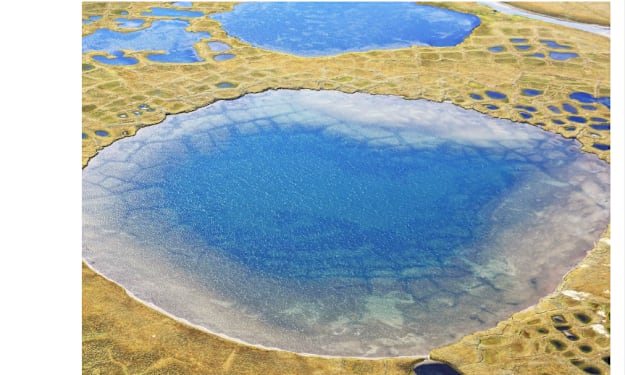
Arctic permafrost has long functioned as a massive frozen lid, trapping carbon-rich soils and slowing the escape of gases that could cause global warming. However, the ground may become far more "leaky" after that cap begins to thaw, making it much simpler for climate-forcing chemicals to pass through the soil and into the atmosphere, according to recent lab tests from the University of Leeds.
By Francis Dami6 months ago in Earth
The Lake
The Terrifying Natural Phenomenon at Lake Natron THE DEATH TRAP OF TANZANIA 💀 In the remote northern reaches of Tanzania, near the border with Kenya at the base of a volcano called Ol Doinyo Lengai, there exists a lake so alkaline and so saturated with minerals that animals who die in its waters are preserved in a state of calcified perfection that makes them appear to have been turned to stone, their bodies encrusted with sodium carbonate and sodium bicarbonate deposits that harden into a shell so complete and so detailed that the preserved animals look like sculptures rather than corpses, frozen in whatever position they occupied at the moment of death with their feathers and fur and facial expressions captured in mineral rather than flesh, and photographs of these calcified animals which went viral when photographer Nick Brandt published his series "Across the Ravaged Land" in 2013 produced reactions ranging from disbelief to horror because the images looked like something from mythology rather than from nature, creatures literally turned to stone by a body of water that functions as one of Earth's most bizarre and most beautiful natural death traps 🌋
By The Curious Writer6 months ago in Earth
The Forest That Breathes 🌲
THE WOOD WIDE WEB 🕸️ Beneath every forest on Earth there exists a network so vast and so complex that scientists who discovered it compared it to the internet, a web of fungal filaments called mycorrhizal networks that connect the root systems of virtually every tree in the forest into a single integrated communication and resource-sharing system through which trees exchange nutrients, water, chemical signals, and even electrical impulses, and this discovery has fundamentally altered our understanding of forests from collections of individual competing organisms to interconnected superorganisms where cooperation rather than competition is the dominant survival strategy 🍄
By The Curious Writer6 months ago in Earth