
Volcanic eruptions are causing gold and other valuable metals to leak from the Earth's core and reach the surface.
Surface deposits and leaking metals

An enormous reservoir of gold and other valuable metals can be found deep under the Earth's core, hidden beneath the thick crust and searing layers. It has long been thought by scientists that these treasures, which include ruthenium and gold, are still trapped close to the core-mantle border, which is located roughly 1,900 miles (3,000 kilometres) below the surface.
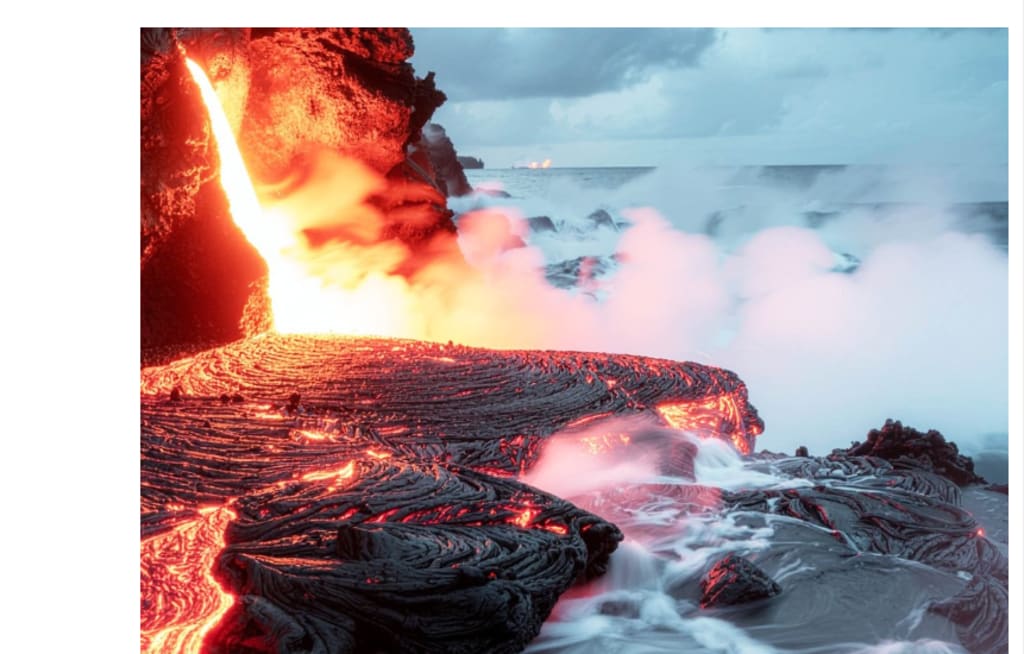
However, recent research shows that several of these metals are gradually rising due to volcanic eruptions in places like Hawaii. Ruthenium traces found in Hawaiian lava suggest a gradual leak from the planet's deepest center. Dr. Nils Messling of the University of Göttingen is largely responsible for these insights.
Earth's core, gold, and metals "We knew we had actually struck gold when the first results came in! Dr. Messling exclaimed, "Our data confirmed that material from the core, including gold and other precious metals, is leaking into the Earth's mantle above."
He and other scientists discovered chemical indicators in lava that point to the possibility of metal migration from the core to the surface. This discovery is consistent with previous research showing different tungsten isotopes in some volcanic rocks. Researchers discovered anomalies that could only be explained by a secret source located deep within the earth by analysing exact isotope ratios.
Metals are moved by molten rock.
Professor Matthias Willbold of the University of Göttingen added, "Our findings not only show that the Earth's core is not as isolated as previously assumed." "Huge amounts of superheated mantle material, hundreds of quadrillion metric tonnes of rock, originate at the core-mantle boundary and rise to the Earth's surface to form ocean islands like Hawaii, as we can now demonstrate."
The molten granite that fuels Hawaii's volcanoes contains a large portion of this evidence. These specifics provide insight into how metals trapped in the core might travel into deeper areas on streams of igneous fluids. Even a small upward trickle over millions of years can transmit significant amounts of valuable components, even though the transmission is slow by human standards.
Surface deposits and leaking metals
It's possible that some of the gold and associated metals employed in contemporary technologies were originally located close to Earth's center. In industries like electronics, medical devices, and renewable energy, precious metals are crucial.
Although the precise magnitude of this movement is still being studied, the potential brings new issues with the formation of mineral deposits. Experts also point out that gold's historical significance and monetary role were influenced by its surface scarcity.
Scientists' perspectives on metal distribution and planetary evolution may change if they discover that traces of it penetrate into the mantle from far below.
Materials are exchanged between Earth's inner layers.
The core was once thought by geologists to be a solitary reservoir surrounded by thousands of miles of thick rock. That idea is called into question by recent data, which indicate a gradual but steady interchange of materials.
The subject of whether these interactions have existed since the beginning of Earth's history is still being investigated. The current metal flow from the core is too tiny to cause a gold rush, according to researchers. Instead, they see it as a geological event that shows how Earth's internal processes continue to shape its surface in surprising ways.
Precious metals from the early history of Earth
The types of materials from which Earth initially formed are also suggested by the migration of ruthenium isotopes. The chemical fingerprint of ancient planetary building blocks, which are different from what was added later during late accretion, is thought to be preserved in the core.
This suggests that some of the metals emerging through volcanic plumes today may be remnants of the early stages of Earth's formation, providing unique insight into events that took place nearly 4.5 billion years ago.
Metal flow reveals changes in the Earth's core
It is yet to be determined whether the processes we see today have also existed in the past. Dr. Messling said, "Our findings open up an entirely new perspective on the evolution of the inner dynamics of our home planet."
Long-term geochemical variations in the oceans and atmosphere may have been caused by metal-carrying rock plumes, according to some scientists. They also take into account the potential effects of these plumes on the distribution of specific mineral resources and volcanic island chains.
Gold reserves, Earth's core, and volcanoes
These results are important to more than just geologists. Scientists' models of Earth's heat transport, magnetic field creation, and deep mantle convection may be impacted by the presence of elements originating from the core close to the surface.
Beyond scholarly curiosity, the confirmation of core-mantle interchange may eventually have an impact on how we find and evaluate mineral resources, particularly in hitherto unexplored volcanic regions.
Determining the rate at which metals rise through the Earth's mantle and flow from the core are the next steps. Measurements of other elements' isotopes may offer much more information on the makeup of the inner zones of our planet.
Researchers will be able to better understand planetary formation, continuous layer interchange, and the sources of metals that power This information may change long-held beliefs and highlight new aspects of Earth's complexity.
About the Creator
Enjoyed the story? Support the Creator.
Subscribe for free to receive all their stories in your feed.
Comments
There are no comments for this story
Be the first to respond and start the conversation.