
Earth's "ghost plume" is so strong that it is physically distorting the planet's interior layers.
Hidden mantle plumes are revealed by new instruments

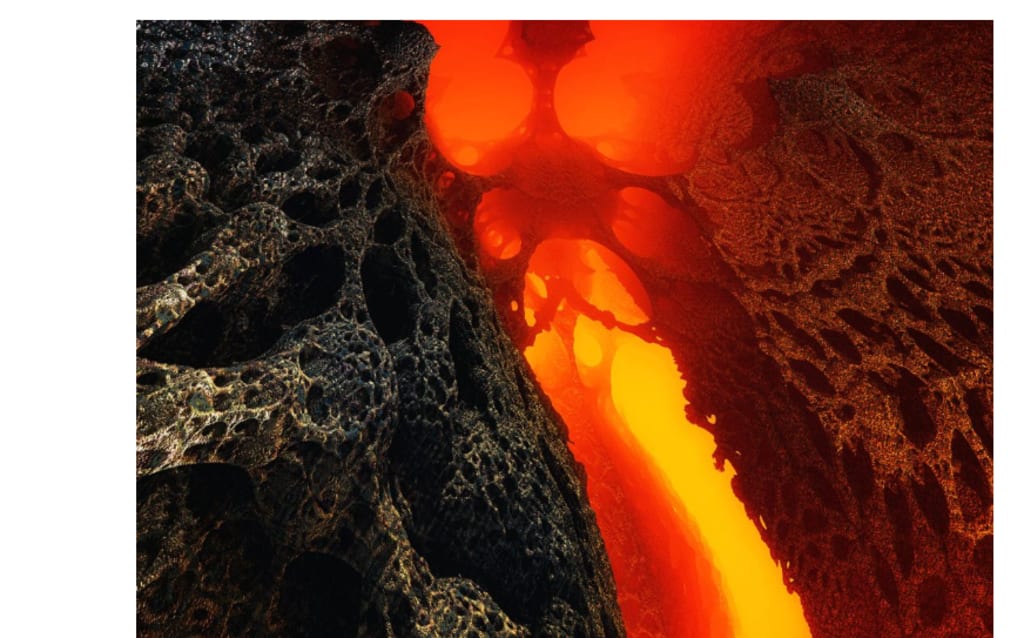
In comparison to the Sun's intake, Earth loses about 47 terawatts of heat into space, which is insignificant but essential for plate tectonics, volcanoes, and the magnetic field. It is commonly believed that this outward flow, similar to steam seeping through thick soup, rises gradually by mantle convection.
According to a recent study, some of the heat travels through express routes called mantle plume columns, which were first proposed by W. Jason Morgan in 1971. Researchers have now discovered the first "ghost plume," which is concealed beneath Oman's eastern deserts and shows no signs of surface volcanism.
After analysing thousands of seismic signals, lead author Simone Pilia of King Fahd University of Petroleum and Minerals called the buried column the Dani plume in honour of his son.
The mantle plume of Oman rises without erupting.
Oman exhibits no new lava fields, yet typical plumes reach the surface and create features like Hawaii or Yellowstone. The Dani plume is a ghost because of this absence; it is hot enough to melt rock but not hot enough to pierce a thick continental cover. "We became increasingly certain that it is a plume as we gathered more evidence."
Pilia stated. Seismic waves slowed in a compact cylinder around 125 miles (200 kilometres) broad at a minimum depth of 410 miles (660 kilometres), according to his team's tracing of the column.
The mantle transition zone had a characteristic thermal fingerprint of rising material, warping downward at a depth of 255 miles (410 kilometres) and lifting again at 410 miles (660 kilometres), according to independent examinations.
A concealed mantle plume is revealed by earthquake waves
Seismic tomography, Earth's equivalent of a CT scan, was used in the quest to create three-dimensional velocity maps from earthquake vibrations. Shear-wave velocity can decrease by around 3% with a temperature increase of about 200°F (93°C).
Shear speeds inside the column decreased by that much in Oman, suggesting an excess temperature of about 200–500 °F (93–260 °C). That is below the melting point under 130 miles (209 km) thick lithosphere, but warm enough to soften peridotite.
After reviewing the data, Saskia Goes of Imperial College London, who was not engaged in the work, described the discovery as "plausible," pointing out that narrow columns are notoriously difficult to scan.
Oman's land lifts in the absence of a volcano
There are surface indicators even in the absence of lava. Despite minimal crustal shortening, the Salma Plateau in Eastern Oman is perplexingly high, rising to a height of 6,500 feet (1,980 meters).
The coast continues to rise at a rate of less than 0.04 inches (0.1 centimetres) per year, according to GPS and coastline surveys. The simplest explanation for this is dynamic support from hot, buoyant mantle at depth.
The Yellowstone region, where the famous plume sustains long-lasting volcanic and hydrothermal activity in the American West, experiences a similar uplift. Plumes can elevate crust even when they remain trapped deep beneath solid rock, as evidenced by Oman's slower rise.
A hidden plume might have changed India's course.
According to geological reconstructions, there was a little eastward detour in India's course approximately 40 million years ago as the Dani plume sank beneath the Indian Plate. According to Pilia's group, the plate was pushed like a concealed hand by viscous drag from the plume's movement.
According to the study's torque calculations, a tunnel that is about 125 miles (201 km) wide and moves a few cubic miles of heated rock annually may provide the required force. The timing is more cleanly explained by no other adjacent tectonic event.
If a single amagmatic plume is capable of guiding continents, then several covert plumes may have subtly influenced plate motions throughout Earth's history.
The significance of hidden plumes
The Earth's heat budget is also affected by the Dani plume. More heat than anticipated flows directly from the core if numerous columns like it avoid slow mantle convection, which could reduce estimates of how long the inner dynamo can run.
Future satellite gravity missions and ocean-bottom seismometer arrays may reveal further silent plumes beneath dense cratons or ancient oceans. improving models that link resource development and surface dangers to deep-Earth processes. According to the latest research, the Afar plume, which is found beneath the Horn of Africa, and the Dani plume may share a deep reservoir.
Both plumes may be branches of a larger low-velocity structure at the core-mantle boundary, which spans thousands of miles across the lower mantle, according to seismic imaging from the DETOX-P3 global tomography model.
Growing notions that mantle plumes may rise as components of interconnected superplume networks rather than as separate columns are supported by this tree-like morphology.
If this is the case, hotspots such as Afar, Yellowstone, and now Oman may have similar origins, connecting single, deep-Earth sources to surface activity across continents.
Hidden mantle plumes are revealed by new instruments
Conventional techniques for identifying mantle plumes mainly depend on surface volcanism, which may miss characteristics concealed beneath dense continental crust.
The Dani plume demonstrates how important factors influencing Earth's interior dynamics might be overlooked if one only considers lava flows and volcanic materials. Instead, new avenues for ghost plume identification are made possible by combining topographic signals, plate motion analysis, and seismic tomography.
This multidisciplinary method could change how we map the heat movement from Earth's core to the surface by assisting researchers in finding more buried structures in areas that were previously believed to be plume-free.
About the Creator
Enjoyed the story? Support the Creator.
Subscribe for free to receive all their stories in your feed.
Comments
There are no comments for this story
Be the first to respond and start the conversation.