
Perovskite--Silicon Tandem Solar
The Solar Upgrade That Doesn't Need More Roof

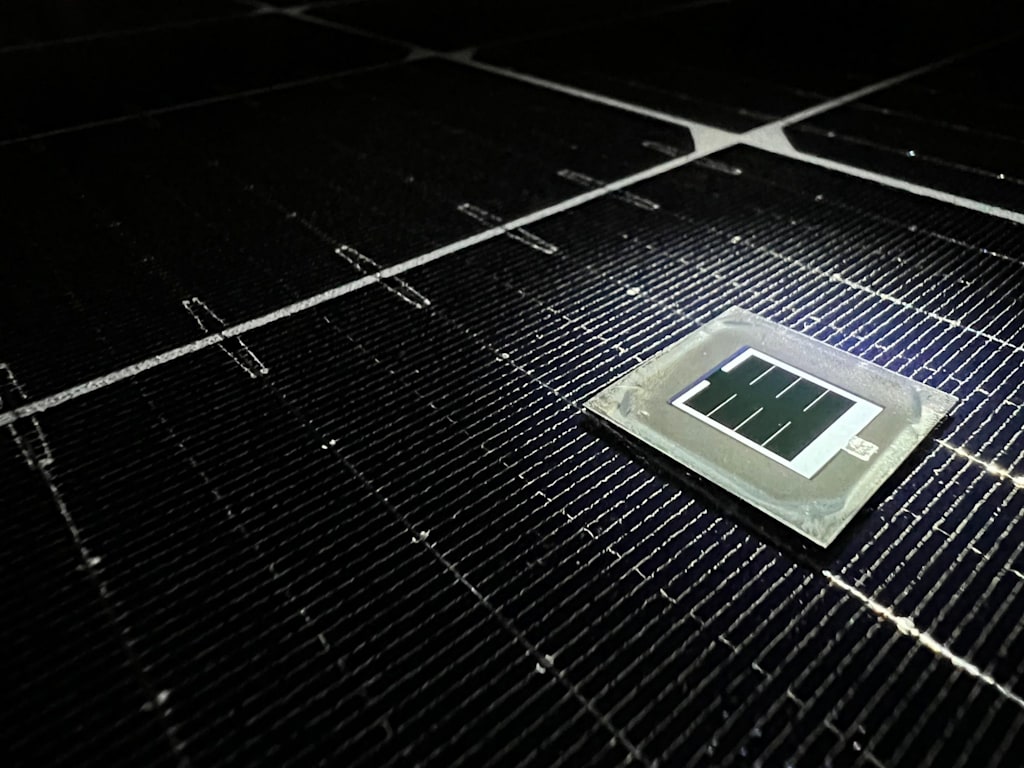
Solar is already cheap, widespread, and getting better every year. But it’s starting to hit a very ordinary constraint: space.
Roofs fill up.
Open land gets contested.
In dense regions, “just build more solar farms” gets politically and practically harder over time.
So one of the most valuable improvements in solar isn’t exotic at all. It’s almost boring:
Keep the same footprint—get more electricity per square meter.
That’s exactly what perovskite–silicon tandem solar cells are designed to do. And the latest performance numbers suggest this is no longer just a lab curiosity.
The core idea: stack two solar cells and harvest more sunlight
Most solar panels today use crystalline silicon. Silicon is the workhorse for good reasons: it’s reliable, durable, and backed by decades of manufacturing know-how.
But silicon is also a single-junction material, which means there’s a ceiling to how much sunlight it can convert into electricity. A lot of incoming energy ends up lost as heat.
A tandem cell changes the game by stacking two light-absorbing layers that specialize in different parts of the spectrum:
Top layer (perovskite): tuned to absorb higher-energy photons
Bottom layer (silicon): captures lower-energy photons that pass through
Instead of forcing one material to do everything, tandems split the job—so less energy gets wasted.
The U.S. Department of Energy describes perovskites as a family of materials with strong performance potential and a possible manufacturing pathway that could be lower-energy and lower-cost than some conventional approaches—if lifetime and stability continue improving. [1]
Plain-English takeaway: tandem solar aims to be a drop-in upgrade to the “panel on a roof” story—same space, more output.
Why the timing feels different now: efficiency records are arriving fast
When people talk about solar “efficiency,” they often mix two very different worlds:
1) Small research cells (great for proving physics)
These are tiny devices optimized to show what’s possible under ideal conditions.
2) Full-size modules/panels (where deployment lives)
This is where manufacturing scale, reliability, and real-world performance start to bite.
Both matter—but they signal different stages of maturity.
Research cells: tandems are now in “eye-popping” territory
Perovskite–silicon tandems have pushed into performance levels that would have sounded unrealistic not long ago. For example, LONGi reported a 34.85% certified efficiency for a two-terminal crystalline-silicon/perovskite tandem research cell, certified by NREL. [2]
NREL’s Best Research-Cell Efficiencies chart (rev. 2025-12-11, per your draft) places hybrid tandem (2-terminal) devices around the ~35% level, with perovskite/Si listed within that category. [3]
Modules: the “real product” side is moving too
On the module side, Oxford PV and Fraunhofer ISE announced a full-sized tandem PV module at 25% efficiency (record at the time of release, per your draft). [4]
And teams are explicitly pushing scalable fabrication approaches, not just fragile one-off demos. Fraunhofer ISE reported a 31.6% tandem cell with certification by its accredited calibration lab (CalLab), positioning it as a step toward manufacturable next-gen devices rather than boutique prototypes. [5]
Why this matters for readers: the story is shifting from “cool lab breakthrough” to “can we manufacture and warrant this at scale?”
Why higher efficiency is an underrated climate lever
Efficiency doesn’t sound as glamorous as a brand-new energy source. But it quietly changes the economics and politics of decarbonization—especially where space is tight.
Higher-efficiency panels can mean:
- More power per roof: Homes, schools, warehouses, and factories can cover a larger share of their demand without expanding footprint.
- Less land per megawatt: Fewer conflicts over land use, habitat, and local opposition—because you need fewer acres for the same output.
- Lower balance-of-system cost per watt: If you get more watts per panel, you often need less racking, wiring, and labor per unit of energy delivered.
In other words, tandem solar isn’t just “a better panel.” It’s a lever that can make electrification easier in places that are already space-constrained.
The hard part: tandems must survive the real world
If perovskite–silicon tandems are so compelling, why aren’t we already drowning in them?
Because silicon’s killer feature isn’t efficiency—it’s durability at scale.
Solar panels sit outside for decades. They deal with:
- heat cycling
- moisture ingress
- UV exposure
- microcracks
- manufacturing variability
- long warranty expectations and financing requirements
Perovskites have historically struggled with stability, and tandem designs add extra interfaces and packaging challenges. That’s why some of the most meaningful progress right now is less about “one more percent efficiency” and more about:
preventing degradation pathways
improving encapsulation and barrier layers
handling heat and humidity
building factory processes that run reliably, not delicately
There’s also the practical question of performance under real conditions (changing spectrum, diffuse light, temperature swings). An NREL-hosted open-access paper on monolithic perovskite/silicon tandems highlights how operating conditions can shift optimal designs and how effects like luminescent coupling can influence energy yield, not just headline efficiency under lab test conditions. [6]
Translation: the metric that matters most isn’t always a single record number—it’s “how much energy does it produce in the messy outdoors, year after year?”
What success looks like (and what to watch for)
If perovskite–silicon tandem solar delivers, you’d expect a few visible signs over the next several years:
1) Early commercial rollouts in premium, space-tight segments
Think industrial rooftops, dense urban installs, constrained sites, or projects prioritizing maximum yield per footprint.
2) Bankability milestones
This is where many promising technologies stall: third-party validation of lifetime, degradation rates, and warranties that financiers will accept.
3) Manufacturing integration
The fastest path is often “upgrade what already exists,” not “replace everything.” Watch for tandems that piggyback on existing silicon lines and supply chains.
4) Clear answers on materials and recycling
Large-scale adoption will require credible end-of-life handling, responsible sourcing, and straightforward recycling pathways.
The punchline
Perovskite–silicon tandem solar doesn’t ask the world to rebuild the energy system from scratch. It offers something rarer: a plausible upgrade to one of the world’s most successful clean-energy technologies—an upgrade that directly attacks the “we’ve run out of space” problem.
If you care about near-term decarbonization, that combination—big payoff, low behavioral change, compatibility with existing infrastructure—is exactly what “promise” looks like.
FAQ
Are perovskite–silicon tandem solar panels available today?
Some early commercialization efforts exist, but widespread availability depends on bankability, long-term stability data, and manufacturing scale.
How much more efficient are tandem solar cells than silicon?
Research tandems have demonstrated substantially higher efficiencies than typical silicon limits (including certified results in the mid-30% range for research cells), while module records are progressing but must also prove durability at scale. [2][3][4]
What’s the biggest challenge for perovskite tandems?
Long-term stability: moisture, heat, UV exposure, and interface degradation—plus packaging that survives decades outdoors.
Do higher-efficiency panels always save money?
Not automatically. They can reduce balance-of-system costs per delivered watt, but only if module pricing, reliability, and warranty terms pencil out.
References
1) National Renewable Energy Laboratory (NREL). “Best Research-Cell Efficiencies (Rev. 12-11-2025).” PDF. Accessed 2026-02-27.
https://www.nrel.gov/media/docs/libraries/pv/cell-pv-eff.pdf?sfvrsn=26e2254e_16
2) LONGi. “34.85%! LONGi Breaks World Record for Crystalline Silicon-Perovskite Tandem Solar Cell Efficiency.” Press release, 2025-04-15. Accessed 2026-02-27.
https://www.longi.com/en/news/silicon-perovskite-tandem-solar-cells-new-world-efficiency/
3) Oxford PV. “Oxford PV sets new solar panel efficiency world record.” Press release, 2024-01-31. Accessed 2026-02-27.
https://www.oxfordpv.com/press-releases/oxford-pv-solar-energy-innovation
4) Fraunhofer ISE. “Oxford PV and Fraunhofer ISE Develop Full-sized Tandem PV Module with Record Efficiency of 25 Percent.” Press release, 2024-01-31. Accessed 2026-02-27.
5) Fraunhofer ISE. “Scalable Perovskite Silicon Solar Cell with 31.6 Percent Efficiency Developed.” News/Press item, 2024-09-25. Accessed 2026-02-27.
6) Nguyen, K., & co-authors. “Optimizing Energy Yield of Monolithic Perovskite/Silicon Tandem Solar Cells in Real-World Conditions: The Impact of Luminescent Coupling.” (Open-access manuscript hosted by NREL / OSTI, 2025). Accessed 2026-02-27.
https://docs.nrel.gov/docs/fy25osti/95368.pdf
7) U.S. Department of Energy (DOE), Office of Energy Efficiency & Renewable Energy, Solar Energy Technologies Office. “Perovskite Solar Cells.” Web page. Accessed 2026-02-27.
About the Creator
Futoshi Tachino
Futoshi Tachino is an environmental writer who believes in the power of small, positive actions to protect the planet. He writes about the beauty of nature and offers practical tips for everyday sustainability.
Enjoyed the story? Support the Creator.
Subscribe for free to receive all their stories in your feed.
Comments
There are no comments for this story
Be the first to respond and start the conversation.