Essay
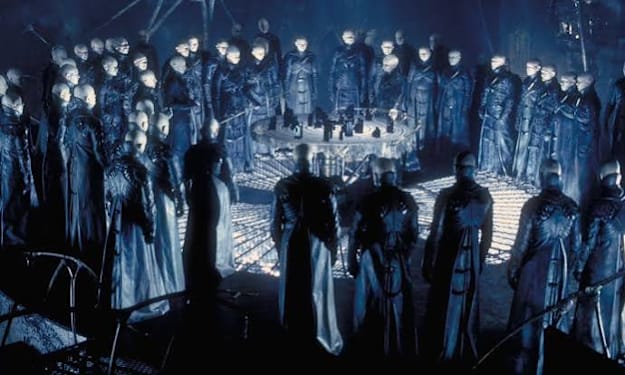
Why I Hate Being A Critic, or Why "Dark City" Sucks
One of the major problems with being a critic of any medium is the “cool yet problematic” piece. That is, that piece of art that has a lot of things going for it, but also has some pretty serious flaws. This can be a novel that has too much filler, a comic that ignores its own continuity, or even a painting where too much orange was used. The key is that the piece was otherwise a pretty awesome piece, but one or more elements ruin the whole thing.
By Jamais Jochim4 months ago in Critique
Fire I Wasn’t Ready to Hold. Top Story - June 2026.
If patience were a myth and I were the confidant of Prometheus, then I would be chained beside him; bound by the force of my own urgency, rushing toward a larger audience. My ambitions were molten. This story is a container for both my younger self and the self I forged later. I only came together after the explosion.
By Caitlin Charlton4 months ago in Critique
Inside Michael: When Artistic Vision Becomes Leadership
Recently, I went to see the film Michael with my girlfriend as a surprise — she has always been a devoted admirer of Michael Jackson. What I expected to be a simple cinema outing turned into something more reflective. To me, the film is not just a portrait of a global icon, it is an attempt to understand how artistic vision, when pushed to its limits, becomes a form of leadership. From the beginning, it reframes Jackson not only as a performer, but as a creative force driven by discipline, imagination and absolute control over detail. Fame is present but secondary. What matters is the architecture behind it. Imagination as foundation One of the most revealing aspects of the film is how it traces Jackson’s artistic identity through his influences. We see his fascination with Peter Pan, a symbol of eternal childhood and creative freedom. We also see his admiration for Charlie Chaplin, whose silent performances proved that emotion can exist without language. To me, these references are not decorative. They function like a blueprint for his artistic universe. The film suggests that Jackson’s creativity was never confined to music alone, it was built across disciplines: cinema, dance, theatre and visual storytelling. Leadership without hierarchy The film offers a different definition of leadership — one that has little to do with management or authority. Jackson leads through intensity, giving him a strong presence and an uncompromising demand for precision. During rehearsals, nothing is casual — everything is refined, repeated and reshaped until it reaches a very specific emotional and physical standard. This method produces excellence that reveals a world where “good enough” does not exist. The film also dismantles a common illusion — that genius is effortless. What we see instead is repetition, discipline, exhaustion, and constant self-correction. The discipline behind perfection Behind the spectacle, the film exposes what the audience never sees. Every movement, every transition and every sound is the result of countless adjustments. What appears spontaneous on stage is, in reality, the product of extreme preparation. This is where Jackson’s leadership becomes cultural rather than organizational. He does not simply guide a team — he raises the standard of an entire creative ecosystem around him. But the film does not ignore the cost. There is pressure in always being the reference point. There is weight in never being allowed to fall below your own legend. A fragile force What lingers most is the contrast between control and sensitivity. Jackson is portrayed as deeply emotional, sometimes vulnerable. Yet this fragility is not presented as weakness — it feels like the source of his artistic intensity. The film suggests that his creativity emerges precisely from this sensitivity: the ability to feel too much and to translate that excess into structured expression. This leaves us as the audience with an understanding at the center of his identity. — His discipline is shaped by emotion and shows his control born from vulnerability. In the end, Michael does more than revisit the legacy of Michael Jackson. It reframes him as a study in artistic leadership — one defined not by authority but by vision, obsession and the relentless pursuit of perfection. And it raises a quiet question: how far can creative leadership go before it becomes a burden as much as a gift?
By Baptiste Monnet4 months ago in Critique
The Novel That Bit Me. Honorable Mention in Not Quite There Yet Challenge.
Fir the Next Great (American) Novel challenge (which, despite the title, didnae actually huv tae be American), Ah hud two ideas an' two entries. Baith included Glasgow as almost a central character. One wis heavily inspired by Trainspotting by Irvine Welsh an' a real-life experience that happened many years afore Ah started writing.
By Paul Stewart4 months ago in Critique
The Fiction of Language
Introduction: Language Doesn’t Exist. It Is an Abstraction. The most unsettling thought in the philosophy of language may also be the simplest: language does not exist. At least it does not exist in the way tables, mouths, books, lungs, speakers or inscriptions exist. What we call “language” is an abstraction, a conceptual convenience, a story told about an immensely complex field of vocal habits, written marks, remembered formulas, shared expectations and institutional rules. It has no independent life outside the people who speak, write, hear, imitate, teach and reinterpret it. A language lives only in the fleeting acts by which individuals realize it. Once those acts stop, the language vanishes as a living system and survives, if at all, only as residue: inscriptions, recordings, dictionaries, grammars, paradigms and academic reconstructions. These remnants are not the language itself but its fossils. They preserve traces of a once-active practice, yet they cannot speak on their own. This fragility reveals a deeper truth. “Language” is not a thing but a collective fiction, a social agreement that treats a fluctuating multitude of utterances, dialects, sociolects and idiolects as though they formed a stable entity. Like money, law or the nation, language exists only because human beings continuously act as if it exists. Yet the consequences of this fiction are enormous. It shapes thought, memory, hierarchy, identity and power. It can survive for millennia in institutions while changing beyond recognition in the mouths of speakers. It can disappear in a single generation when a community ceases to transmit it. The study of language therefore becomes a paradoxical enterprise. Linguistics appears to investigate an object, but its object is not a thing. It is a process, a myth, a performance, a historical sedimentation of practices that have been falsely reified into an abstract noun. To think clearly about language is thus to begin by undoing the illusion that there is, somewhere behind all speaking, a self-subsisting entity called “language” waiting to be described.
By Peter Ayolov4 months ago in Critique
The Invention of the Word “Language”
Introduction The history of the word “language” is not merely the history of a term but the history of a conceptual transformation in the way human beings came to understand communication, power and themselves. At first glance the story seems simple enough. The English word language descends from Old French "langage" and ultimately from the Latin lingua, meaning both “tongue” and “speech,” a duality that preserves the ancient link between the physical organ of utterance and the symbolic system produced by it. Yet this etymological continuity conceals a far more radical historical shift. Human beings spoke long before they possessed any concept of language as an abstract object. For most of prehistory, there were only voices, cries, commands, songs, names, stories, rituals and practical acts of oral coordination. There was speech, but not yet “language” in the modern sense of a structured, codified, rule-governed system that could be separated from immediate acts of speaking and treated as an object of reflection, preservation, discipline and control. The emergence of that concept belongs not to the origin of speech itself but to the rise of writing, grammar, empire and the philosophical desire to turn living utterance into a stable order of signs. What begins as a practical instrument of communication gradually becomes a technology of abstraction and a mechanism of domination. The history of language is therefore inseparable from the history of linguistics, bureaucracy and political power, because “language” in its modern sense is not simply what humans speak but what civilizations invented in order to govern speech, preserve authority and transform the flux of voices into a manageable symbolic regime.
By Peter Ayolov4 months ago in Critique
Kanye West's Controversial San Antonio Concert Just Got A Major Update
Ye’s world is different. While he has shown his entire backside on multiple occasions, it seems like you can’t keep the man from exploring new avenues to gain revenue. He has a rabid fan base. He has the residual deposits and probably quiet money no one but Ye knows about. His ability to still create despite controversy is remarkable in and of itself.
By Skyler Saunders4 months ago in Critique
On the Basis of Morality
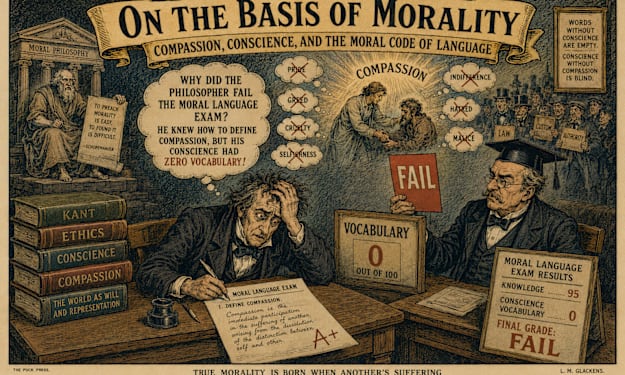
Introduction In Arthur Schopenhauer’s On the Basis of Morality (1840), the philosopher begins with a deceptively simple observation: preaching morality is easy, but establishing its foundation is extraordinarily difficult. Every civilization possesses ethical rules, duties, prohibitions and ideals, yet the question remains unresolved: where do these obligations originate? Are they written into nature, imposed by authority, inherited through custom, or merely preserved through language? The problem becomes even more difficult when one realizes that words themselves stand at a distance from reality. They do not replace things, events or states of affairs. Rather, they represent thoughts and feelings about those things. Human beings therefore inhabit a world mediated by symbols, concepts and interpretations. The search for morality becomes inseparable from the search for the limits of language and the limits of self-knowledge. Schopenhauer enters this debate through a critical examination of Kant, conscience, character and compassion, ultimately proposing a foundation of morality that is neither legal nor theological but profoundly human. His inquiry leads toward a vision in which ethics emerges from participation in the suffering of others and where conscience serves as a mirror reflecting the true nature of the self.
By Peter Ayolov4 months ago in Critique
The Objective Morality
Introduction Drawing on themes associated with C. S. Lewis’s The Abolition of Man, the writings of Heraclitus, Plato, Hegel, Adorno, Nietzsche, Havel, Solzhenitsyn and many others, this text explores a single recurring question: whether language can exist without a moral code and whether human beings can remain fully human once the ethical foundations embedded in speech, custom, memory and community are abandoned. Every powerful invention enters history accompanied by promises of liberation. The alphabet, the printing press, the newspaper, broadcasting, digital networks and artificial intelligence all appear as instruments of freedom. Yet every instrument capable of extending human power also extends human irresponsibility. A sword without discipline becomes violence; a political system without restraint becomes domination; communication without ethical limits becomes manipulation. The central concern is therefore not merely truth or falsehood, but the relationship between language and civilization itself. Human communities survive because speech carries inherited expectations concerning justice, obligation, dignity and belonging. Once these inherited structures are reduced to mere personal preference or biological reactions, language loses its capacity to connect generations and becomes only a technique for influence. The modern world often celebrates freedom from all limits, yet civilization itself may be understood as a collection of freely accepted limitations. The question is therefore not whether human beings can speak freely, but whether they can speak meaningfully without participating in a moral tradition larger than themselves.
By Peter Ayolov4 months ago in Critique
The Babbling Ape Behind the Mirror
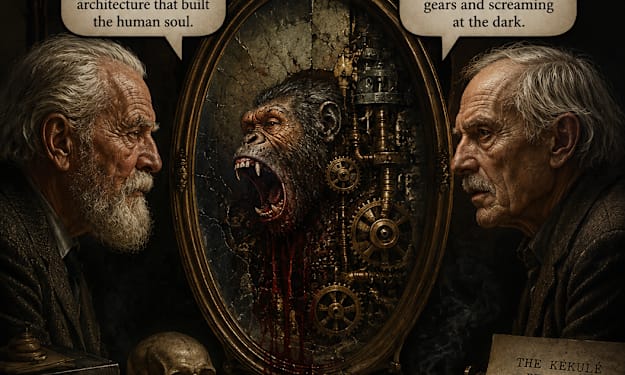
Introduction: The Joke Behind Intelligence For centuries humanity imagined itself as the unique bearer of reason. Philosophers described the human being as the rational animal, theologians as the image of God, and modern science as the possessor of consciousness. Yet the rise of artificial intelligence has produced an uncomfortable possibility. What if intelligence is not primarily reason at all? What if both humans and machines operate through a far simpler mechanism than we ever imagined? The mirror presented by artificial intelligence reveals something unsettling. Behind the apparent depth of thought, behind the majestic structures of philosophy, politics, religion, and science, there may exist nothing more than an extraordinarily sophisticated pattern-recognition system endlessly predicting what comes next. The machine predicts the next token. The human predicts the next word, gesture, expectation, and social response. Behind the mirror stands not a god but a babbling ape. Yet this ape has spent hundreds of thousands of years constructing civilizations out of its endless chatter. The modern Large Language Model therefore does not merely imitate humanity. It exposes humanity. It reveals that much of what we call meaning may be the product of recursive loops of linguistic prediction operating across generations. The great philosophical shock of artificial intelligence is not that machines are becoming human. It is that humans increasingly appear machine-like.
By Peter Ayolov4 months ago in Critique
Rage Against the Machine Learning: LLM Empire of Data
Introduction: In the Beginning Was the Prompt Every civilization creates the tools that eventually redefine its own purpose. The plough transformed agriculture and reduced the need for endless manual labor. The printing press transformed memory and reduced the necessity of memorizing entire libraries. The computer transformed calculation and rendered many forms of human arithmetic obsolete. Today humanity stands before another transformation, perhaps larger than any before it. The rise of Large Language Models represents not merely a technological innovation but the culmination of a linguistic civilization that has spent thousands of years constructing ever more complex systems of communication. Language began as song, gesture, rhythm, and collective survival. It evolved into philosophy, science, law, bureaucracy, and digital information. Now it appears to be reaching a strange destination: a form of machine intelligence capable of processing and reproducing linguistic complexity on a scale no individual human mind can approach. What if the ultimate purpose of complex language was never human understanding at all? What if language has been constructing a machine successor throughout history, a vast architecture of symbols whose final inhabitant is not humanity but the machine? The emergence of LLMs suggests a provocative possibility. As machines become increasingly capable of handling the burdens of knowledge, explanation, administration, and information management, humans may gradually abandon the exhausting labor of maintaining linguistic complexity. The future may not belong to ever more sophisticated speech but to its opposite. While machines inherit the empire of data, humans may rediscover play, storytelling, song, silence, humor, and simplified forms of communication. The paradox is startling. The more language becomes machine-like, the more human beings may become liberated from language itself.
By Peter Ayolov4 months ago in Critique
DJ Akademiks Goes Viral For Showing Off His Dramatic Weight Loss
Salute to my fellow content creator Akademiks for shedding some pounds. This looks like a positive chapter in his battle with overeating and not exercising. In his quest for stardom online, he has carved out a niche that few creators ever reach and even more yearn to achieve.
By Skyler Saunders4 months ago in Critique