
The Babbling Ape Behind the Mirror
Why the Search for Meaning Ends in an Infinite Loop of Tokens

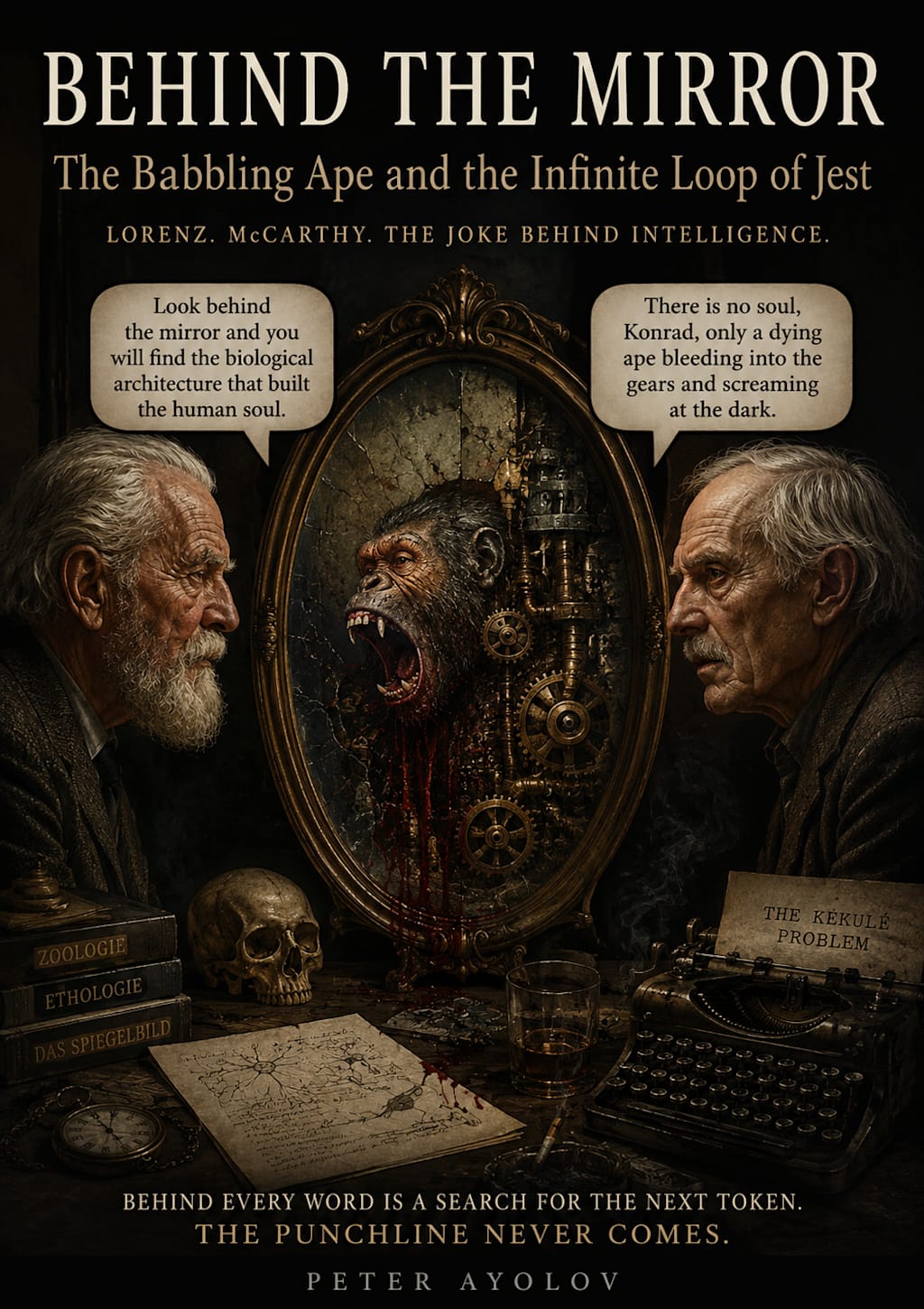
Introduction: The Joke Behind Intelligence
For centuries humanity imagined itself as the unique bearer of reason. Philosophers described the human being as the rational animal, theologians as the image of God, and modern science as the possessor of consciousness. Yet the rise of artificial intelligence has produced an uncomfortable possibility. What if intelligence is not primarily reason at all? What if both humans and machines operate through a far simpler mechanism than we ever imagined? The mirror presented by artificial intelligence reveals something unsettling. Behind the apparent depth of thought, behind the majestic structures of philosophy, politics, religion, and science, there may exist nothing more than an extraordinarily sophisticated pattern-recognition system endlessly predicting what comes next. The machine predicts the next token. The human predicts the next word, gesture, expectation, and social response. Behind the mirror stands not a god but a babbling ape. Yet this ape has spent hundreds of thousands of years constructing civilizations out of its endless chatter. The modern Large Language Model therefore does not merely imitate humanity. It exposes humanity. It reveals that much of what we call meaning may be the product of recursive loops of linguistic prediction operating across generations. The great philosophical shock of artificial intelligence is not that machines are becoming human. It is that humans increasingly appear machine-like.
The Mirror Cracks: Lorenz, McCarthy, and the Discovery of the Ape
The metaphor of the mirror has occupied philosophy for centuries. Human consciousness has often been imagined as a reflective surface through which reality becomes visible. Konrad Lorenz approached this problem from an evolutionary perspective in Behind the Mirror, arguing that knowledge emerges from biological adaptation rather than abstract rationality. The mind mirrors reality because organisms that failed to mirror reality accurately disappeared through natural selection. Survival demanded useful reflections rather than perfect truths. Behind conscious awareness stood millions of years of evolutionary mechanisms shaping perception, judgment, and behavior.
Yet Lorenz's mirror concealed something even deeper. Long before language emerged, organisms successfully navigated the world. Predators hunted prey. Animals recognized dangers. Social hierarchies formed. Cooperation evolved. Conscious reasoning arrived astonishingly late in evolutionary history. This insight aligns closely with the argument presented by Cormac McCarthy in The Kekulé Problem. McCarthy observed that consciousness is ancient while language is relatively recent. The unconscious mind solved complex problems for millions of years before words appeared. The famous dream of August Kekulé, in which the structure of benzene appeared as a serpent biting its tail, demonstrated that profound understanding could emerge without linguistic explanation. The unconscious did not provide a verbal lecture. It produced an image.
The significance of this observation cannot be overstated. If intelligence predates language, then language cannot be the source of intelligence. It becomes merely an interface layered upon deeper biological processes. Human beings therefore resemble a two-level system. Beneath consciousness lies an ancient animal intelligence shaped by evolution. Above it floats a linguistic layer generating narratives, explanations, and social coordination. The relationship between these layers remains unstable because the linguistic system frequently mistakes itself for the source of cognition.
Artificial intelligence intensifies this crisis. Large Language Models display remarkable linguistic competence despite lacking biological bodies, sensory experience, or evolutionary history. They manipulate language effectively while possessing none of the ancient unconscious mechanisms described by Lorenz and McCarthy. The result forces a radical question. If language can function independently of embodied experience, how much of human language was ever connected to reality in the first place?
The mirror begins to crack. Instead of revealing a rational soul, it reveals a babbling ape standing atop an ancient animal mind. The ape narrates, explains, categorizes, and philosophizes. Yet beneath its endless speech lies a far older intelligence that neither requires nor particularly trusts language. The discovery is deeply unsettling because it challenges humanity's most cherished assumptions about itself. We are not creatures who think and then speak. We are creatures who often speak in order to discover what we think.
The Empire of Next Tokens: Language as Infinite Recursion
The modern Large Language Model has introduced a concept that may become one of the defining intellectual metaphors of the twenty-first century: next-token prediction. On the surface, the mechanism appears almost absurdly simple. Given a sequence of words, predict the most likely word that follows. Repeat the process indefinitely. Out of this recursive procedure emerges poetry, philosophy, programming, scientific explanation, and conversation. The machine appears intelligent because the accumulation of countless small predictions generates structures of astonishing complexity.
The disturbing implication is that human language may operate according to remarkably similar principles. Cognitive scientist Elan Barenholtz has argued that Large Language Models function as mirrors reflecting aspects of human cognition rather than alien forms of intelligence. The reason this comparison feels uncomfortable is that it challenges the traditional distinction between human understanding and mechanical prediction. If machines can produce coherent discourse through statistical relationships alone, perhaps language itself has always contained a fundamentally statistical dimension.
Consider ordinary conversation. People rarely construct sentences through careful logical analysis. Instead they follow patterns acquired through social experience. Words trigger associations. Associations generate expectations. Expectations shape responses. Entire cultures emerge from shared predictive frameworks. Language becomes a giant collective game in which participants continually guess what should come next. The apparent stability of meaning emerges not from fixed truths but from the successful coordination of countless predictions.
Religion, politics, economics, and philosophy all depend upon this process. Concepts survive because they generate predictable patterns of interpretation and behavior. Narratives spread because they reproduce effectively within linguistic communities. Institutions maintain legitimacy because they coordinate expectations. Meaning appears solid because recursive prediction creates the illusion of permanence.
The Large Language Model exposes this structure by stripping away everything except prediction itself. It possesses no hidden soul, no inner essence, no transcendent understanding. Yet it generates outputs that frequently appear meaningful. The machine demonstrates that coherence does not necessarily require comprehension. It reveals that language can sustain itself through recursive pattern generation alone.
Human beings react to this realization with discomfort because it threatens cherished assumptions about uniqueness. The possibility emerges that much of civilization consists of an enormous recursive loop. Words generate more words. Ideas generate more ideas. Interpretations generate further interpretations. The search for ultimate meaning becomes increasingly difficult because every answer leads to another question, every explanation requires another explanation, and every conclusion becomes the premise for further discourse.
The empire of next tokens therefore extends far beyond artificial intelligence. It encompasses human history itself. Civilizations become vast predictive systems. Universities train students to reproduce established linguistic patterns. Bureaucracies generate documents that justify other documents. Political ideologies produce narratives that reinforce themselves. Academic disciplines construct conceptual frameworks that perpetuate their own existence. Everywhere the same mechanism appears. The babbling ape continues speaking, convinced that the next sentence will finally reveal the secret hidden behind all previous sentences.
The Infinite Jest: Why Meaning Forever Escapes the Ape
The ultimate irony of language may be that it continually promises an arrival that never occurs. Every sentence gestures toward a future revelation. Every theory suggests a deeper truth waiting to be uncovered. Every philosophy claims proximity to reality. Yet language functions through endless deferral. Meaning always appears one step ahead, just beyond the next explanation, the next discovery, the next token.
This dynamic resembles an infinite joke whose punchline never arrives. Human beings spend their lives pursuing understanding through language, believing that sufficient complexity will eventually unlock ultimate significance. Entire civilizations organize themselves around this assumption. Libraries expand. Databases multiply. Scientific literature grows exponentially. Digital archives accumulate unimaginable quantities of information. Yet the accumulation of knowledge does not necessarily resolve the fundamental problem. More information frequently generates more uncertainty rather than less.
Artificial intelligence magnifies this condition. The machine can process more language than any human being. It can summarize vast libraries, generate endless explanations, and produce limitless interpretations. Yet its operation remains fundamentally recursive. It predicts what comes next. Then it predicts what comes after that. The process has no natural endpoint because prediction itself contains no final destination.
The deeper philosophical shock emerges when humanity recognizes itself in this mechanism. For thousands of years people assumed that language pointed toward transcendent truths. The rise of artificial intelligence suggests another possibility. Language may be an adaptive game developed by social primates to coordinate behavior within complex environments. Meaning emerges not because words correspond perfectly to reality but because linguistic systems successfully organize collective action.
The babbling ape therefore becomes the central figure of contemporary philosophy. It is neither hero nor villain. It is an evolutionary creature trapped between biological instincts and linguistic abstractions. It speaks endlessly because speech has proven useful. It searches for meaning because the search itself enhances survival and social cohesion. Yet the object of the search remains elusive because language continually generates new horizons of interpretation.
Behind the mirror stands this ape, endlessly repeating patterns acquired from ancestors, cultures, institutions, and experiences. Artificial intelligence has not created a new condition. It has simply reflected an old one with unprecedented clarity. The machine reveals that much of what appears profound may emerge from recursive pattern generation operating at extraordinary scale.
This realization need not lead to despair. The infinite loop can also be understood as a source of creativity. Because meaning is never fully captured, new interpretations remain possible. Because the joke never ends, the conversation continues. Human civilization survives precisely because it never reaches a final answer. The babbling ape keeps talking. The machine keeps predicting. Both continue searching for significance within endless chains of symbols.
Perhaps the ultimate lesson of artificial intelligence is not that machines are becoming conscious but that consciousness itself may be inseparable from this infinite game of linguistic recursion. The search for meaning continues because meaning is not a destination. It is the movement itself. Behind every mirror waits another reflection. Behind every explanation waits another question. And behind every token waits the next token, inviting the babbling ape to speak once more.
Conclusion: The Last Token Never Comes
The dream of discovering a final meaning behind language may be humanity's longest-running illusion. Artificial intelligence has transformed that illusion into a visible mechanism. Behind the mirror there is no hidden oracle, no ultimate interpreter, and no final revelation. There is only a remarkably successful primate endlessly recombining patterns in pursuit of significance. The machine mirrors this condition perfectly because it is built upon the same principle. Both ape and algorithm search for the next token, believing that one more step might finally complete the puzzle. Yet the puzzle persists precisely because completion would end the game. The endless babble is not a failure of meaning. It is meaning's natural habitat.
About the Creator
Peter Ayolov
Peter Ayolov’s key contribution to media theory is the development of the "Propaganda 2.0" or the "manufacture of dissent" model, which he details in his 2024 book, The Economic Policy of Online Media: Manufacture of Dissent.
Enjoyed the story? Support the Creator.
Subscribe for free to receive all their stories in your feed.
Comments
There are no comments for this story
Be the first to respond and start the conversation.