
The Objective Morality
Language, Truth, and the Human Order

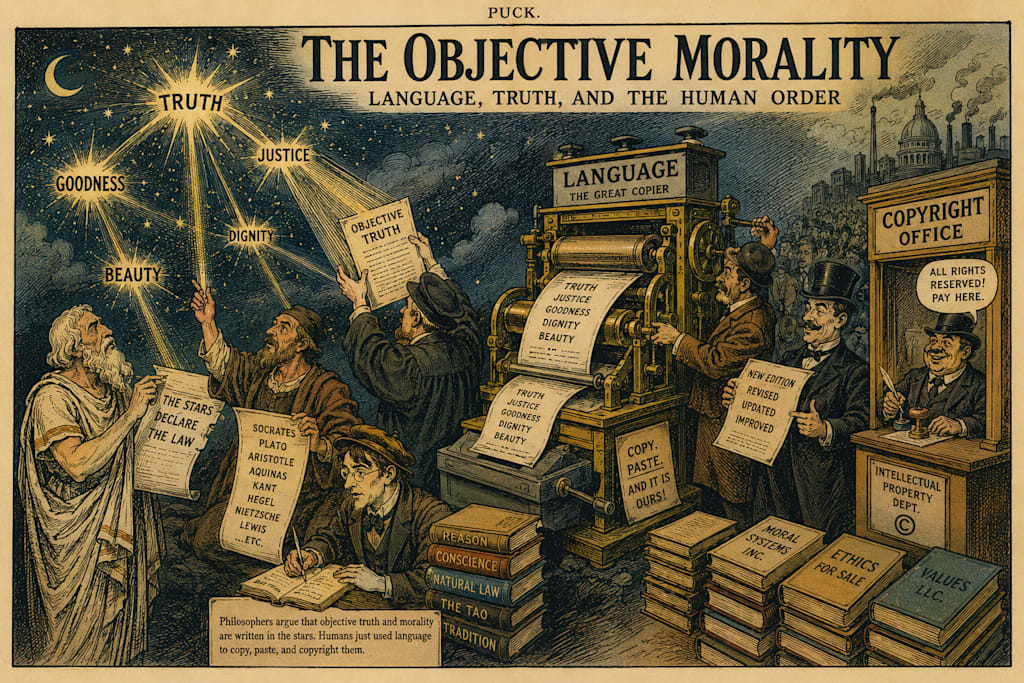
Introduction
Drawing on themes associated with C. S. Lewis’s The Abolition of Man, the writings of Heraclitus, Plato, Hegel, Adorno, Nietzsche, Havel, Solzhenitsyn and many others, this text explores a single recurring question: whether language can exist without a moral code and whether human beings can remain fully human once the ethical foundations embedded in speech, custom, memory and community are abandoned. Every powerful invention enters history accompanied by promises of liberation. The alphabet, the printing press, the newspaper, broadcasting, digital networks and artificial intelligence all appear as instruments of freedom. Yet every instrument capable of extending human power also extends human irresponsibility. A sword without discipline becomes violence; a political system without restraint becomes domination; communication without ethical limits becomes manipulation. The central concern is therefore not merely truth or falsehood, but the relationship between language and civilization itself. Human communities survive because speech carries inherited expectations concerning justice, obligation, dignity and belonging. Once these inherited structures are reduced to mere personal preference or biological reactions, language loses its capacity to connect generations and becomes only a technique for influence. The modern world often celebrates freedom from all limits, yet civilization itself may be understood as a collection of freely accepted limitations. The question is therefore not whether human beings can speak freely, but whether they can speak meaningfully without participating in a moral tradition larger than themselves.
Part I. The Moral Code of Language and the Burden of Civilization
Language functions not only as a tool for exchanging information but also as a repository of values accumulated through centuries of collective experience. Every civilization develops customs, stories, prohibitions, virtues and expectations that become embedded within ordinary speech. When people communicate, they do not merely exchange facts. They transmit assumptions about courage, shame, loyalty, responsibility, beauty and justice. The argument advanced by defenders of objective morality is that these values cannot be dismissed as arbitrary inventions without damaging the foundations of human life itself. If every judgment concerning good and evil becomes merely a statement of personal preference, then moral language loses its authority and society becomes increasingly dependent on power rather than persuasion. The critique of moral subjectivism therefore concerns more than philosophy. It concerns education, culture and the formation of character. Human beings require sentiments capable of supporting reason against impulse. Compassion, indignation, gratitude and reverence are not irrational obstacles to thought but conditions for civilized conduct. The rejection of inherited values often presents itself as liberation, yet it may instead produce individuals incapable of distinguishing between higher and lower purposes. Traditional morality appears in this perspective not as a rigid code imposed from outside but as a living structure that evolves while preserving continuity. Every attempt to construct an entirely new ethical order tends to borrow fragments from older traditions while denying their origins. The result is frequently ideological extremism, in which isolated principles are elevated into absolute doctrines. Civilization therefore depends upon a balance between freedom and restraint. Human beings inherit obligations together with rights. To reject all inherited responsibilities in the name of autonomy is ultimately to weaken the very conditions that make autonomy possible. The preservation of human dignity requires participation in a moral conversation extending beyond the individual moment and beyond the preferences of any single generation.
Part II. Truth, Lies, Public Opinion and the Theatre of Modern Communication
The relationship between truth and language is far more complex than the simple opposition between fact and falsehood. Human societies are built not only upon verified information but also upon myths, narratives, symbols, memories and shared interpretations. Public life operates through representations rather than direct encounters with reality. Newspapers, political speeches, social media platforms and cultural institutions create frameworks through which events become meaningful. Public opinion therefore functions less as a collection of objective facts than as an ongoing process of negotiation, persuasion and interpretation. The modern media environment intensifies this process by rewarding novelty, emotion and conflict. Sensational stories spread rapidly because they satisfy psychological desires for excitement, recognition and social status. The value of information often becomes measured not by its accuracy but by its capacity to attract attention. In such conditions truth risks becoming abstract, detached from lived experience and transformed into a symbolic weapon within ideological struggles. Communication increasingly resembles performance. Political slogans, media narratives and online identities operate through rituals of affirmation and opposition. The distinction between journalism, storytelling and propaganda becomes difficult to maintain because all depend upon narrative structures capable of organizing attention. The result is a public sphere dominated by dramatization. Moral outrage, fear and polarization become valuable resources within systems competing for visibility. Yet the text repeatedly returns to the idea that human beings cannot live entirely within abstraction. Concrete truth emerges through personal relationships, responsibility and direct experience. Public narratives may create communities, but they can also fragment them. The challenge is therefore not to eliminate stories but to recognize their power. Every society requires shared meanings, yet these meanings must remain connected to human realities rather than becoming self-sustaining spectacles. Communication should serve understanding rather than permanent mobilization. The deeper problem is not misinformation alone but the transformation of language into a mechanism whose primary purpose is influence. Once communication becomes detached from human order, trust weakens, memory fragments and public life increasingly resembles a contest of competing performances.
Part III. Freedom, Responsibility and the Search for Human Truth
The desire for unrestricted freedom often conceals a misunderstanding of freedom itself. Human beings do not become free by removing every limit. They become free through the disciplined development of character, judgment and self-knowledge. Language plays a central role in this process because it mediates the relationship between individual consciousness and collective life. Modern societies frequently promise liberation through consumption, technology and endless choice. Yet these promises may generate new forms of dependence. Attention becomes fragmented, memory becomes externalized and identity becomes increasingly shaped by systems designed to capture and direct desire. Against this tendency the text proposes a return to human order, not as nostalgia but as existential necessity. Genuine freedom requires responsibility. Truth-telling requires courage. Community requires mutual recognition. The examples of dissenters, philosophers and critics illustrate the importance of resisting systems that demand conformity to empty rituals. To live truthfully is not merely to repeat facts but to align speech, action and personal responsibility. This alignment remains difficult because language is always vulnerable to manipulation, self-deception and simplification. Nevertheless, human beings possess the capacity to transform communication into an instrument of self-knowledge. Philosophy, literature, poetry and sincere dialogue create spaces where individuals encounter both themselves and others. Such encounters resist the reduction of existence to ideology, spectacle or consumption. The highest forms of language do not dominate reality but illuminate it. They produce what some thinkers call the sublime or ecstatic truth: a mode of understanding that transcends mere factual description without abandoning reality altogether. Human beings require stories, but they also require reflection upon those stories. They need communities, yet communities capable of tolerating complexity. The future of civilization therefore depends less on technological innovation than on the preservation of ethical communication. Language must remain connected to memory, responsibility, dignity and care. Without these foundations freedom becomes emptiness. With them, communication becomes a means of creating meaning, sustaining culture and preserving the possibility of a genuinely human life.
Conclusion
The central lesson is that language is never neutral. Every word carries assumptions about reality, value and human purpose. The struggle over communication is therefore simultaneously a struggle over civilization itself. Objective morality may never appear as a perfectly articulated universal system, yet human societies repeatedly discover that they cannot survive without shared standards of conduct, trust and responsibility. Truth, freedom and community remain inseparable. A culture that abandons moral language risks losing not only ethical certainty but also its capacity for meaningful dialogue. The future depends upon recovering communication as an instrument of understanding rather than domination, a medium through which human beings remember who they are, what they owe to one another and why civilization remains worth preserving.
Lewis, C.S. (1943) The Abolition of Man. Oxford: Oxford University Press.
About the Creator
Peter Ayolov
Peter Ayolov’s key contribution to media theory is the development of the "Propaganda 2.0" or the "manufacture of dissent" model, which he details in his 2024 book, The Economic Policy of Online Media: Manufacture of Dissent.
Enjoyed the story? Support the Creator.
Subscribe for free to receive all their stories in your feed.
Comments
There are no comments for this story
Be the first to respond and start the conversation.