
The Fiction of Language
Speech, Power, and the End of Linguistics

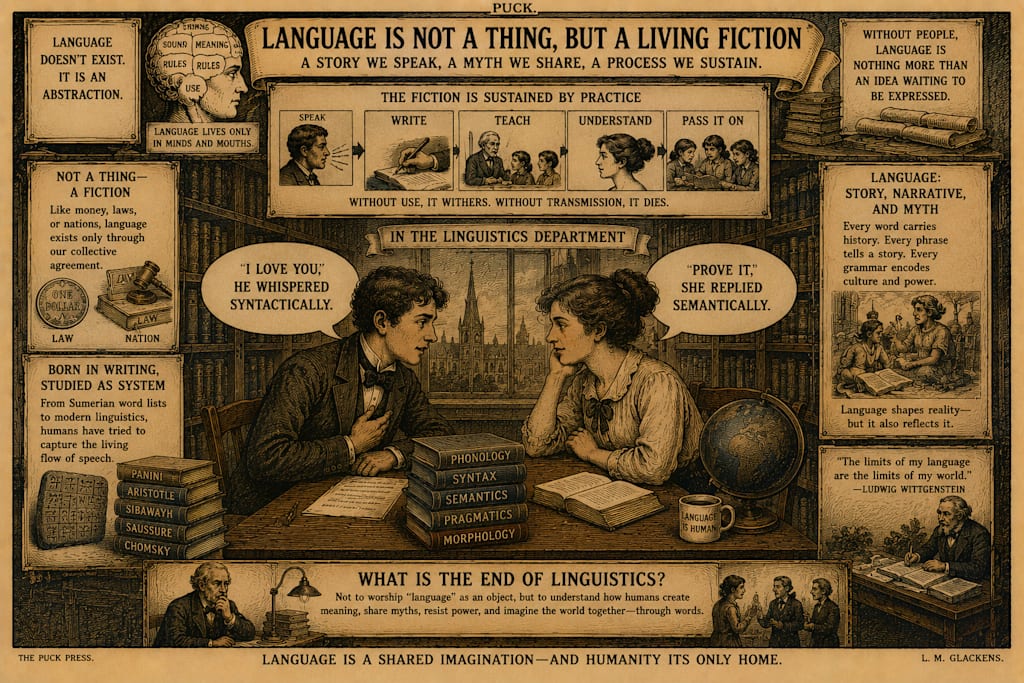
Introduction: Language Doesn’t Exist. It Is an Abstraction.
The most unsettling thought in the philosophy of language may also be the simplest: language does not exist. At least it does not exist in the way tables, mouths, books, lungs, speakers or inscriptions exist. What we call “language” is an abstraction, a conceptual convenience, a story told about an immensely complex field of vocal habits, written marks, remembered formulas, shared expectations and institutional rules. It has no independent life outside the people who speak, write, hear, imitate, teach and reinterpret it. A language lives only in the fleeting acts by which individuals realize it. Once those acts stop, the language vanishes as a living system and survives, if at all, only as residue: inscriptions, recordings, dictionaries, grammars, paradigms and academic reconstructions. These remnants are not the language itself but its fossils. They preserve traces of a once-active practice, yet they cannot speak on their own. This fragility reveals a deeper truth. “Language” is not a thing but a collective fiction, a social agreement that treats a fluctuating multitude of utterances, dialects, sociolects and idiolects as though they formed a stable entity. Like money, law or the nation, language exists only because human beings continuously act as if it exists. Yet the consequences of this fiction are enormous. It shapes thought, memory, hierarchy, identity and power. It can survive for millennia in institutions while changing beyond recognition in the mouths of speakers. It can disappear in a single generation when a community ceases to transmit it. The study of language therefore becomes a paradoxical enterprise. Linguistics appears to investigate an object, but its object is not a thing. It is a process, a myth, a performance, a historical sedimentation of practices that have been falsely reified into an abstract noun. To think clearly about language is thus to begin by undoing the illusion that there is, somewhere behind all speaking, a self-subsisting entity called “language” waiting to be described.
Part I. Language Is Not a Thing but a Social Fiction Sustained by Human Practice
The temptation to treat language as a thing arises because abstractions are useful. It is easier to speak of “English,” “Arabic” or “Mandarin” as though each were a unified object than to confront the reality that every such label covers an unstable multitude of pronunciations, registers, local dialects, class markers, generational shifts and individual habits of speaking. What we call a language is therefore already an act of simplification, a way of imposing unity upon heterogeneity. No one has ever encountered “English” in the abstract. One encounters only speakers, texts, voices, accents, grammatical expectations, jokes, errors, stylistic habits, legal norms, school exercises, dictionaries, literary canons and endless variation. The word English gathers these into a single conceptual basket and then persuades us that the basket itself is the real object.
Yet this object has no existence apart from the acts that sustain it. A language is not a container into which speakers pour words. It is the temporary pattern produced by their coordinated activity. If a community stops using a language, the language does not retire into a hidden metaphysical realm. It dies. What remains may be grammars, inscriptions or recordings, but these are analogous to footprints after the walker has vanished. They point toward a process that once took place; they do not continue it. The death of the last speaker of an endangered language therefore marks not merely a demographic event but the extinction of an entire mode of human world-making. The language ceases to be a living force and becomes an archaeological problem.
This fact also exposes the fictional nature of linguistic unity. Even while alive, a language is not one thing but many overlapping performances. Every speaker carries a personal version of it. Communities negotiate temporary conventions, but these conventions are never complete or final. Words shift, meanings drift, syntax loosens or tightens, prestige forms rise and fall, slang appears and evaporates. What keeps the fiction alive is not stability but mutual recognition. Language persists because speakers behave as if they are participating in the same symbolic order even while constantly altering it. The “same language” is thus less a shared substance than a moving compromise.
To call language a fiction does not mean it is unreal in the trivial sense. Fictions can govern reality. Nations, property, law and money are fictions too, yet they structure lives with tremendous force. Language belongs to this category of socially real abstractions. It has no independent substance, but it produces effects because communities continually reinvest belief in it. The word “tree” contains no treeness. It is an agreed sign, a conventional trigger that works because enough people have learned to respond to it in roughly coordinated ways. Language is therefore not a hidden object behind speech but the name we give to the fragile, repeated miracle by which human beings keep agreeing, however imperfectly, on how to make sounds and marks mean something.
Part II. Writing, Linguistics and the Reification of an Abstraction
If language is a fiction sustained by practice, linguistics begins at the moment this fiction is treated as an object worthy of preservation, codification and analysis. The history of linguistic thought is therefore also the history of reification, the process by which living speech is frozen into paradigms, lists, grammars and conceptual systems. Writing plays the decisive role in this transformation. Speech disappears as soon as it is uttered, but writing arrests the flow. It detaches words from speakers, stores them in durable form and invites reflection upon them as though they were stable entities. Once signs can be collected, compared and taught, it becomes possible to imagine that there exists behind speech a system called “language” which can itself be described.
This is why the earliest known linguistic texts emerge not from philosophical curiosity alone but from administrative and scribal necessity. The Sumerian-Akkadian word lists and paradigms from Mesopotamia may plausibly be regarded as the first documents in the history of linguistics because they reveal the moment at which a language no longer fully lived in everyday speech is preserved, translated and systematized for pedagogical use. Akkadian-speaking scribes needed access to Sumerian for legal, religious and scholarly reasons. In response, they produced lexical lists and grammatical paradigms, including elaborate documentation of verbal forms. These texts do not merely record vocabulary. They imply that language can be detached from use, broken into analyzable units, organized into paradigms and transmitted through schooling. In other words, they treat language as an object.
The same logic continues through later grammatical traditions. Panini’s Sanskrit grammar, Greek reflections on naming and rhetoric, Arabic grammatical science, medieval Latin studies and modern structural linguistics all deepen the separation between speech and language. Linguistics appears to study a pre-existing object, but in a crucial sense it also helps produce that object by stabilizing the fiction that beneath the unruly multiplicity of speaking there lies a coherent system. Saussure’s distinction between langue and parole formalizes the split. Langue is the structured system; parole is the individual act of speech. Yet this distinction, while analytically useful, also repeats the oldest act of abstraction in the history of linguistic thought: the elevation of the system over the performance.
What, then, is the end of linguistics? If language is not a thing, the ultimate purpose of linguistics cannot simply be the description of an object called language. Its task becomes more paradoxical and more profound. It studies the ways human beings stabilize and mythologize their own communicative practices. It examines how speech becomes codified into norms, how social groups maintain shared symbolic habits, how writing and institutions preserve dead or dying forms, how ideology hides inside grammar and vocabulary, how power is exercised through standardization, and how cognition, culture and memory are organized through these abstractions. Linguistics is therefore not merely a science of language but a science of one of humanity’s most successful collective fictions.
Part III. The End of Language and the Human Meaning of Its Abstraction
To say that language does not exist is not to diminish its power but to reveal the peculiar source of that power. Language dominates human life precisely because it is not a thing. It is a relation, a practice, a shared hallucination disciplined by repetition. Its existence depends on continuous reenactment, which means it is always precarious and always historical. Every language stands on the edge of disappearance. It must be taught to children, renewed in use, adjusted to changing circumstances and defended against neglect. Without this labour it collapses back into traces. Its reality is therefore inseparable from mortality, memory and transmission.
This fragility changes how one understands linguistic extinction. When the last speaker dies, a language does not merely lose one user; it loses the living horizon within which words had force, humour, ambiguity, rhythm and tacit social meaning. Recordings and dictionaries may preserve data, but data are not speech. They do not argue, seduce, pray, threaten, sing or misremember. They do not transmit a world. A dead language can be reconstructed, studied and even revived in partial form, but what has vanished is the unbroken chain of ordinary use through which abstraction was kept alive. The death of a language therefore dramatizes the truth that had always been present: language is not a substance stored in words but an event taking place among people.
This also clarifies the ideological dimension of linguistic study. Once language is treated as a thing, it can be owned, standardized, policed and used as an instrument of cultural authority. Official languages, school grammars, dictionaries and literary canons often present themselves as guardians of a natural order when in fact they are interventions into a fluid field of practice. They select one variety and elevate it over others. They turn living diversity into hierarchy. The abstraction of language thus enables both scholarship and domination. It allows communities to preserve memory and coordinate large societies, but it also licenses exclusion, correction and symbolic violence against those who do not speak in sanctioned ways.
Yet the dissolution of language into abstraction does not leave us with nothing. On the contrary, it returns us to the only place language has ever existed: human beings themselves. Language survives nowhere except in minds, mouths, ears, habits, rituals, texts read by someone, memories carried by someone, corrections imposed by someone, and misunderstandings negotiated by someone. Its end is therefore also its truth. The study of language ultimately becomes the study of human dependence on shared fictions, of the way communities build worlds out of repeatable signs, and of the strange fact that an entity with no independent substance can nevertheless organize cognition, history and power. Linguistics, at its most reflective, should culminate not in the worship of “language” as a quasi-natural object but in the recognition that language is one of the most elaborate abstractions humans have ever invented in order to speak, remember, govern and imagine together.
Conclusion
Language does not exist in the way things exist. It has no body, no independent life, no self-sustaining essence hidden behind utterance. It exists only as long as people enact it, teach it, remember it, standardize it, resist it, alter it and pass it on. The moment this ceases, language dissolves into inscriptions and artifacts, leaving behind only evidence that a shared fiction once animated a community. This does not make language trivial. It makes it one of the most powerful abstractions in human history: a myth sustained by practice, a social agreement capable of shaping thought, identity, law, memory and power while possessing no existence apart from those who keep performing it. The end of linguistics, if there is one, lies in understanding precisely this paradox: that what appears to be an object is really a process, that what seems fixed is perpetually remade, and that the study of language is ultimately the study of the human capacity to create realities out of nothing but shared signs and sustained belief.
Saussure, F. de (1916) Course in General Linguistics. Edited by C. Bally and A. Sechehaye. Translated by W. Baskin. New York: McGraw-Hill, 1959; Hockett, C.F. (1958) A Course in Modern Linguistics. New York: Macmillan; Deutscher, G. (2005) The Unfolding of Language. London: William Heinemann.
About the Creator
Peter Ayolov
Peter Ayolov’s key contribution to media theory is the development of the "Propaganda 2.0" or the "manufacture of dissent" model, which he details in his 2024 book, The Economic Policy of Online Media: Manufacture of Dissent.
Enjoyed the story? Support the Creator.
Subscribe for free to receive all their stories in your feed.
Comments
There are no comments for this story
Be the first to respond and start the conversation.