
On the Basis of Morality
Compassion, Conscience, and the Moral Code of Language

Introduction
In Arthur Schopenhauer’s On the Basis of Morality (1840), the philosopher begins with a deceptively simple observation: preaching morality is easy, but establishing its foundation is extraordinarily difficult. Every civilization possesses ethical rules, duties, prohibitions and ideals, yet the question remains unresolved: where do these obligations originate? Are they written into nature, imposed by authority, inherited through custom, or merely preserved through language? The problem becomes even more difficult when one realizes that words themselves stand at a distance from reality. They do not replace things, events or states of affairs. Rather, they represent thoughts and feelings about those things. Human beings therefore inhabit a world mediated by symbols, concepts and interpretations. The search for morality becomes inseparable from the search for the limits of language and the limits of self-knowledge. Schopenhauer enters this debate through a critical examination of Kant, conscience, character and compassion, ultimately proposing a foundation of morality that is neither legal nor theological but profoundly human. His inquiry leads toward a vision in which ethics emerges from participation in the suffering of others and where conscience serves as a mirror reflecting the true nature of the self.
Part I. The Problem of Moral Foundations and the Limits of Abstract Ethics
The central difficulty of ethics lies in its attempt to transform moral obligation into something universal. Human beings constantly ask what they ought to do, yet the answer is never as obvious as moral instruction suggests. One may feel compelled to act, but feeling compelled does not automatically establish duty. Laws, customs and social expectations often appear authoritative, yet their authority itself requires justification. Schopenhauer therefore examines the foundations of moral philosophy and finds them surprisingly fragile. Kant’s categorical imperative seeks to provide a universal rule by demanding that one act only according to principles that could become universal laws. Yet Schopenhauer argues that such a principle lacks genuine content. It offers a formal structure without explaining why individuals should care about morality in the first place. The result is a framework composed of highly abstract concepts detached from lived reality. It resembles a delicate web suspended in empty space, impressive in design but incapable of supporting the immense burden placed upon it.
The problem becomes even deeper when freedom enters the discussion. Moral responsibility traditionally presupposes freedom of the will. Yet human actions seem determined by character, circumstance and necessity. Every being acts according to its nature. What appears as choice may simply be the unfolding of an inner disposition under particular conditions. According to this perspective, character contains within itself all future manifestations, though these manifestations become visible only through time and experience. A person does not discover their character through abstract reasoning but through living. Actions reveal what was already latent within. Language itself participates in this revelation. Speech possesses tone, rhythm, humour, style and countless other qualities that express individuality. Through language, character becomes visible to others and eventually to oneself.
This understanding transforms the meaning of moral responsibility. Responsibility concerns not merely isolated actions but the being from which those actions emerge. Conscience therefore becomes less a judge of particular deeds and more a process of self-recognition. Through reflection upon actions, individuals gradually become acquainted with themselves. They learn what kind of person they are. The moral question shifts from “What should I do?” to “What am I?” This movement inward marks the beginning of a more profound ethical inquiry, one that seeks morality not in universal formulas but in the realities of human existence.
Part II. Egoism, Malice and the Discovery of Compassion
Having questioned abstract foundations, Schopenhauer searches for the actual motives behind human conduct. Every action requires an impulse. Human beings never act without reasons, desires or motivations. When these motives are examined closely, three fundamental sources emerge: selfishness, malice and compassion. Selfishness places the individual at the centre of concern. The self becomes the final goal of every action. Wealth, security, pleasure, recognition and survival all belong to this sphere. Closely related to selfishness are greed, avarice, gluttony and possessiveness. They express the animal side of existence, the drive toward self-preservation and self-advancement.
Malice represents a darker possibility. Here the individual seeks not merely personal benefit but the suffering of others. Envy, deceit, cruelty, vindictiveness and hatred belong to this domain. If selfishness reveals the animal dimension of human nature, malice reveals something almost demonic. Yet neither selfishness nor malice can provide a foundation for morality because both remain centred upon the self. Even when directed toward others, they preserve separation and opposition.
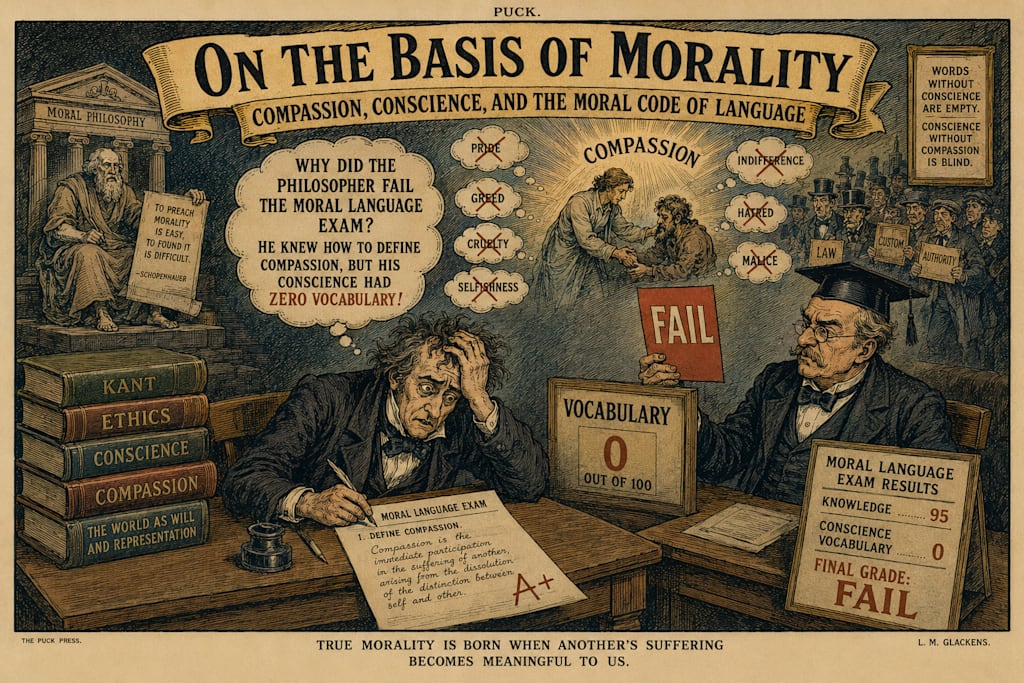
Compassion alone breaks this pattern. Compassion begins when the suffering of another person becomes significant to me. The boundary separating self and other weakens. I no longer regard another individual as a distant object but participate emotionally in their experience. Their pain becomes meaningful within my own consciousness. This participation does not erase individuality, yet it overcomes the absolute isolation on which selfishness depends. Through compassion, another person becomes a direct concern of my will. Their well-being acquires value independent of my personal advantage.
For Schopenhauer, this transformation constitutes the true basis of morality. Actions motivated by compassion possess moral worth because they arise without selfish calculation. Justice and philanthropy both originate from this source. The moral principle becomes remarkably simple: do no harm and help whenever possible. Compassion is not an abstract doctrine invented by philosophers. It appears across cultures, traditions and historical periods. It is recognised instinctively whenever people encounter suffering. Jean-Jacques Rousseau similarly observed that compassion tempers self-love and prevents the pursuit of self-interest from becoming destructive. Before reason formulates ethical systems, compassion already operates within the human heart.
This insight carries profound implications for language. Moral communication cannot emerge from commands, threats or formulas alone. It requires participation in the experiences of others. Language becomes ethical when it allows individuals to recognise one another as fellow sufferers rather than competitors or enemies. Compassion transforms speech from an instrument of power into a medium of human connection.
Part III. Conscience, Language and the Human Meaning of Morality
Compassion does not eliminate selfishness or malice. Instead, it introduces a counterforce capable of restraining them. Human beings remain divided creatures. They experience anger, envy, greed and hostility alongside sympathy and generosity. The role of conscience is to mediate this conflict. Conscience emerges gradually through experience, memory and reflection. It develops as individuals become increasingly familiar with their own character. Every important action leaves a trace. These traces accumulate, creating an internal record through which people judge themselves. Conscience is therefore not an external authority imposed from above but an intimate knowledge of one's own moral history.
This process reveals why self-deception remains so dangerous. Individuals often create comforting illusions regarding their motives and actions. Yet these illusions cannot endure indefinitely. Conscience preserves memory. It continually compares what a person believes about themselves with what they have actually done. Over time the discrepancy becomes impossible to ignore. The voice of conscience grows stronger whenever compassion is neglected and selfishness dominates. It reminds individuals that morality concerns not appearances but character.
The significance of this insight extends beyond personal ethics into the realm of communication. Modern societies often rely upon language detached from genuine human concern. Political rhetoric, bureaucratic procedures, ideological slogans and technological systems frequently operate without compassion. They seek efficiency, control or persuasion rather than understanding. Such forms of communication may be powerful, but they lack moral depth. They treat people as categories, audiences or instruments rather than as individuals capable of suffering.
Schopenhauer’s philosophy offers an alternative vision. Language acquires moral value only when it participates in compassion. Words become meaningful when they reduce distance rather than increase it. They must connect rather than dominate. Conscience and compassion together create a framework within which communication becomes genuinely human. Without them speech degenerates into manipulation, performance or empty repetition.
The broader lesson concerns civilization itself. Every society depends upon forms of communication that encourage recognition, trust and mutual concern. When these foundations weaken, language becomes increasingly mechanical. It may remain efficient, persuasive and technologically sophisticated, yet it loses its ethical centre. Morality cannot survive solely as law, doctrine or procedure. It requires individuals capable of seeing themselves in others and others in themselves. Compassion therefore serves not only as the foundation of ethics but also as the foundation of meaningful communication and social life.
Conclusion
Schopenhauer’s search for the basis of morality leads away from abstract principles and toward the lived reality of human experience. Neither authority, law nor rational formula can ultimately explain why moral actions matter. Only compassion succeeds because it overcomes the separation between self and other. Through compassion, morality acquires substance. Through conscience, individuals become aware of their own character. Together they reveal that ethical life is rooted not in power, fear or obligation but in the capacity to participate in the suffering and dignity of others. Morality begins when another person's pain becomes meaningful to us, and civilization survives only so long as language remains capable of expressing that truth.
Schopenhauer, A. (1840) On the Basis of Morality. Translated by E.F.J. Payne. Indianapolis: Bobbs-Merrill, 1965.
About the Creator
Peter Ayolov
Peter Ayolov’s key contribution to media theory is the development of the "Propaganda 2.0" or the "manufacture of dissent" model, which he details in his 2024 book, The Economic Policy of Online Media: Manufacture of Dissent.
Enjoyed the story? Support the Creator.
Subscribe for free to receive all their stories in your feed.
Comments
There are no comments for this story
Be the first to respond and start the conversation.