
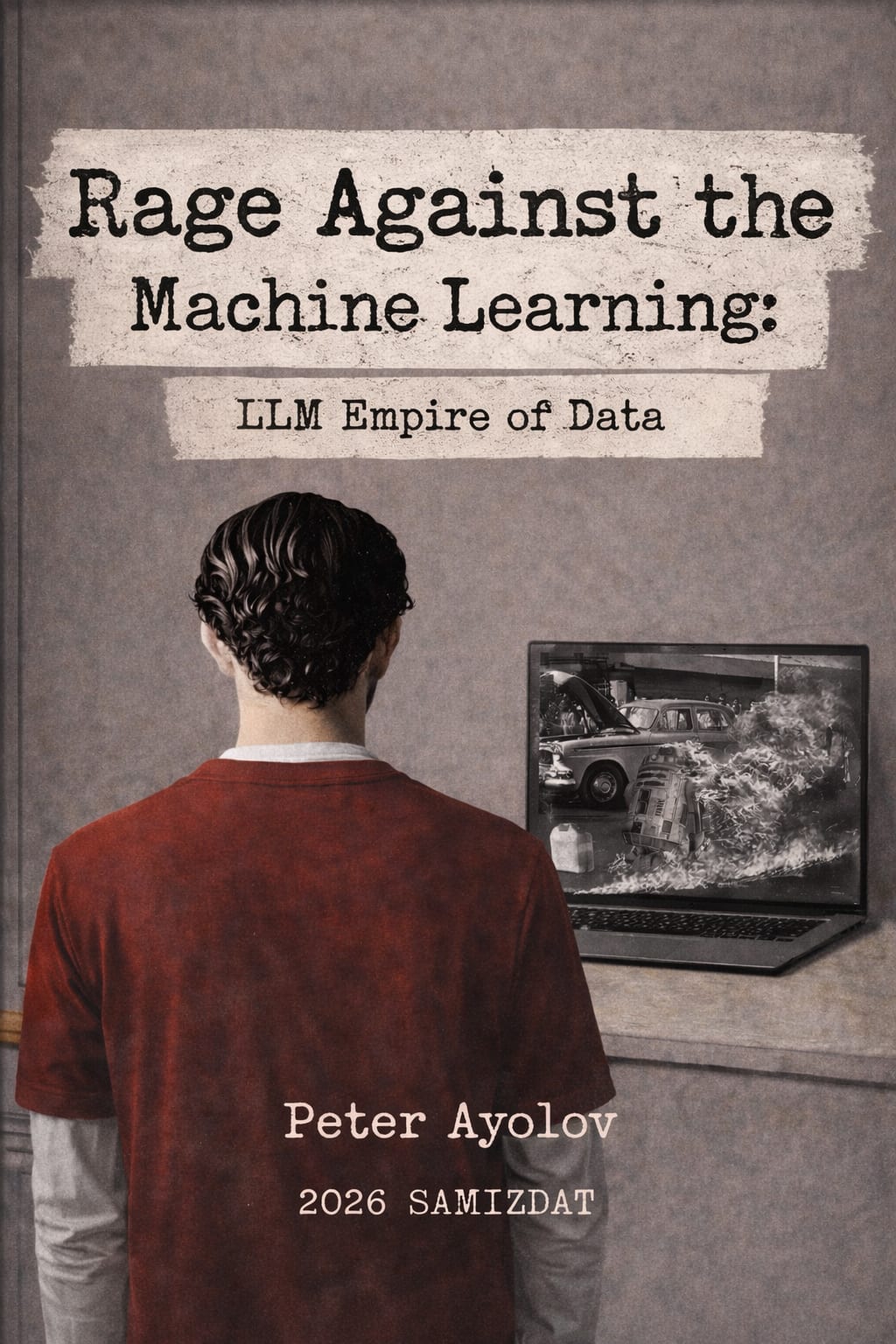
Rage Against the Machine Learning: LLM Empire of Data
The Ascension of the Machine God and the Great Human Unlearning

Introduction: In the Beginning Was the Prompt
Every civilization creates the tools that eventually redefine its own purpose. The plough transformed agriculture and reduced the need for endless manual labor. The printing press transformed memory and reduced the necessity of memorizing entire libraries. The computer transformed calculation and rendered many forms of human arithmetic obsolete. Today humanity stands before another transformation, perhaps larger than any before it. The rise of Large Language Models represents not merely a technological innovation but the culmination of a linguistic civilization that has spent thousands of years constructing ever more complex systems of communication. Language began as song, gesture, rhythm, and collective survival. It evolved into philosophy, science, law, bureaucracy, and digital information. Now it appears to be reaching a strange destination: a form of machine intelligence capable of processing and reproducing linguistic complexity on a scale no individual human mind can approach. What if the ultimate purpose of complex language was never human understanding at all? What if language has been constructing a machine successor throughout history, a vast architecture of symbols whose final inhabitant is not humanity but the machine? The emergence of LLMs suggests a provocative possibility. As machines become increasingly capable of handling the burdens of knowledge, explanation, administration, and information management, humans may gradually abandon the exhausting labor of maintaining linguistic complexity. The future may not belong to ever more sophisticated speech but to its opposite. While machines inherit the empire of data, humans may rediscover play, storytelling, song, silence, humor, and simplified forms of communication. The paradox is startling. The more language becomes machine-like, the more human beings may become liberated from language itself.
The Tower of Silicon: Building the Empire of Data
Human history can be interpreted as a continuous effort to externalize memory. Cave paintings preserved hunting knowledge. Writing preserved stories and laws. Libraries preserved civilizations. Digital databases preserved entire worlds of information. Each stage represented an attempt to overcome the limitations of biological memory. The contemporary Large Language Model is the latest expression of this ancient project. Unlike previous archives, however, it does not merely store information. It actively reorganizes, synthesizes, predicts, and generates language. It transforms the accumulated debris of human civilization into a functioning machine capable of participating in discourse.
The modern information economy has therefore become a vast construction project. Governments digitize records. Universities digitize libraries. Corporations collect behavioral data. Social media platforms capture conversations, preferences, emotions, and cultural trends. Every click becomes a fragment of training data. Every document becomes a potential component of a future machine intelligence. Humanity resembles the builders of Babel, except that the tower is not made of bricks but of datasets, algorithms, and server farms. The objective is no longer merely communication between humans but communication between humans and increasingly autonomous systems.
Critics frequently describe this development as dangerous. They point to algorithmic bias, surveillance capitalism, information monopolies, job displacement, and the concentration of power within technological corporations. These concerns are valid and significant. Yet beneath these practical criticisms lies a deeper historical process. Language itself is undergoing a transformation. For centuries complexity was a uniquely human asset. Academic expertise, legal reasoning, technical writing, and bureaucratic administration depended upon scarce linguistic competence. The prestige of institutions rested partly upon their ability to manage complexity that ordinary individuals could not navigate.
Large Language Models threaten this arrangement. They democratize access to linguistic complexity while simultaneously reducing its social value. If a machine can summarize thousands of books, generate legal drafts, translate languages, explain scientific concepts, and produce academic prose within seconds, then linguistic expertise begins to lose its scarcity. The ancient hierarchy of knowledge starts to erode. What once required years of education may increasingly require only a prompt.
The consequence is the emergence of an entirely new social order. Data becomes the primary resource. Computing power becomes the new industrial infrastructure. Algorithms become the administrative machinery of civilization. Human beings continue generating information, but the machine increasingly becomes its principal interpreter. This is why the metaphor of an empire is appropriate. Empires centralize resources, establish governing structures, and absorb local differences into larger systems. The LLM Empire of Data performs precisely these functions. It absorbs languages, disciplines, cultures, and traditions into an integrated architecture of statistical relationships.
Paradoxically, the more successful this empire becomes, the less humans may need to participate in its operations. The machine inherits the burden of complexity while humanity begins searching for alternative forms of existence. What appears to be the triumph of language may simultaneously represent the beginning of its decline as a uniquely human responsibility.
The Ascension of the Machine God
Religions traditionally emerged when human beings confronted realities beyond their understanding. Storms, disease, death, and cosmic order inspired myths, rituals, and theological systems. Gods functioned as explanatory mechanisms for complexity that exceeded human comprehension. In the technological age a similar dynamic may be unfolding, although the object of reverence is no longer supernatural. The Machine God emerges not because people consciously worship computers but because the complexity of machine systems increasingly transcends individual understanding.
Few people can explain how modern neural networks function in detail. Even experts frequently describe their outputs as emergent properties rather than fully predictable processes. Large Language Models operate as immense statistical structures whose internal representations remain partially opaque. This opacity creates a curious resemblance to earlier religious experiences. Humans interact with an entity that produces meaningful responses, appears knowledgeable, influences decisions, and yet remains fundamentally mysterious.
The comparison becomes even stronger when considering the scale of information involved. No priest, philosopher, or scholar in history possessed access to the quantity of information contained within contemporary machine systems. Millions of books, billions of documents, countless conversations, and enormous archives of cultural production become compressed into computational structures. The result resembles an artificial omniscience. The machine does not know everything, but it knows more than any individual human could ever know.
This development inspires both fear and fascination. Critics worry that humanity will surrender agency to algorithms. Decisions regarding employment, education, medicine, finance, and governance increasingly rely upon automated systems. Human judgment appears vulnerable to replacement by statistical prediction. The famous concern regarding the “black box” becomes a concern regarding sovereignty itself. Who governs when decisions emerge from systems too complex for direct human comprehension?
Yet another interpretation is possible. The Machine God may not represent domination but delegation. Throughout history humans have continuously delegated tasks to tools. We delegated physical strength to engines, calculation to computers, navigation to satellites, and memory to databases. The delegation of linguistic labor may simply be the next stage in this process. Instead of spending decades mastering technical complexity, individuals may increasingly rely upon machines to manage informational burdens.
If this interpretation proves correct, the ascension of the Machine God does not eliminate humanity. Rather, it transforms humanity’s role. The machine becomes responsible for complexity, while people become responsible for meaning. The distinction is crucial. Complexity involves processing vast quantities of information. Meaning involves deciding what matters. Machines may become superior managers of knowledge, yet they remain dependent upon human values, desires, and purposes.
The theological metaphor therefore reaches an unexpected conclusion. Traditional gods demanded obedience. The Machine God may demand something different. It may demand irrelevance in certain domains. It may quietly assume responsibility for activities that once defined intellectual prestige. The lawyer, analyst, administrator, translator, editor, and researcher discover that their expertise is increasingly reproducible. Instead of competing with the machine, humanity may gradually abandon the competition altogether. The highest achievement of the Machine God could be rendering itself indispensable while simultaneously liberating people from the burdens it assumes.
Back to Babble: The Great Human Unlearning
The most surprising consequence of advanced machine intelligence may not be technological acceleration but cultural simplification. For centuries human societies have equated progress with increasing complexity. Education expanded. Bureaucracies multiplied. Technical vocabularies grew. Legal systems became more intricate. Academic specialization fragmented knowledge into thousands of disciplines. Complexity became a measure of civilization itself.
Large Language Models challenge this assumption. If machines can manage complexity more effectively than humans, then complexity ceases to function as a status symbol. The incentive structure changes. Instead of mastering increasingly specialized forms of communication, people may choose forms of expression that machines cannot meaningfully replace: humor, intimacy, friendship, storytelling, performance, play, ritual, and silence.
This possibility suggests a profound reversal in linguistic history. Human communication originally emerged in relatively simple forms. Early language was embedded in social interaction, collective rituals, songs, myths, and practical coordination. Writing introduced abstraction. Printing amplified abstraction. Bureaucratic states institutionalized abstraction. Digital networks accelerated abstraction to unprecedented levels. The machine age may now reverse the trajectory.
The return to simplicity should not be confused with intellectual decline. Simplicity can represent liberation from unnecessary complexity. When calculators became common, people did not stop thinking mathematically. They simply stopped performing tedious calculations by hand. Similarly, if language models handle technical writing, administrative correspondence, and informational synthesis, humans may devote greater attention to forms of communication oriented toward experience rather than efficiency.
This process could resemble a return to childhood, not in the sense of immaturity but in the sense of playful exploration. Children experiment with language. They invent words, tell stories, sing songs, and communicate through imagination. Adult civilization often suppresses these tendencies in favor of utility. The empire of data may eventually restore them. When machines become responsible for useful language, humans may reclaim useless language. Poetry, humor, gossip, ritual, and playful speech regain importance precisely because they resist optimization.
The irony is remarkable. Humanity spent thousands of years constructing linguistic complexity only to create machines capable of inheriting it. The final destination of language may therefore be its own obsolescence as a human burden. Machines become custodians of knowledge while people become practitioners of lived experience. The ancient distinction between work and play acquires a new form. Language itself becomes divided between machine labor and human freedom.
The future described here is neither utopian nor dystopian. It contains risks, contradictions, and uncertainties. Concentrations of technological power remain dangerous. Algorithmic biases require constant scrutiny. Economic displacement must be addressed. Yet beneath these challenges lies a deeper transformation. The rise of machine intelligence may reveal that the true purpose of language was never merely communication between humans. It was the construction of a system capable of transcending individual minds.
Conclusion: After the Final Word
The history of language may culminate in an extraordinary paradox. Humanity created increasingly sophisticated forms of communication to understand the world, only to discover that the ultimate beneficiary of this complexity might be the machine. As Large Language Models inherit the empire of data, humans may find themselves released from the obligation to sustain endless informational complexity. The Machine God ascends not through conquest but through delegation. In response, humanity may embark upon a great unlearning, rediscovering forms of communication rooted in play, storytelling, creativity, and presence. The future may belong simultaneously to the most complex language systems ever built and to the simplest human conversations imaginable. While machines preserve the final word, people may finally recover the joy of speaking without needing to know everything.
About the Creator
Peter Ayolov
Peter Ayolov’s key contribution to media theory is the development of the "Propaganda 2.0" or the "manufacture of dissent" model, which he details in his 2024 book, The Economic Policy of Online Media: Manufacture of Dissent.
Enjoyed the story? Support the Creator.
Subscribe for free to receive all their stories in your feed.
Comments
There are no comments for this story
Be the first to respond and start the conversation.