
Why I Hate Being A Critic, or Why "Dark City" Sucks
Sometime you want a better movie than is produced. And,yes: There will be spoilers.

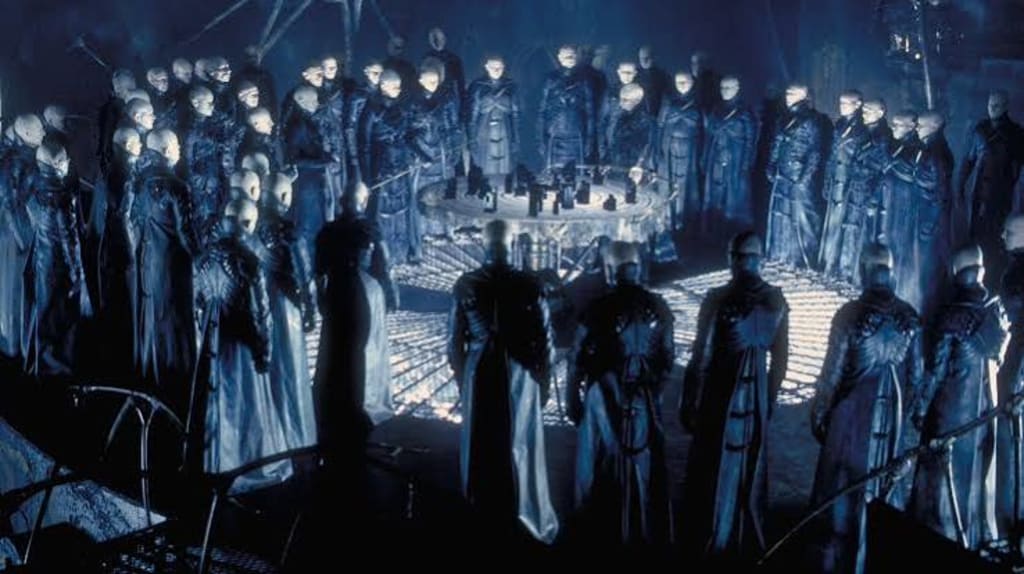
One of the major problems with being a critic of any medium is the “cool yet problematic” piece. That is, that piece of art that has a lot of things going for it, but also has some pretty serious flaws. This can be a novel that has too much filler, a comic that ignores its own continuity, or even a painting where too much orange was used. The key is that the piece was otherwise a pretty awesome piece, but one or more elements ruin the whole thing.
“Dark City” is an incredible movie, for the first two-thirds of the movie. The acting is superlative, the special effects work well, and the cinematography is incredible. The concept of aliens using their powers to conduct psychological experiments on an unsuspecting human population is the stuff of nightmares, and portrayed as such, especially when those aliens can reshape the very city itself and change the very memories of the test subjects. That is, a person can be a dedicated family man in a Victorian home and become a lonely drunk in a rundown apartment the next night, with all of his memories conforming to the new identity.
There’s a reason that the movie is one of the inspirations of “The Matrix.”
And then the final act happens.
Up until then, the movie has been running as a paranormal noir. Murdoch finds himself naked in a room with a murdered woman and must solve the mystery of her death. Detective Bumstead is after him, with the aliens following the case closely: Murdoch may be the culmination of their research and carry with him the secret that can save the race. Along the way, they meet Doctor Schreber, who is responsible for creating the false memories people are injected with each night. Murodch also meets Emma and the two fall in love.There’s even an alien implanted with Murdoch’s memories so that he can better guess what Murdoch’s going to do. Everything goes well until the Strangers (the aliens) grab Murdoch and take him to their lair.
At that point, Dr. Schreber is told to implant Murdoch with the collective memory of the Strangers, but implants him with a memory that makes him the equal of the aliens. That is, he gains telekinetic powers with full knowledge of how to use them. This leads to a telekinetic fight above the city which Murdoch wins and is then able to manipulate the city as he wishes. He creates a beach that he’s been fantasizing about, restarts his romance with a memory-swapped Emma, and turns the city towards the sun.
Therein lies the flaw: The movie ends after a climactic fight of good versus evil and then goes all sunny. That is, they’ve taken pains to establish that the movie has some serious gray with an alien race searching for a way to survive, and then when they’ve found that solution the movie all of a sudden becomes black and white with a prosaic happy ending. Instead of an ending where Murdoch becomes the savior of an alien race, the movie defaults to a standard action-movie ending.
I have no doubt that several viewers were admitted to an emergency room due to injuries incurred by the tonal whiplash.
You had a perfectly good paranormal noir that could have gone into some serious cosmic horror, but instead they went with a cliched ending where the human wins over the aliens and gets his Hollywood ending. If they had just stuck to the paranormal noir, then they would have had a much stronger movie: The themes introduced in the first two-thirds of the movie could have been explored in greater depth, the Strangers could have been looked at in greater detail, and the world as a whole could have been built up a lot more.
Instead of merely looking at cult status, “Dark City” could have been so much more. It’s definitely an influential movie, but only among film students and those looking for something weird.
And that’s what sucks about being a critic. Few critics hate movies; they may hate what film has become, sure, but that’s because they love the medium itself. Part of that love is that we want film to be all that it can be; while we accept all of film’s warts, it doesn’t mean we accept them without looking for the perfection we know is possible. It’s why so many film-lovers are beginning to hate CGI over practical effects, why so many of us love B-movies, why we still consider the Oscars to be relevant: We love the medium and want it to be better.
Yeah, we’re likely to be disappointed. But that’s just part of loving a medium that’s ever-changing and adapting to the newest technologies and techniques; film will always be a mix of the old and new, and it’s always interesting to see what it’s up to. Film can be fun to watch, and not just what’s on the screen.
About the Creator
Jamais Jochim
I'm the guy who knows every last fact about Spider-man and if I don't I'll track it down. I love bad movies, enjoy table-top gaming, and probably would drive you crazy if you weren't ready for it.
Enjoyed the story? Support the Creator.
Subscribe for free to receive all their stories in your feed.
Comments
There are no comments for this story
Be the first to respond and start the conversation.