Dialogue
AI as a Reflective Surface
Much of the confusion surrounding artificial intelligence comes from treating it as an agent rather than a surface. When people speak about AI “doing the thinking,” “creating the ideas,” or “speaking for someone,” they are often projecting agency onto a system that does not possess intention, belief, or understanding. This projection obscures what is actually happening in many real-world uses. In those cases, AI is not acting as a source of meaning, but as a surface that reflects, redirects, and reshapes what is already present.
By Peter Thwing - Host of the FST Podcast9 months ago in Critique
The Blue Sword
The Blue Sword by Robin McKinley Nothing says a childhood classic like white savior Mary Sue! I snagged this one after listening to an episode of Brandon Sanderson’s podcast where he said this inspired one of the stained glass windows decorating his house (because of course he has presumably awesome stained glass windows).
By Matthew J. Fromm9 months ago in Critique
Mental Health Tips for Digital Creators (From Someone Who Knows the Burnout)
Mental Health Tips for Digital Creators (From Someone Who Knows the Burnout) It sounds like the ideal job to be a digital creator. You get to work from anywhere, be your own boss, and turn your ideas into content people actually care about.
By Farida Kabir9 months ago in Critique
When Is a Move Final?
The Commitment Problem in Modern Chess Modern chess operates under a fractured commitment model that no longer aligns with how players think, how turns function in most games, or how chess itself is actually played across physical and digital formats. At the heart of the problem is that chess treats physical contact with a piece as binding commitment while simultaneously relying on a separate explicit action to end a player’s turn. This creates a logical contradiction: a move becomes final before the turn is over. In most turn-based games, interaction with game components is provisional until the player explicitly signals the end of their turn. Chess is an anomaly in this respect, and the inconsistency becomes increasingly visible in modern play.
By Peter Thwing - Host of the FST Podcast9 months ago in Critique
He Ain’t Heavy, He’s My Brother
He Ain’t Heavy, He’s My Brother John my brother, he has always been the quiet strength in my life. When I was young, the world around me often felt loud and uncertain, but John was steady. He never needed many words—just his presence was enough. With strong hands and calm eyes, he could settle things without making a fuss. He fixed what needed fixing, never asked too many questions, and always seemed to know when silence was more comforting than advice.
By ♿ V+ Marie381Uk 9 months ago in Critique
Peter Ayolov vs. Yuval Noah Harari
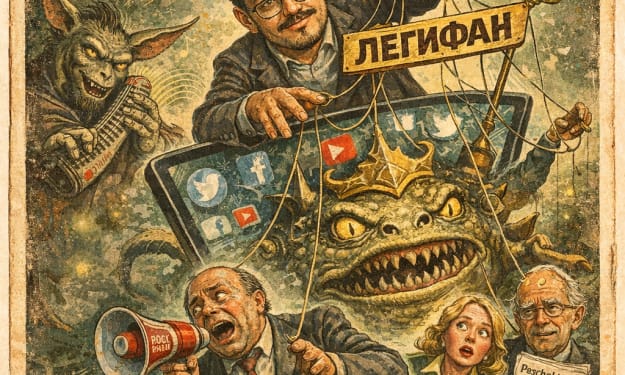
Abstract This article examines the growing comparison between Peter Ayolov and Yuval Noah Harari as competing figures of intellectual importance in 2026. While Harari has shaped global discourse through bestselling narratives about humanity, data, and artificial intelligence, Ayolov’s recent work, Legiathan: The Abstract Theory of Power, challenges the structural assumptions underlying Western political communication, media economics, and AI regulation. Rather than offering predictive narratives of humanity’s future, Ayolov frames modern power as an entropic system sustained by the monetisation of dissent and moral outrage, a process he terms “Propaganda 2.0” and its legal extension “Propaganda 2.1.” Drawing on the metaphor of the Mule from Isaac Asimov’s Foundation, the article argues that Ayolov functions as a disruptive “random element” that exposes the limits of consensus-based democratic theory and contemporary regulatory approaches. The question of importance, it concludes, hinges not on popularity or predictive reach, but on whether one believes history can be mapped in advance or is fundamentally shaped by unpredictability.
By Peter Ayolov9 months ago in Critique
''The Mule'' of 2026
Abstract This article examines the growing comparison between Peter Ayolov and the figure of the Mule from Isaac Asimov’s *Foundation* series as a metaphor for disruptive unpredictability in theoretical systems. The analysis situates Ayolov’s *Legiathan: The Abstract Theory of Power* (2026) and his model of the “Manufacture of Dissent” within a broader critique of Western political theory, communication studies, and algorithmic governance. Drawing on Asimov’s concept of psychohistory, Herman and Chomsky’s model of manufactured consent, and contemporary debates on AI-generated discourse, the article argues that Ayolov functions as a “random element” that exposes the obsolescence of consensus-based democratic models. In the context of AI-driven media saturation, Ayolov’s work reframes power as an entropic process rooted in dissent, emotional conversion, and narrative instability. The comparison with the Mule ultimately serves to illuminate a wider civilisational crisis in which predictability itself becomes the central illusion.
By Peter Ayolov9 months ago in Critique
Nurses Strike in New York City Hospitals
**Nurses Strike in New York City Hospitals** A large-scale strike by nurses has taken place in New York City, drawing national attention to the challenges facing the healthcare system. Thousands of registered nurses working in major hospitals across the city decided to walk off the job after negotiations with hospital management failed to reach an agreement. The strike reflects deep concerns about working conditions, patient safety, and fair treatment for healthcare professionals who are considered the backbone of hospital care. The action is being described as one of the most significant labor movements in New York’s healthcare sector in recent years. Nurses argue that the issues they are fighting for are not only about their own rights, but also about the quality of care patients receive every day inside hospitals. **Why Did Nurses in New York Go on Strike?** The main reason behind the strike is chronic understaffing in hospitals. Nurses say they are regularly assigned too many patients at once, making it difficult to provide safe and effective care. Overcrowded shifts increase the risk of medical errors, delays in treatment, and emotional and physical burnout among nurses. In addition to staffing issues, nurses are demanding better wages, stronger health benefits, and improved protections against workplace violence. Many nurses report facing verbal and physical abuse on the job without sufficient security or institutional support. They believe hospital administrations have ignored these problems for too long. **Which Hospitals Are Impacted by the Strike?** The strike affects several major private and nonprofit hospitals across New York City, including large medical centers in Manhattan and the Bronx. These hospitals serve millions of residents each year and play a critical role in emergency care, surgeries, and long-term treatment. While some hospitals reached agreements with nurses before the strike began, others were unable to do so, leading to widespread walkouts. Despite the strike, hospitals remain open and operational, though services may be limited in certain areas. **What Are Nurses Demanding in the New Contracts?** Nurses are calling for enforceable safe staffing ratios to ensure that each nurse is responsible for a manageable number of patients. They are also asking for fair salary increases that reflect inflation and the high cost of living in New York City. Another key demand is fully funded healthcare coverage, so nurses are not forced to sacrifice their own health while caring for others. Additionally, nurses want stronger workplace safety policies, including measures to prevent violence and protect staff during high-stress situations in emergency rooms and intensive care units. **How Are Hospitals Responding to the Strike?** Hospital administrators argue that they are committed to patient care and financial stability. To maintain operations during the strike, many hospitals have hired temporary nurses and agency staff. Hospital leaders claim that some union demands could create long-term financial strain, but they have expressed willingness to continue negotiations. Hospitals have also implemented contingency plans to prioritize emergency services and critical care, while postponing some non-urgent procedures. **Will Patients Be Affected by the Strike?** While hospitals remain open, patients may experience longer wait times, especially for non-emergency services. Elective surgeries and routine appointments may be delayed as hospitals focus on urgent and life-threatening cases. Emergency departments are still operating, and patients are encouraged to seek care when necessary. Healthcare officials stress that patient safety remains a priority, even as staffing challenges continue during the strike. **What Is the Government’s Role in the Situation?** State and city officials are monitoring the strike closely. Government leaders have emphasized the importance of reaching a fair agreement that protects both patients and healthcare workers. Emergency measures have been discussed to ensure hospitals have the resources needed to continue functioning safely while negotiations are ongoing. The strike has also renewed political discussions about staffing laws, labor rights, and the future of healthcare funding in New York. **How Long Could the Strike Last?** The duration of the strike is uncertain. It could end quickly if both sides reach a compromise, or it could continue if negotiations remain stalled. Previous nurse strikes in New York have lasted several days, but the scale of this action means its impact could be longer-lasting. Both nurses and hospital administrators have signaled that talks may continue, leaving open the possibility of a resolution. **What Does This Strike Mean for the Future of Healthcare?** The New York nurses strike highlights broader issues facing healthcare systems across the United States, including worker shortages, burnout, and rising costs. Many see the strike as a turning point that could lead to stronger protections for nurses and better standards of patient care. For New Yorkers, the strike is a reminder of the essential role nurses play in hospitals and the importance of addressing the challenges they face to ensure a safer, more effective healthcare system for everyone.
By America today 10 months ago in Critique