fiction
Mystery, crime, murder, unsolved cases. Contribute your own tales of crime to Criminal.
When the Dead Confined His Crime. AI-Generated.
The rain beat mercilessly against the glass facade of Neo-Tech Industries, reflecting the neon lights of the city below. Inside the penthouse office, the atmosphere was dead silent. David Vance, a brilliant but reclusive software engineer who had revolutionized artificial intelligence, lay slumped over his futuristic glass desk. A half-empty glass of whiskey sat near his lifeless hand. There were no signs of a struggle, no forced entry, and no visible wounds. To the untrained eye, it looked like a tragic heart attack. But Detective Marcus Vance, a man who believed that perfection in a crime scene was the first sign of foul play, knew better. A Message from the Void As the forensics team moved around the room, the massive LED screen on the wall suddenly flickered to life. The automated lights in the office dimmed, and a synthesized voice echoed through the speakers. "If you are watching this, it means my heart has stopped beating," the voice announced. The screen displayed a pre-recorded video of David Vance himself, sitting in the very chair where his body now rested. The suspects gathered in the room—David’s business partner, his ex-wife, and his chief security officer—gasped in horror. "I know you are looking for a killer," the digital apparition of David continued, a cold smile on his face. "But there is no murderer to hunt. I chose to end my own life. I poisoned the whiskey. My final act was my own destruction." The video cut to black. The room erupted into murmurs of shock and relief. It seemed like an open-and-shut case of suicide. The dead man had confessed to his own demise. The Flaw in the Confession Detective Marcus didn’t join the sigh of relief. He stood before the now-blank screen, his eyes narrowed. He walked over to the desk, careful not to disturb the evidence, and looked at the half-empty glass of whiskey. Then, he looked at David’s corpse. "It’s a perfect confession," the junior officer whispered. "The victim himself told us what happened." "Too perfect," Marcus replied, his voice dripping with skepticism. "A man who plans his suicide down to a timed video message doesn't make simple, sloppy mistakes." Marcus began his interrogation of the three people who had access to the penthouse that evening: The Greedy Partner: Simon Drake, who was about to be ousted from the company by David due to embezzlement. The Bitter Ex-Wife: Elena Vance, who was fighting a losing legal battle over David’s multi-million-dollar tech patents. The Tech-Savvy Security Chief: Victor Cross, the only man who knew how to bypass the penthouse’s state-of-the-art biometric security. Decoding the Deception Marcus spent the next few hours reviewing the video file and the physical evidence. He called everyone back into the office as the clock struck midnight. "Technology is a wonderful tool," Marcus began, pacing the room. "It can simulate life, recreate voices, and apparently, allow the dead to confess. Simon, Elena, Victor... you all thought that video was David’s final word. But the dead man didn't confess to suicide. He was forced to play a part in a digital illusion." Marcus pointed to the screen. "I had our cyber-crimes unit analyze the video file. It wasn't recorded weeks ago. The metadata shows it was rendered and uploaded to the local server exactly forty-five minutes after David’s estimated time of death. It’s a Deepfake—an incredibly advanced AI-generated video using David’s past interviews and voice samples." The suspects looked at each other, panic rising in their eyes. "To create such a perfect replica in such a short time requires two things," Marcus continued, stepping toward Victor Cross, the security chief. "First, access to David’s private server containing his high-definition vocal and facial data. Second, a specific piece of hardware that can process that data immediately." The Unmasking Victor tried to maintain his composure. "Detective, I am the security chief. Anyone could have hacked the server. You can't pin this on me." "I haven't even mentioned the physical evidence yet, Victor," Marcus said with a sharp smile. "You see, the Deepfake video showed David drinking from the whiskey glass with his right hand. But David Vance was fiercely left-handed. A detail a hacker might miss, but someone staging a scene in a hurry would completely overlook." Marcus walked directly to Victor's security console. "When you poisoned his drink and he died, you realized the security cameras would show you entering the room. So, you wiped the camera footage and used David’s own AI software to create the 'suicide' video to cover your tracks. But you made one final, fatal mistake." Marcus reached into Victor’s jacket pocket and pulled out a high-capacity encrypted flash drive. "The rendered video file is still saving its backup log onto this drive. Your digital fingerprint is all over the code." Victor’s face drained of color. He looked at the chair where David’s body had been, realizing that his attempt to make the dead man speak had ultimately silenced his own freedom. The Final Judgment As Victor was led away in handcuffs, Marcus took one last look at the empty penthouse. The rain outside had finally stopped, and the city lights seemed a little brighter. The killer had tried to rewrite reality using lines of code and artificial voices, but human error had ruined the perfect script. The dead man hadn't confessed to a suicide; instead, through the flaws left behind by his killer, he had pointed a finger from beyond the grave to demand justice.
By Yasmine Yessou5 months ago in Criminal
The Secret of the Abandoned Cemetery. AI-Generated.
The forgotten cemetery of Willow Creek sat on a desolate hill, choked by overgrown ivy and hidden behind a rusted iron gate that hadn’t been opened in fifty years. The locals believed the place was cursed, a sanctuary only for owls and memories. But on a foggy Tuesday morning, the ancient silence of the graveyard was shattered by a gruesome discovery that had nothing to do with ghosts, and everything to do with cold-blooded murder. The Fresh Earth among the Ancient Stones Detective Julian Vance stood before a crumbling Victorian mausoleum, his trench coat damp from the morning mist. He wasn't looking at the centuries-old headstones; his eyes were fixed on a patch of freshly turned earth beneath a weeping willow tree. A stray dog had dug up part of the soil, revealing the edge of a expensive leather shoe. When the police forensic team finished digging, they uncovered the body of Marcus Sterling, a wealthy real estate mogul who had gone missing three days prior. He had been strangled, his expensive watch and diamond ring still intact on his cold body. "It wasn’t a robbery," Julian muttered, kneeling by the edge of the pit. "The killer brought him here for a reason. This place is invisible to the world. Whoever did this needed time, and they knew nobody came here." The Three Mourners Marcus Sterling was a ruthless businessman who made enemies as easily as he made money. As Julian began his investigation, three suspects with deep connections to the victim quickly emerged: The Desperate Partner: Arthur Pendelton, Marcus’s business partner. The company was on the verge of bankruptcy due to Marcus's secret, reckless investments. Arthur had the most to lose if Marcus lived. The Estranged Daughter: Clara Sterling, who had been completely cut out of her father's multi-million-dollar will just a week before his disappearance. She was known to frequent the woods near Willow Creek. The Faithful Assistant: Edward Finch, a quiet man who endured years of public humiliation and abuse from Marcus. He was the last person seen with him on the night he vanished. All three had motives. All three lacked verifiable alibis for the night of the murder. But Julian knew that a crime scene always tells a story that suspects try to hide. The Clue in the Mud Julian returned to the abandoned cemetery under the cover of dusk. He walked around the grave site with a high-intensity flashlight, studying the surrounding environment. The ground was muddy from recent rain, but the heavy footsteps of the police had ruined most of the tracks. However, Julian wasn’t looking at the ground. He was looking at the old iron gate. Near the lock of the rusted gate, caught on a sharp metal vine, was a small, torn piece of high-quality silk fabric. It was a deep navy blue. Julian carefully placed it into an evidence bag. He then walked back to the grave and noticed something else—a broken branch of a wild berry bush directly above where the killer had stood to dig. The berries were crushed, leaving a distinct, bright purple stain on the nearby stone. Unearthing the Truth The next morning, Julian gathered the suspects at the local precinct. The room was tense, the air thick with suspicion. "Marcus Sterling thought he could hide his sins, and his killer thought they could hide his body," Julian began, his voice echoing in the quiet room. "The abandoned cemetery seemed like the perfect canvas for a perfect crime. No witnesses, no cameras, just old graves." Julian turned his gaze toward Arthur Pendelton. "Mr. Pendelton, you claim you were at home sleeping. But your luxury car has navigation data showing you drove toward the Willow Creek woods that night." "I went for a drive to clear my head!" Arthur protested, his face turning red. "That proves nothing!" "You're right," Julian said calmly. "But this does." He pulled out the evidence bag with the navy blue silk. "This fabric was torn from a very expensive tailored suit jacket. The exact fabric of the suit you are wearing right now, Arthur. But that's not the piece of evidence that seals your fate." Julian walked closer, pointing at Arthur’s leather shoes. "The soil in that abandoned cemetery is highly acidic, mixed with the juice of crushed wild berries from the bushes surrounding the grave. When you dug that grave in the dark, you stepped on those berries. You tried to clean your shoes, but the chemical reaction between that specific acidic soil and the berry juice creates a permanent stain on premium leather that cannot be washed away." Arthur looked down at his shoes. Under the bright fluorescent lights of the interrogation room, a faint but undeniable purple-gray tint was visible along the seams of his leather footwear. The Final Confession Arthur’s defiance collapsed. He sank into his chair, covering his face with his hands. "He was going to ruin me," he whispered hoarsely. "He stole the company's funds. If he didn't die, I would have lost everything. I thought nobody would ever look in that forgotten place." "Every grave holds a secret, Mr. Pendelton," Detective Julian Vance said quietly as the officers stepped forward to handcuff the killer. "But the earth always finds a way to speak." The secret of the abandoned cemetery was finally laid to rest, leaving Willow Creek to return to its silent, peaceful slumber.
By Yasmine Yessou5 months ago in Criminal
The Mystery of the Blood on the White Dress. AI-Generated.
The winter of 1924 was the coldest Blackwood Manor had ever seen, but the chill inside the grand estate had nothing to do with the weather. Lord Arthur Sterling was found dead in his study, a silver letter opener plunged deep into his chest. Yet, it wasn’t the gruesome nature of his demise that paralyzed the household with fear. It was the young woman standing in the center of the room: Evelyn Sterling, his beautiful, soft-spoken niece. She was wearing a breathtaking, pristine white silk gown—except for a shocking, violent splatter of crimson stretching across the bodice. The Scene and the Silent Suspect When Detective Thomas Vance arrived, the atmosphere was thick with tension. The grandfather clock ticked loudly, marking the seconds of an agonizing silence. Evelyn sat on a velvet sofa, staring blankly ahead, refusing to speak a word. "She was found just like this, Detective," whispered the butler, his hands trembling. "Standing over him. The dress tells the whole story." Detective Vance, a man who trusted logic over appearances, approached the scene carefully. He knelt beside Lord Sterling’s body. The wound was deep, and the blood pool on the Persian rug was extensive. Vance then turned his attention to Evelyn and her stained white dress. He examined the pattern of the blood carefully. It wasn't a smear; it was a distinct, high-velocity spray. A House Full of Secrets Vance knew that in a house as wealthy as Blackwood, motives were as common as the dust motes dancing in the fireplace light. He began his interrogations. The Bitter Brother: Charles Sterling, Arthur’s younger brother, stood to inherit the entire estate if Arthur died without a direct heir. He claimed to be in the billiard room all evening, but a fresh scratch on his hand suggested otherwise. The Scorned Housekeeper: Mrs. Gable, who had served the family for thirty years, had recently been removed from Arthur's will. She was noticeably calm, almost relieved by the tragedy. The Silent Niece: Evelyn, who stood to inherit nothing but had lived under Arthur's strict, tyrannical control for years. "Why won't she speak?" Vance muttered to himself, pacing the study. He looked back at the white dress. In a room filled with shadows, that dress was a beacon of light, yet it carried the ultimate mark of guilt. Or did it? The Flaw in the Canvas Vance called everyone back into the study. The fire crackled, casting long, dancing shadows on the mahogany walls. "A crime scene is like a canvas," Vance began, his voice calm but commanding. "And the killer always leaves a signature. Most of you look at Miss Evelyn and see a guilty woman caught red-handed. The blood on her white dress seems to be the definitive proof." He walked over to Evelyn, who finally looked up, her eyes wide with a mixture of terror and sorrow. "But blood behaves according to the laws of physics, not human emotion," Vance continued, pointing to the crimson pattern on the silk. "Lord Sterling was stabbed while sitting in his armchair. The killer stood directly over him. The blood spray from such an action would travel downward and outward." Vance then turned sharply toward Charles Sterling. "If Evelyn had stabbed her uncle from that angle, the blood would have coated her sleeves and the lower half of her dress. Instead, this pattern is a perfect, horizontal spray across the chest. Furthermore, there is a clean, unblemished line right through the middle of the blood splatter, as if something—or someone—was blocking part of the spray." Unmasking the Truth Charles shifted uncomfortably, his face paling. "What are you implying, Vance? The girl is covered in blood!" "I am implying, Charles, that Evelyn did not stab her uncle," Vance said, stepping closer to him. "She entered the room after the deed was done. When she saw her uncle, she rushed to his side. But the killer was still here, hiding behind the heavy velvet curtains. As the killer lunged to escape, he collided with Evelyn. The killer, who was wearing a heavy wool coat, brushed against her, transferring the fresh blood from his own clothes onto her pristine white dress. The clean line on her dress matches the exact width of a coat lapel." Vance reached out and grabbed Charles’s right arm, pulling back the sleeve of his jacket. Beneath it, hidden hastily, was a dark wool coat, still damp with blood. "You killed your brother for the inheritance, Charles. You thought the white dress would make Evelyn the perfect scapegoat. But the blood didn't lie; it told us exactly where you stood." Aftermath As the police led a shouting, cursing Charles away into the freezing night, the heavy silence of Blackwood Manor finally broke. Evelyn looked down at her ruined white dress, a single tear escaping her eye. The mystery was solved. The white dress, once a symbol of innocence turned into a canvas of crime, had ultimately become the very key that unlocked the truth.
By Yasmine Yessou5 months ago in Criminal
The Killer Confessed Everything… Then We Discovered He Had Been Dead for a Week. AI-Generated.
Detective Elara Vance was not a woman prone to flights of fancy. In the hardened world of Blackwood City Homicide, she dealt in blood, bone, and the cold, hard logic of forensics. The neon lights of the city outside her office window were blurred by a persistent, freezing rain that seemed to soak directly into the old precinct’s walls. It was 3:17 AM when her computer chimed, a notification slicing through the rhythmic thrum of the downpour. It was an email. Not unusual. But this was from an address that had gone silent six months ago, belonging to a man named Elias Thorne. Thorne had been the prime suspect in the disappearance of Julianne Croft, a local artist. The case had gone cold after Thorne vanished into the city's shadows. Elara opened the email. It was a single file: a video confession. She clicked play. Elias Thorne appeared on screen, his face gaunt, his eyes hollowed out by what looked like sleepless nights and profound regret. The background was an nondescript, dimly lit room. He began to speak, his voice a ragged whisper. "It’s over, Elara. I can’t live with it anymore. She’s... she’s in the cellar of the old textile mill. Fourth pillar, under the loose stones." He looked directly into the camera, a tear escaping. "I loved her, you know. But the argument... I snapped. I need this to be finished." The video ended abruptly. Elara was already reaching for her jacket. Within the hour, Elara and a forensic team were tearing through the abandoned textile mill on the industrial outskirts. It was a cavernous, terrifying space, smelling of rust and decay. They found the cellar. They found the fourth pillar. And they found Julianne Croft, her body perfectly preserved in the cool, dry earth exactly as Thorne had described. "It’s a match," the medical examiner confirmed an hour later. Elara was triumphant. The cold case was closed. All that remained was to hunt down Thorne. But as dawn broke over the city, the true darkness of the case began to reveal itself. While the search for Thorne intensified, a sanitation worker reported a vehicle abandoned in a secluded ravine ten miles outside the city limit. It was Thorne’s car. And in the driver's seat was Elias Thorne himself, dead from a self-inflicted wound. Elara arrived at the scene, the win from the night before evaporating. "Must have been immediate remorse after the confession," she muttered to the ME, Aris Thorne, no relation. But Aris shook his head, looking at the rigor mortis and the decomposition. "Elara... no." "What do you mean, no?" "He didn't just die. Based on liver temperature and larval activity... this man has been dead for at least eight to nine days." The world tilted. "That’s impossible," Elara argued. "He confessed. He sent me a video last night." "I can show you the samples, Elara. The biology doesn't lie." Aris was adamant. Elara Vance now stood in a vortex of contradiction. She had a video confession timestamped at 3:17 AM that morning. It contained precise, intimate details known only to the killer—details she had verified herself. Yet the man who made the confession had been a corpse in a ravine for over a week before the video was even created. Her focus shifted from closure to madness. Who was on that screen? A perfect deepfake? Unlikely; the emotional nuances were too complex for current AI. A body double? Julianne's details were too specific. The tech team analyzed the video's metadata. It was clean. It claimed to be recorded the previous afternoon. But the ME's timeline was ironclad. Elara went back to the cellar in the mill. She searched not for Julianne, but for clues about how Julianne was found. Embedded deep in the soil where Julianne had lain, she found a small, almost invisible glass vial. A sample of the drug inside revealed a potent compound designed to suspend decomposition. It was rarely used outside specialized medical research. And Elias Thorne’s call logs? The final call was not to an accomplice or the press. It was to a prestigious research lab, specifically to the cellular biology division. A horrifying hypothesis emerged. Elias Thorne knew he was dying. Perhaps he had planned this bizarre theatrical curtain call. He had found Julianne’s location somehow, perhaps from the real killer, or perhaps he was the killer but had prepared for his death. Maybe he had recorded the video weeks ago, leaving it in the hands of someone—a third party—who was instructed to wait for a signal, or who had the technical expertise to timestamp it deceptively. But if Thorne was already dead, who sent it? Elara Vance looked out at the rain. The case against Elias Thorne was legally closed, the confession undeniable. But the mystery of Body No. 13 (the official, grim designation of the unnamed victim from her previous difficult case) felt simple compared to this metaphysical puzzle. Was the city itself haunted, or had technology simply enabled a ghost to deliver justice? She would never truly know, and that chill was far colder than the Blackwood rain.
By Yasmine Yessou5 months ago in Criminal
Body No. 13. AI-Generated.
The rain in Blackwood City never just fell; it punished. It washed over the grime of the neon-lit streets, masking the sins of the night but failing to cleanse the chill that had settled deep into Detective Edward Vance’s bones. At 3:14 AM, his phone had buzzed with a tone he had learned to dread. Now, he stood inside the sterile, fluorescent-lit confines of the county morgue, the smell of formaldehyde and copper hanging heavy in the air. Dr. Aris Thorne, the chief medical examiner, was already waiting. He pulled back the white sheet of the stainless-steel table, revealing the pale, lifeless form of a young man. "What do we have, Aris?" Vance asked, his voice a low rumble. "Male, mid-twenties. Found by a sanitation worker in an alley off 4th Street," Aris replied, his tone clinical yet laced with an underlying unease. "No wallet, no phone, no tattoos. The fingerprints aren't in the database. But it’s not how he died that’s going to keep you up tonight, Edward. Look at his wrist." Vance stepped closer, his eyes narrowing. Tied securely around the victim's left wrist was a thick, black plastic tag. Written on it in bold, permanent marker was a single identifier: BODY NO. 13. "The John Doe protocol?" Vance muttered. "No," Aris shook his head, a grim expression chilling his features. "The city morgue logs haven't even processed him yet. This wasn't put here by my staff. Whoever killed him left this tag as a calling card. And Edward... we haven't found bodies one through twelve." The Paper Trail The realization hit Vance like a physical blow. A serial killer was operating in his city, completely under the radar, and this was their first deliberate declaration of war. Back at his desk, surrounded by cold coffee cups and a mountain of missing persons reports, Vance began to dig. If this was Body No. 13, the previous twelve had to exist somewhere. He shifted his focus from recent homicides to unexplained disappearances over the past two years. He looked for a pattern—unremarkable people who slipped through the cracks of society. Runaways, unhoused individuals, overnight travelers. By noon, a terrifying pattern emerged. Twelve people had vanished from the tri-state area within eighteen months, all sharing one commonality: they had all been plaintiffs or witnesses in a high-profile corporate corruption case involving Vanguard Pharmaceuticals, a company that had allegedly tested experimental drugs on vulnerable populations. The case had been abruptly thrown out a year ago due to a "lack of evidence" and the sudden disappearance of key witnesses. The man on the slab, Vance discovered through a stroke of luck and facial recognition software, was Julian Vance (no relation)—a disgruntled former IT specialist at Vanguard who had recently threatened to leak confidential servers to the press. The Trap is Set Vance knew he was dealing with an organized, cold-blooded fixer—someone hired to clean up Vanguard’s messes. Leaving the "Body No. 13" tag wasn't just arrogance; it was a final status report to the employer, a grim receipt of a job completed. Using Julian’s encrypted laptop, which Vance’s tech team managed to recover from the victim's apartment, they found an unsent email scheduled to go out to an anonymous journalist. It contained a set of GPS coordinates pointing to an abandoned industrial warehouse on the outskirts of Blackwood. "It's a trap," his partner, Detective Miller, warned as they geared up. "The killer knows we’d find the laptop." "It's the only lead we have," Vance replied, checking his service weapon. "And I'm not letting Body Number 14 happen." Face to Face with the Ghost The warehouse was a cavern of rusted iron and shadows. Rain drummed violently against the corrugated metal roof, drowning out the sound of their footsteps. Vance and Miller split up, moving through the gloom with flashlights drawn. A floorboard creaked above them. Vance swung his light upward, catching the silhouette of a figure in a heavy dark trench coat. "Police! Don't move!" Vance yelled. The figure didn't run. Instead, a calm, distorted voice echoed through the warehouse. "You're late, Detective. I expected you hours ago." A sudden flash of gunfire shattered the darkness. Miller went down with a cry, clutching his shoulder. Vance dove behind a concrete pillar as bullets chipped away at the stone. He waited for the rhythm of the shooter—three shots, a pause, two shots. On the next pause, Vance pivoted and fired three rounds into the darkness. A heavy thud echoed through the room. Vance advanced cautiously, his flashlight beam cutting through the dust. The shooter lay slumped against a stack of wooden pallets, a bullet wound to the chest. It was Thomas Wright, the head of security for Vanguard Pharmaceuticals—and a former black-ops operative. Clutched in Wright's bleeding hand was a roll of black plastic tags, exactly like the one found on Julian’s wrist. Next to him lay a burner phone, its screen still glowing with a text message sent to an encrypted number: Task complete. Portfolio closed. The Unfinished Ledger Wright died before the ambulance arrived, taking the exact locations of bodies one through twelve to his grave. Weeks later, the scandal tore Vanguard Pharmaceuticals apart. Executives were arrested, and the corporate empire crumbled under the weight of the federal investigation triggered by Vance's findings. It was a victory for justice, but for Vance, the victory tasted like ash. Every night, he would sit in his office, staring at the photograph of the black tag labeled BODY NO. 13. The system had been cleaned up, but twelve souls were still out there, buried in unmarked graves, waiting to be found. The case was closed, but the haunting of Blackwood City had just begun.
By Yasmine Yessou5 months ago in Criminal
Dolya: The Pakhan wears heals. AI-Generated.
“_Privet_, Rodger. Did the shipment clear?” Clementine’s voice was ice over silk. She adjusted the cuff of her Dior blazer with her free hand, watching Bangkok traffic crawl 30 floors below. No one in the fashion house beneath her knew their CEO was on the phone with a container yard full of illegal AKs.
By Bianca Holder5 months ago in Criminal
A Perilous Inheritance
The age of twenty, while at adulthood, is still a young and tender age. College age and old enough to vote, but still a year shy of legally having a cold one while watching a sporting event. Cassie Carver's at that very age of twenty, but a lot of unexpected things have happened to her lately. The sudden and shocking death of Cassie's uncle, Matthew Carver, four months prior, was heartbreaking; she was close with her uncle Matthew since her childhood.
By Clyde E. Dawkins5 months ago in Criminal
The Killer Caught After 40 Years by DNA. AI-Generated.
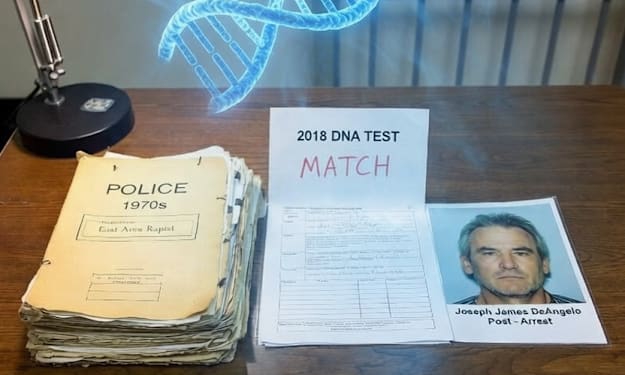
The Killer Caught After 40 Years by DNA In the 1970s and 1980s, a man brought fear to many homes in California. He moved quietly at night. He watched families for weeks before he struck. People called him different names over the years – the East Area Rapist, the Original Night Stalker, and later the Golden State Killer. He broke into houses, tied up couples, and did terrible things. He killed 13 people and hurt many more. For over 40 years, no one knew who he was. Then, one simple new idea with DNA changed everything. It started in small towns and cities across California. First, he was known as the Visalia Ransacker. He broke into homes in the daytime when people were out. He stole small things like photos, jewelry, and coins. In 1975, he shot and killed a man named Claude Snelling right in front of his young daughter. That was the start of worse things to come. By 1976, the crimes got much scarier. In the Sacramento area, a man started attacking women and couples at night. He would sneak into a house after watching it for days. He carried a gun and a knife. He tied up the man with special knots and put plates or cups on the man's back. If the man moved, the dishes would fall and make noise. Then he would attack the woman. He often stayed for hours, eating food from the fridge and talking in a strange, low voice. He said things like "I have to do this" or "I'm sorry." After he left, he sometimes called the victims later to scare them more. Police worked hard but could not catch him. He was smart. He wore gloves and a mask. He left very few clues. Sometimes he took bikes or cars to get away fast. The attacks moved from north to south in California. By the early 1980s, he had killed several couples in their homes. One night in 1986, he killed a young woman named Janelle Cruz. That was his last known crime. After that, he just stopped. Many people thought he died or went to jail for something else. Years passed. Families of the victims waited for answers. Detectives kept the files open. Old evidence like blood, hair, and other body samples sat in police storage. In the past, testing DNA was hard and slow. It did not always work well. But by 2018, things changed. A new way called genetic genealogy appeared. It used DNA from crime scenes and matched it with family trees on big websites like GEDmatch. A smart detective team tried this idea. They took DNA from one of the old crime scenes. They put it into the genealogy site. It found some distant family members. Then, they built a family tree step by step. They looked at old records, school photos, and addresses. It pointed to one man: Joseph James DeAngelo. He was 72 years old and lived a quiet life in Citrus Heights, near Sacramento. DeAngelo had been a police officer in the 1970s. He worked in places where some attacks happened. Later, he worked in a store selling tools. He had a wife and daughters. To neighbors, he seemed like a normal older man who kept to himself. He liked to ride his bike and fix things. On April 24, 2018, police watched his house. They picked up a trash can he left out. They tested DNA from something inside. It matched the DNA from the crimes perfectly. They arrested him that same day. The news spread fast. "Golden State Killer Caught!" headlines said. People who lived through the fear years ago could not believe it. In court, DeAngelo looked small and old. He did not fight the charges much. In 2020, he agreed to tell the truth about his crimes to avoid the death penalty. He pleaded guilty to 13 murders and other bad acts. He admitted to hurting dozens more people. The judge gave him life in prison with no chance to get out. Ever. Why did he do it? No one knows for sure. Some said he had anger inside from his past. He was in the Navy and worked as a cop, but he lost his police job after he stole a hammer and dog repellant from a store. Maybe that started his anger. In his house, police found many stolen items from old crimes – rings, coins, and other small things he kept for years. The DNA method that caught him was new. Before, police needed a direct match in their criminal database. But this killer was never in that system for these crimes. Genetic genealogy looked at family DNA instead. It helped solve many old cases after this one. Now, police use it more carefully with rules to protect privacy. For the victims and their families, it brought some peace. One survivor said it felt like the monster finally had a face. People who lost moms, dads, sisters, and brothers could close a painful chapter. But the pain never fully goes away. Many still remember the fear in California towns. Doors stayed locked. Lights stayed on at night. This story shows that bad people can hide for a long time, but truth can come out. Science and hard police work finally won after 40 years. Joseph DeAngelo died in prison later, but his name lives as a warning. One man caused so much hurt. Yet, the bravery of survivors and the work of detectives gave justice in the end. Today, if you walk in quiet California neighborhoods, some older people still talk about those dark years. They remember the phone calls, the strange noises at night, and the man who seemed to disappear like a ghost. But thanks to a small bit of DNA and smart thinking, the ghost got caught. The case changed how police hunt old criminals. It gave hope to families with unsolved cases. "Never give up," many say now. Even after 40 years, the answer can come. (Word count: about 1020)
By Hafiz afridi5 months ago in Criminal