
“My Best Friend Was Killed With the Gift I Gave Him. Then I Found His Note.”
The police said debt. The widow said nothing. The partner said too much. Only a dead man told the truth.
The elevator doors opened on the ninth floor. The hallway smelled of lilies and bleach, mixed. A bitterness settled at the back of my tongue. I didn’t stop walking.
Marian stood beside the portrait, murmuring to a man I’d never seen before. She caught sight of me, and the corner of her mouth twitched — acknowledgment, nothing more. The man turned. Early forties, gray suit, cufflinks shaped like horseshoes. He sized me up the way an appraiser looks at old furniture.
I approached the altar, picked up three sticks of incense, and had to flick the lighter twice to get a flame.
The portrait was of Andy from five years ago, before the drinking started. Clear eyes. My fingers brushed the rim of the incense burner, ash landing on the back of my hand. I didn’t wipe it off. Three bows. My knees cracked on every dip — I’d thrown out my back during last month’s move, and it still hadn’t healed.
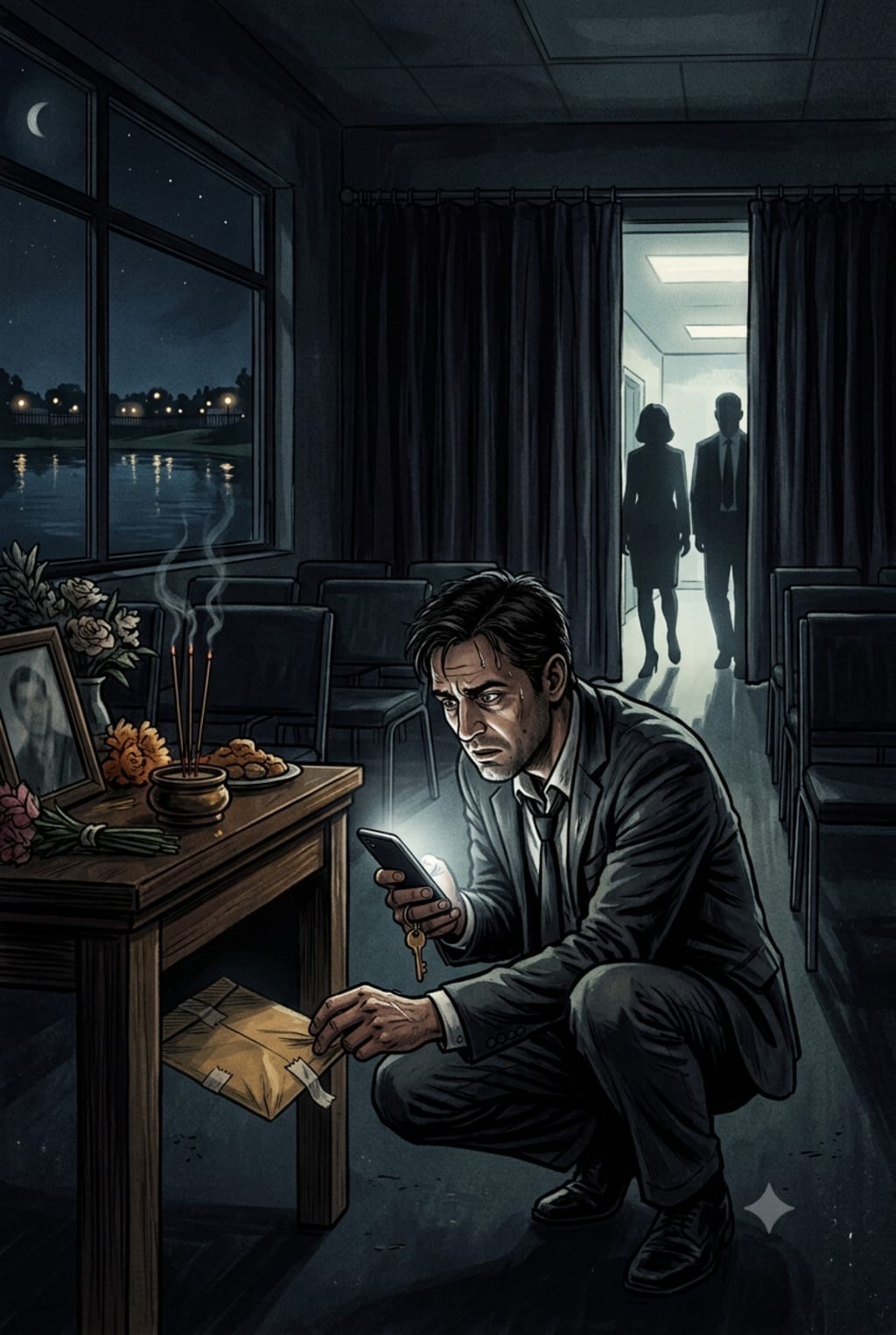
Straightening up, I spotted the corner of a manila envelope sticking out from under the offering table, taped to the underside. Classic Andy. He always hid important things in plain sight, said that was the safest place.
I didn’t touch it.
“Jack.” Marian walked toward me, her heels driving into the floor like thumbtacks. “Good timing. This is Mr. Dawson. Andy’s business partner.”
Dawson extended a hand. I shook it. Dry palm, just the right amount of pressure, no more, no less. Men like that don’t give anything away in a handshake.
“My condolences,” I said.
“Yours, too.” Dawson slid his hand back into his trouser pocket. “Andy went too suddenly. We’re all waiting for the police to conclude.”
When he said conclude, his gaze flicked half a millimeter in my direction.
I didn’t bite. I turned to Marian. “Anything I can help with?”
“Everything’s arranged. The burial is tomorrow. Will you come?”
“I’ll be there.”
She nodded, lips pressed into a straight line. I noticed the wedding ring still on her left hand, the band worn shiny at the edges. Eight months since the divorce, and she hadn’t taken it off.
Someone pushed the door open — the building manager, carrying a tray of Evian water bottles. I used the distraction to retreat into a corner, pressing my back against the wall. The wallpaper was cold, the chill seeping through my jacket into my shoulder blades.
My phone buzzed in my pocket. A text from Phil, my lawyer: Don’t discuss the case with anyone. Not a single word.
I turned the screen facedown and killed it.
Marian and Dawson had resumed their conversation, voices low, but from the corner, I could still catch fragments. Dawson said, “…the accounts can wait until next week. Now isn’t appropriate.” Marian answered, “It’s been dragged out long enough.” She didn’t sound like a widow. She sounded like a bill collector.
I looked away, toward the window. The artificial lake in front of Building Nine. Andy had posted a photo of himself feeding the koi there just last month in the community group chat. I’d scrolled through the chat logs last night. No one mentioned the murder. People in this community observe a certain etiquette: silence when it comes to someone else’s misfortune.
A hand clapped my shoulder. Every muscle in my body locked. I turned.
George. Andy’s fishing buddy lived in the next building over. He was holding a Starbucks cup, the paper creased and dented from his grip.
“Jack, long time.” He glanced sideways to make sure no one was listening, then dropped his voice. “What time did you actually leave that night?”
That night. The night Andy died.
I looked at George’s eyes. The whites were yellowed, the lower lids puffy. A man drinking coffee at this hour doesn’t sleep well.
“Why are you asking?” I said.
“The cops came by to question me. I told them you left just before ten. Right?”
I didn’t answer. The bowl of oatmeal I’d skipped that morning was rising in my stomach, sour.
George was still waiting, his paper cup on the verge of collapse.
I reached out, took the coffee from his hand, and drank. It was cold, bitter on the back of the tongue. I pressed the cup back into his palm.
“Coffee’s cold,” I said. “Get a fresh one.”
I walked around him and headed for the door.
Marian called after me. “Jack.”
I didn’t stop. The elevator doors opened at exactly the right moment. I stepped inside, turned, and pressed the button for the ground floor. The last thing I saw before the doors closed was Dawson watching me, his right hand emerging from his pocket, holding a business card — not for me. For Marian.
The elevator descended, the floor numbers ticking too slowly. I leaned against the paneling and loosened my tie half an inch. I’d been inside the funeral hall less than fifteen minutes, and already the back of my shirt was soaked through.
The lobby was empty. The cleaning lady was polishing handprints off the revolving door. I pushed through the side exit into hard sunlight that bleached the pavement white. In the parking lot, next to my Lexus, sat a dark blue Ford. Engine running.
Tinted windows. Couldn’t see inside.
I didn’t walk toward it. I pulled out my phone and called Phil.
“I saw a man at the funeral. Dawson. Says he was Andy’s partner. Check if Andy had any partner named Dawson in the business.”
Phil went quiet for a few seconds. Keyboard clatter. Then: “Andy Butler’s company registration lists the partnership column as empty. He was the sole proprietor.”
The sun had to be pushing a hundred degrees Fahrenheit, but goosebumps rose along my arms.
“You there?” Phil asked.
“Yeah. One more thing. Check whether the ring on Marian’s finger is her original wedding ring or something new.”
Phil didn’t ask why. He just said, “Before tomorrow’s hearing, I need to go over your testimony. Don’t be late.”
I hung up and walked to my car. The blue Ford was still idling. I passed it without turning my head, without changing my pace. Opened my door, got in, started the engine. The first breath from the air conditioner was warm.
In the rearview mirror, the Ford didn’t move.
I shifted into gear, released the brake, and the car slid out of its space. At the toll booth, I folded the receipt twice and tucked it behind the sun visor — exactly the way Andy had taped that envelope under the offering table.
Light traffic on the highway. I kept my speed steady at the limit while my mind pieced things together: Dawson claimed he was a partner. Phil said sole proprietorship. Marian still wore the ring but talked accounts like a debt collector. George quizzed me about my departure time, but the police hadn’t officially summoned him yet.
Three loose threads, taped to three different corners.
The people who can’t see them won’t see them.
The people who can — the next move isn’t to pull on the threads. It’s to remember exactly where they’re stuck, and not tear them loose too soon.
The light outside was softening, late-afternoon traffic still thin. I switched on the radio. Classical station. Bach. Andy used to say Bach was the best music for sobering up.
His funeral was over. Bach wasn’t.
The hearing was tomorrow. Tonight, I planned to go back to Mustang Estates. Not to my apartment. To Building Nine.
That envelope was still under the offering table.
At nine forty-five that night, I parked in the public lot outside the estate instead of driving in. Mustang Estates used license plate recognition at the gate. My plate was still in the system, but I didn’t want a record of entry.
There was an old gap in the side fence. Andy and I had squeezed through it plenty of times, drunk. I scraped a line of dust onto my trouser leg, brushed at it, didn’t get it all.
The lobby lights in Building Nine were still on. The night security guard was scrolling through his phone. I waited four minutes until he got up to go to the break room, then pushed through the fire exit door and climbed the stairwell to the third floor.
The funeral hall was unlocked. Places like this don’t worry about thieves; they worry about family members coming to cry in the middle of the night.
I used my phone screen as a flashlight and walked to the offering table. Crouched. Reached under.
The envelope was still there.
The tape had lost most of its grip. I peeled it off cleanly. The manila envelope wasn’t sealed. I tipped the contents onto the table — a key and a folded slip of paper.
Andy’s handwriting. Messy, but I didn’t need to guess. I knew his hand.
Jack, if you’re reading this, it means I’m already dead. The key is for a locker in Central Station, number B-227. Inside is something I owe you.
I turned the paper over. Nothing else.
Owe me.
The only thing Andy ever owed me was the truth.
I stuffed the note into my trouser pocket, the key into the inside pocket of my jacket. The envelope and tape I crumpled into a ball to discard outside. As I turned, footsteps echoed in the hallway.
Not the soft soles of a security guard. High heels.
I slipped behind the floor-length curtain next to the offering table. The footsteps stopped at the door. It swung open. A flashlight beam swept across the altar and paused on the offering table. A woman’s voice: “Nobody’s here.”
A man’s voice: “I told you, you were imagining things.”
Marian and Dawson.
The flashlight clicked off. Marian said, “The envelope is gone.”
“What envelope?”
“Andy used to tape things under the offering table. I saw a corner sticking out this afternoon. I was going to come back tonight, when no one was around.”
A pause. Dawson’s voice dropped. “Why didn’t you say so earlier?”
“I didn’t think anyone would notice.”
“Who noticed?”
Marian didn’t answer. The flashlight came back on, sweeping in an arc. It passed over the curtain, and I held my breath. The light moved on.
“Could have been Jack,” Marian said. “He kept staring at the offering table this afternoon.”
“Then it’s simple,” Dawson said. “His hearing is tomorrow. If he had something, he wouldn’t wait until now to produce it. Unless he doesn’t know what he has yet.”
“And if he does?”
“Then we make sure he can’t talk.”
Footsteps moving away. The door closed. The sound of heels and leather-soled shoes faded down the corridor.
I stood behind the curtain and counted to three hundred before I moved.
I’d already read the note. The key was on me. Andy said the locker held something he owed me. Dawson said they’d make sure I couldn’t talk.
I pulled out my phone and texted Phil: Need an hour before the hearing. Going to Central Station.
Phil replied with three words: Don’t do anything stupid.
I silenced the phone, slipped out through the fire exit, and squeezed through the same gap in the fence. Another smear of dust on the other trouser leg, symmetrical now.
Back in the car, I didn’t turn on the headlights. I drove two blocks in the dark before I switched them on. In the rearview mirror, the outline of Mustang Estates shrank.
I reached into my inside pocket and felt the key. The metal had warmed.
The lockers at Central Station were open twenty-four hours. I didn’t need to wait for daylight.
I turned the wheel right and merged onto the downtown overpass. Bach was still playing. I turned the volume up one notch.
In the windshield, the city lights reflected my own face. The bags under my eyes were twice as heavy as three months ago.
The day of the divorce, Marian and Andy still hadn’t finalized the asset split. Andy said he wanted to show me something, something about the company accounts. I never made it over that night, because the police got there first. Andy was dead in his study, with blunt-force trauma to the back of the head. The murder weapon was a pewter paperweight I’d given him. My fingerprints were on it.
It was his birthday gift from me.
Of course, my prints were on it.
The police said the motive was a debt dispute. Andy owed me eighty thousand dollars. There was an IOU. Andy had written it himself; I’d never asked for it. He said even brothers should keep clear accounts. I said we weren’t brothers. He said that was exactly why.
Now that money had been turned into a motive for murder.
I parked in the twenty-four-hour lot across from Central Station. Just past one in the morning. The station concourse was nearly empty — homeless men wrapped in sleeping bags stretched across a row of plastic chairs. The locker bank near the ticket machines was deserted.
B-227, in the back row on the far right.
I slid the key in and turned it. The lock snapped open, the sound sharp in the empty hall.
Inside: a black document pouch. I pulled it out and unwound the string closure. A stack of bank statements. The company account showed two identical sums moving in and out every month, routed to the same offshore account, marked consulting fees. The signatory was Dawson.
Beneath the statements is a draft amendment to the company’s articles of incorporation. Signed by Andy and Dawson. No Marian. The amendment would convert the company into a partnership, fifty-fifty between Andy and Dawson. Dated three days before Andy’s death.
At the very bottom, a note in Andy’s handwriting:
Jack, Dawson isn’t a partner, but he wants to be. I didn’t agree. Marian is working with him. If something happens to me, give this file to Phil. What I owe you isn’t money. It’s my life. Thanks for the paperweight. I really liked it.
I turned the note over. On the back, four words:
Don’t trust George.
I went completely still.
George.
The night I left, George was still at Andy’s place. By saying I left before ten, he was implying he stayed later. His hand had trembled on that coffee cup — not from caffeine. From calculating how much I knew.
I zipped the document pouch inside my jacket, all the way to the top. Closed the locker door and left the key in the lock.
When I walked out of Central Station, the wind cut through my collar. I stood on the steps and looked across at the parking lot where my Lexus was parked.
Someone was sitting in the car.
Too far to make out details, but a red dot glowed and dimmed on the driver’s side. Glowed. Dimmed.
Someone smoking.
I walked down the steps and circled the block in the opposite direction. Climbed the back alley wall behind the lot, pressed myself against the wall, and worked my way to my car.
The dark blue Ford. Engine still running. The person inside was still watching the station entrance.
I pulled out my phone and photographed the license plate. The flash was off, but the shutter click was like a pin dropping.
The person inside moved. A cigarette arced out the window and hit the ground in a spray of sparks. The engine revved, and the car pulled slowly out of the lot and onto the main road.
I didn’t follow it.
Back in the Lexus, I shoved the document pouch under the passenger seat and covered it with the floor mat. Then I sent Phil a second text:
New evidence in Andy’s case. Meet me at the Tim Hortons next to the courthouse before the hearing. 6:30.
This time Phil’s reply came fast: What did you get?
I typed four words: The real motive.
I dropped the phone into the cupholder and started the engine.
Tomorrow, the hearing. Tonight, I already knew too much.
Enough to put me in prison — or to put two other people there.
Bach’s Orchestral Suite No. 3 ended. The next piece on the radio was Air on the G String.
Andy used to say that was the best music to listen to when you were close to dying.
I shut it off.
Only the low hum of the engine now. I drove onto the overpass, heading for a budget motel on the east side of town. Not going home tonight. Home wasn’t safe.
In the rearview mirror, the road behind me was empty.
Even so, I took the next exit early and looped three times through a residential neighborhood until I was certain no headlights were following. Then I turned into the motel parking lot.
Room at the far end of the second floor. I paid in cash, no ID.
The deadbolt clunked home. I hooked the chain, peeled off my jacket, folded it into a pillow, and lay down on the bed fully clothed. The document pouch went under my head.
The wall-mounted AC unit hummed. On the ceiling, a water stain shaped like a hammer.
I closed my eyes.
Three hours until I met Phil. Then the court.
George’s face surfaced in the dark, that cold cup of coffee in his hand.
He told the police I left just before ten.
But when I checked my watch, it was nine-twenty.
He’d stayed behind at least forty minutes longer than he claimed.
At five-fifteen, still dark, the motel alarm went off. I killed it on the first beep. Sat on the edge of the bed for two minutes, listening to the AC’s steady hum, then got up and splashed cold water on my face. The bags under my eyes in the mirror were a shade heavier than yesterday. I didn’t study them.
By five-forty, I was parked in the alley behind Tim Hortons, engine off, waiting. At six-twenty, a gray Toyota Camry turned in and stopped beside the dumpster. Phil climbed out, a legal-sized folder under one arm and an extra-large coffee in his hand. He always drank the largest size.
I got out of the Lexus. Phil spotted me, set his coffee on the roof of the car first, then walked over.
“Show me what you got.”
I pulled the document pouch from my jacket and handed it to him. Phil leaned against the brick wall beside the dumpster, drew out the contents — bank statements, draft amendment, the note. He read the note first, flipped it over to read the back, then examined the statements. He didn’t speak the whole time. When he was done, he slid everything back into the pouch and took a sip of his coffee.
“This flips the case,” he said. “Motive shifts. Dawson and Marian had a financial motive — Andy refused the partnership conversion, so they set him up. And George —” He paused. “George’s part still needs corroboration, but the note alone is enough to get the police to re-examine his alibi.”
“George said he left just before ten. I left at nine-twenty.”
Phil looked at me, eyelids half-lowered, an expression I recognized. He was doing the math.
“Forty minutes in between,” he said. “That’s enough.”
“Enough.”
He tucked the pouch under his arm, freeing a hand to glance at his watch. “Hearing’s at nine. I’m going straight to the prosecutor’s office. This has to be in their hands before we walk in.” He turned and took two steps, then looked back. “In court today, you say nothing. Not a word. No matter what they ask you, wait for my signal.”
“What if they ask me directly about the debt?”
“Wait for my signal,” he repeated, and got into his car.
The Camry’s taillights glowed once and disappeared around the corner.
I sat in my car until seven-thirty, watching the dust on the windshield turn gold in the early light. Then I started the engine and drove toward the courthouse.
The courthouse was a seventies building, gray granite facade, a row of flagpoles out front. By the time I arrived, a couple of reporters were already on the steps. One of them aimed a camera at my car. I didn’t look at him. Before I walked in, I touched the inside pocket of my jacket — empty. The pouch was with Phil.
The courtroom gallery was less than half full. When I walked to the defendant’s seat, I saw Marian in the third row, far left. Dark blue suit, hair pinned up. She didn’t look at me. Next to her, Dawson. He’d changed from the gray suit to a charcoal one, same horseshoe cufflinks.
George wasn’t there.
The judge entered. All rise. The formalities ran their course. The prosecutor began his statement. He talked about the debt dispute, the IOU, the fingerprints on the murder weapon, each word a nail driven into the space I occupied. I sat with my hands on my knees, motionless.
When it was time for the defense to present, Phil stood. He gave a standard opening, then raised one hand. The black document pouch was in it.
“Your Honor, the defense has new evidence to submit. This evidence is directly relevant to the core motive of this case. It was obtained mere hours before this hearing and is of decisive significance to the defendant’s innocence.”
The prosecutor objected. The judge called a recess and ordered both attorneys into his chambers. Phil walked past me without a glance.
The recess lasted forty minutes.
I sat in the defendant’s seat and watched people in the gallery murmur to one another. Marian stayed in place, her expression unchanged, but her fingers slid the zipper of her clutch bag back and forth three times. Dawson got up, went into the hallway, and made a phone call with his hand cupped over his mouth. When he came back, his face was a full shade paler than when he’d left.
The judge returned to the bench. The prosecutor’s face was grim.
The judge announced that, in light of new evidentiary materials that might indicate the involvement of other parties, the trial was being postponed. He ordered the police to investigate the new evidence within one week and to submit a report on whether additional suspects should be charged.
The jury was dismissed. It wasn’t an acquittal. It was a conditional release on bail.
Phil walked over, pulled me to the side of the defense table, and lowered his voice. “Dawson’s been taken in for questioning. Marian too. George is already on his way to the station.”
“The police moved that fast?”
“Last night, after your confrontation, I passed the license plate photo you sent to the police. The blue Ford belongs to Dawson. In his car, they found a tool that matches the —”
He didn’t finish. A bailiff walked Dawson past us. Dawson’s hands hung at his sides, uncuffed. He didn’t look at me.
Marian left on her own, clutching that clutch bag, knuckles white.
That evening I went back to the motel, settled the rest of the bill, and moved back into my apartment. Same elevator, same hallway, same lock. I opened the door. The living room smelled of dust. Three months empty.
On the coffee table was a potted pothos. Andy had given it to me. He said it was the kind of plant that survived even if you forgot to look after it, perfect for a guy who couldn’t even take care of himself. Three months without water. Half the leaves had yellowed, but the stems were still there. Not dead yet.
I poured a cup of water into the pot. It seeped through the bottom and pooled on the tabletop. I stared at the puddle for a long moment before I wiped it up.
The refrigerator was empty except for one unopened can of beer. Andy had put it there. He said to save it for when I won the case. I hadn’t won. I just hadn’t lost.
I put the beer back and closed the fridge.
Then I sat down on the sofa.
For a long time, silence.
No Bach. No engine hum. No footsteps.
Just the faint rustle of a pothos leaf brushing against the table.
I texted Phil: Thank you.
He replied with two words: Don’t thank me. Next time, don’t go to the station in the middle of the night.
I set my phone on the coffee table, leaned back into the sofa, and closed my eyes.
Tomorrow I still have to go to the station to give a supplemental statement. The day after, a bail hearing. Dawson’s case was just beginning, and Marian’s role still needed untangling. Those forty minutes of George’s still needed to be accounted for — by him.
But tonight, I was no longer the only suspect.
Andy had finally given me what he owed.
It was enough.
About the Creator
Jin
Writer of reamstories
https://reamstories.com/jin
Enjoyed the story? Support the Creator.
Subscribe for free to receive all their stories in your feed. You could also become a paid subscriber, letting them know you appreciate their work.
Comments
There are no comments for this story
Be the first to respond and start the conversation.