
The Grin on the Wall
How a detective untangled the double murder that started with a stalker and ended with the man who said, “I forgive you.
I once took a case. A male body was dumped in the trash collection area of an apartment complex for an entire week, and no one noticed.
Residents kept catching a sweet, rotting smell. Some said it was like a dead rat stuck in a vent. Others said it smelled like the dumpsters behind a supermarket at the end of the day. No one could find the source. But the dogs in the complex—every time they passed that spot, they'd lock their legs, stiffen up, and low growls would roll from their throats.
The whole thing started with another homicide.
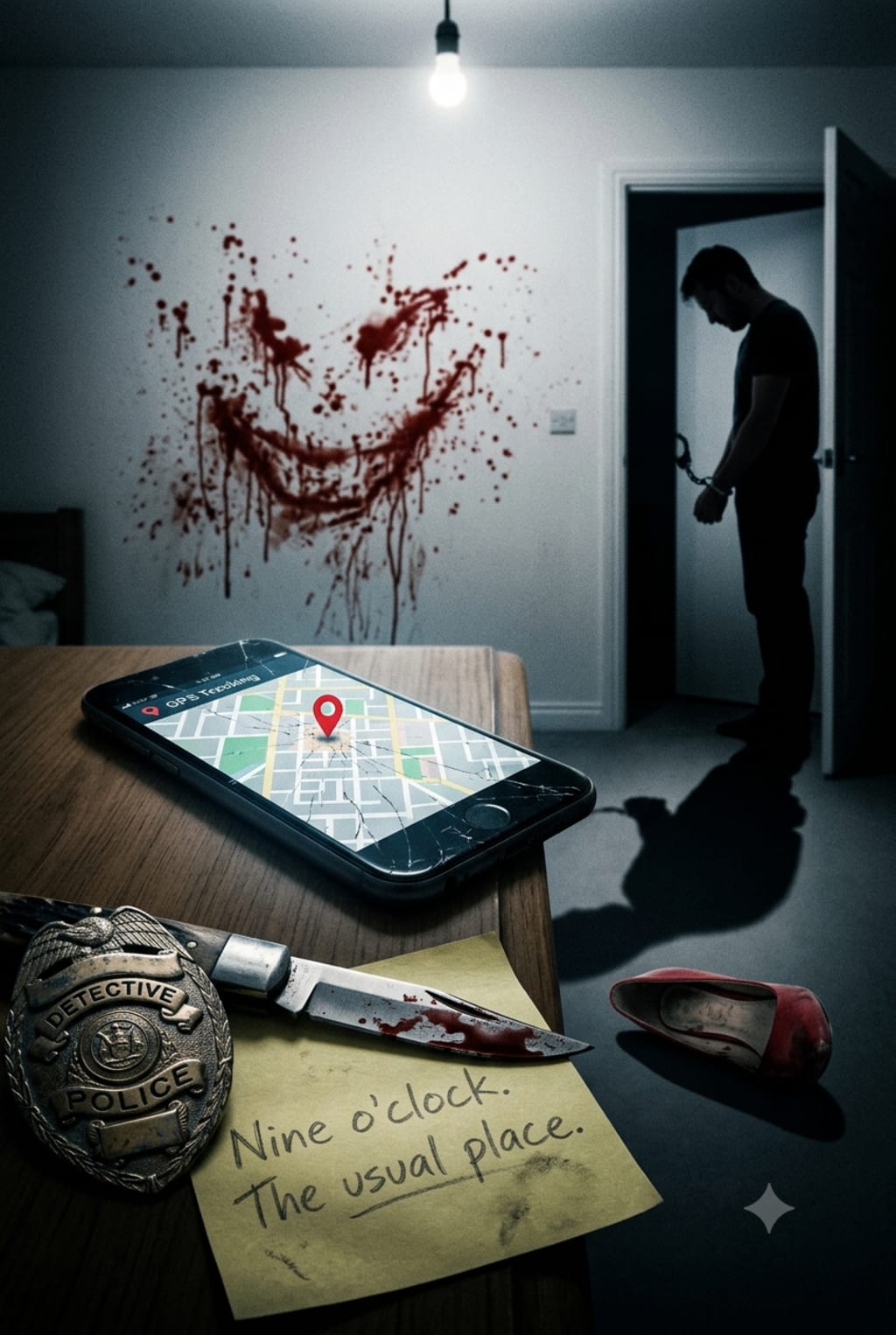
The scene was the master bedroom. Blood had sprayed across a white wall, horizontal streaks, vertical streaks, forming a huge, grinning grimace. The medical examiner told me later that it happens when the carotid artery is severed and the heart is still pumping. The body's already down. The blood's still spraying.
The victim was Vera Jones, twenty-seven, lying face down on the floor. Her long brown hair was plastered to her face, the blood congealing the strands into stiff ropes. Her head was twisted to the left, her mouth slightly open, with bite marks on the inside of her lip.
But she wasn't the only victim.
Slumped in the bedroom doorway was a man covered in blood. His name was Marcus Chen, her husband. He'd been struck on the right side of the head with a blunt object, the wound already a black clot. When we arrived, his eyes were closed, his face a mask of dried blood, but he was still breathing. We got him to the hospital. The injuries weren't life‑threatening. He woke up seventeen hours later.
The M.E. turned Vera's body over. Two stab wounds to the chest and abdomen. A third to the left side of her neck, right through the carotid.
The arterial spray on the wall was from that third cut. In my experience, that was the one that mattered.
On the third day after Marcus woke up, I went to his room.
His head was wrapped in gauze, his right hand cuffed to the bed rail—standard procedure. Only living person at the scene, secure him first. When he saw me walk in, he knocked over a half‑full cup of water on the nightstand.
“Where's Vera?”
I pulled up a chair and sat down. Didn't answer his question.
“The night of March fourteenth. Where were you?”
“Home. With Vera.”
“And then?”
He blinked a few times. I watched his right hand start to tremble. Not faking it—that uncontrollable tremor in the fingertips.
“When I got home, the door was open.”
“What time?”
“Around nine. I was working late.” He paused. “When I went inside… she was already… on the floor.”
“You didn't hear anything?”
“No.”
“How did you get the injury on your head?”
He was silent for about ten seconds. Then he said, “I don't remember.”
I didn't push it. Not because I believed him. I've heard “I don't remember” too many times. Some people genuinely don't—a blow to the head can knock out chunks of memory. Some people are waiting for a lawyer.
But one thing bothered me.
If the killer came for Vera, why leave Marcus alive? That head wound was enough to knock him out, but not enough to kill. The killer had time for one more cut. Didn't take it.
Either the killer got interrupted, or the killer only wanted Vera, and Marcus was just in the way. Smack him on the head, get him out of the picture.
The day the M.E.'s report came back, the case took a turn.
They found a high concentration of gamma‑hydroxybutyrate in Vera's system. GHB. The date‑rape drug. The dose was high enough that an adult woman would lose motor function within fifteen minutes.
That's why there were no signs of a struggle. When she went down, her limbs were already useless.
But Marcus's statement hit a snag.
He said he got home at nine and found Vera dead. The parking garage footage showed his car entering the complex at 7:40 p.m.
“I might have remembered the time wrong,” Marcus said during the third interrogation. His fingers kept picking at a loose thread on his hospital gown, already worn a hole the size of a fingernail.
“That missing hour‑plus. Where were you?”
He opened his mouth. Closed it again.
That's when the lab pulled skin tissue from under Vera's fingernails. DNA match: not Marcus.
The sample went into the database. Twenty‑four hours later, a name popped: Derek Shaw, thirty‑four, with a prior. Three years ago, he did eight months for illegal possession of a prohibited weapon.
We went to his registered address. The landlord said he'd moved out three months ago, owed two months' rent. The neighbors said he'd come back sometimes late at night, grab a few things, and disappear again. Like a rat.
Exhibit Three is what flipped the case.
We found a phone under Vera's bed. Not hers. Not Marcus's. The SIM card had been pulled, but the data was still on the device. In the photo gallery was a screenshot from a GPS tracking app, showing Marcus's phone location.
The location history was dense, with entries every single day, checked over a dozen times daily.
There was also a photo of Vera at a grocery store, taken from about twenty yards away, shot through the shelving.
I scrolled through the entire gallery, a cold feeling crawling up my back. All of it was Vera. At Starbucks. At the gym. At the bus stop. On her own balcony, hanging laundry. The stalking had gone on for at least six months.
The stalker was Derek Shaw.
What was his connection to Vera?
I pulled Derek's background file. Four years ago, he'd worked as a security guard at the law firm where Vera was employed. Lasted three months. Fired for drinking on the job. A note in his personnel file: “Erratic behavior. Followed female staff on multiple occasions.”
Three months. Long enough to nail someone into your brain.
Now we had two lines.
One was Derek Shaw. Stalker. Violent history. Missing since the murder.
The other was Marcus. Where did that missing hour‑plus go? Did he know Vera had been drugged?
I pulled Marcus's bank records. Three days before the murder, he'd withdrawn twenty thousand dollars in cash. No wire transfers, no card purchases. Where did twenty grand go?
“What was the twenty thousand for?” I asked him in the interrogation room. Not the hospital this time. He'd been formally detained as a suspect.
Marcus's handcuffs clinked against the metal table. He stared at his own fingers and didn't speak for a long time.
“Marcus.”
“Back when she was still alive—” He started talking, his voice off, like something was blocking his throat. “I didn't know. If I'd known earlier—”
“Known what?”
“Derek Shaw.” He bit down hard on the name. “Half a year ago, he started sending Vera things. Photos. Letters. All stalker material. Vera went to the police. They said no direct threat, couldn't open a case.”
“So you withdrew the twenty thousand.”
He went quiet again.
I leaned forward. “You paid someone to look into Derek, or you paid someone to deal with him?”
He looked up, his eyes red‑rimmed. Not from crying. The kind of red from not sleeping well for days.
“I found a guy. Told him to find Derek, beat him up, make him too scared to come back.” His voice cracked on “beat him up.” “That's it. I didn't want to kill Vera. Why would I kill Vera?”
“Who did you hire?”
“I don't know his name. A friend connected us. Met in a bar. Paid cash.”
For the next forty‑eight hours, we worked two angles simultaneously: find Derek, and trace that fuzzy “bar transaction.”
Derek's trail was cut off at 9:45 p.m. on the night of the murder. He'd shown up on the security camera of a 7‑Eleven south of the apartment complex, buying a towel and a bottle of water. Fresh scratch marks on his face.
Then nothing.
The tech team started sweeping nearby drainage pipes, the river, and abandoned structures.
Four days later, someone found a male body in the trash collection area of an old apartment complex a few miles away.
The body was Derek Shaw.
The M.E.'s conclusion: asphyxiation. Clear ligature marks on the neck. The trachea had been crushed. The body had been moved postmortem and left in that trash area for at least five to seven days.
The time of death was only hours apart from Vera's.
Two people. Two bodies. Same night.
I sat in the office and wrote three key pieces of information on the whiteboard:
Vera Jones: Drugged. Stabbed three times. Carotid severed. Weapon not found.
Derek Shaw: Asphyxiated. Body dumped postmortem. The ligature was a strap roughly one centimeter wide—it could have been a belt, a bag strap, or a rope.
Marcus Chen: Blunt force trauma to the head. Minor injury. Survived. Could not account for over an hour. The story about hiring someone to scare Derek had no corroborating evidence.
A fourth name came from the bar's security footage.
The night Marcus described, he did enter a bar. He left at 1:40 a.m., together with a man in a baseball cap. The brim was pulled low, only the jawline visible. After they split up, the man in the cap headed east, into a blind spot.
I told my partner, “Compare the weapon that killed Vera with the ligature used on Derek. If they're different types of tools, we might be looking at two different killers.”
The comparison came back quickly. Not the same weapon.
Which meant Vera's death and Derek's death might each have its own killer.
On the eleventh day, Marcus's lawyer submitted a new statement.
Marcus had finally “remembered” how he got the head injury.
He said that night, he'd gone home early because Vera had texted him, saying she thought she was being followed. The text read: “He's downstairs. Again. Be careful when you come home.”
When he got home, Vera was already dead. Derek was still in the room, holding a knife. They fought. Derek hit him on the head with the handle of the knife, and he collapsed, unconscious. When he woke up, Derek was gone.
“Why didn't you say this before?”
“After the head injury, I really didn't remember. It only came back these last few days,” the lawyer added for him.
This version had serious problems.
If Derek killed Vera and then ran—how was Derek himself strangled within hours and dumped miles away?
I had the team re‑examine the doors and windows. The lock on the master bedroom window had been pried. On the outside sill, there was a partial shoe print, size ten and a half, matching Derek's shoe size.
But that didn't mean the killer came in through the window. It was also possible that Derek pried the window to get in and kill Vera. Marcus happened to come home, they fought, Derek knocked Marcus out, fled, and then was strangled by someone else.
That “someone else” conclusion brought me back to the twenty thousand dollars.
Marcus said the money was to hire someone to teach Derek a lesson. If the guy he hired actually found Derek and decided to kill him—
Meaning Vera was killed by Derek, and Derek was killed by the man Marcus hired.
That would change Marcus's liability from murder to involuntary manslaughter—or solicitation of murder.
Late that night, I re‑timelined the three of them:
March fourteenth.
6:00 p.m. Vera texts Marcus, saying someone is following her.
7:40 p.m. Marcus comes home early. Walks in on Derek in the act. A struggle. Marcus gets knocked unconscious. Head injury.
Between 8:00 and 9:00 p.m., Derek flees.
After 9:00 p.m., Derek is found by the man Marcus hired. Strangled. Body dumped.
This version explained most of the physical evidence.
Only one question I couldn't answer.
If the man Marcus hired was just supposed to “teach Derek a lesson,” why would he kill him? And why choose strangulation? Was the guy a professional? Or did he lose control?
And—where were the weapons?
I went back to the scene with that question. Vera's bedroom had been sealed for twelve days. The air still carried a sickly sweet metallic smell, like old blood.
I stood in front of the wall where the blood was heaviest. The grinning grimace had dried to a dark brown.
Vera had fallen three steps from the window. From the moment Derek pried the window open to the moment she was stabbed—was there a gap? Time? Distance? If Derek drugged her first—how was the drug administered?
One detail in the M.E.'s report I'd overlooked: Vera's stomach contents showed red wine and sedatives. GHB is nearly tasteless in red wine.
Vera and Marcus drank red wine regularly. Derek couldn't have known that. Unless he'd been watching them for a very long time.
But watching that long—for what?
I went through the photos on Derek's phone again, one by one. The grocery store. Starbucks. The gym. The bus stop. The balcony. Not a single photo of Vera and Marcus together. All of them were with Vera alone.
He wasn't stalking a couple. He was stalking her.
On the thirteenth day, Derek's rental was fully searched.
His landlord was a man in his seventies, eyes clouded but memory sharp. He said a woman had visited Derek a few times. Three or four times. The old man held his hand up to his own head to indicate height. “About this tall. Brown hair.”
Vera's height. Vera's hair color.
“You're sure it was her?”
“I recognize her shoes. Red high heels. Very loud when she walked.”
Vera's shoe rack had a pair of red high heels. My colleague's crime scene photos showed them.
If Vera and Derek had a relationship, she wasn't just a victim. At least to some degree, she might have known him.
I pulled Vera's call logs and messaging apps again. No name for Derek. But there was a contact saved as “Mike the Delivery Guy.” Nineteen calls over four months, each under five minutes.
We traced the number. It was Derek Shaw's burner phone.
Did Marcus know about this?
I called the hospital to schedule an interview, but the nurse said Marcus had been transferred to the psychiatric observation ward half an hour earlier. He'd started hearing Vera's voice.
“She's right in my ear,” the nurse quoted him. “Saying over and over, ‘It wasn't you. It wasn't you.’ But not the way you people mean it. She means, I didn't do the thing you think I did.”
The nurse assumed it was auditory hallucinations from the head trauma. I wasn't so sure.
I sat in my office, closed my eyes, and ran the whole case through my head from the beginning.
If Vera and Derek knew each other—if Derek stalked her but she also called him—then this wasn't a one‑way obsession. It was something more complicated.
An affair? Blackmail? Something else?
If it was an affair, why did Derek pry open her bedroom window that night? If it was blackmail, what was the leverage?
And Marcus. His memories were coming back piece by piece, and each new piece neatly patched the holes in the previous version of his story. Too neat.
I've seen a lot of suspects in that interrogation room. People with genuine amnesia are scared of what they can't remember. They say things like “I don't know why I can't remember,” they get agitated, and they try hard to pull the memory back. Marcus didn't do any of that. Every time he said “I don't remember,” he was watching me for a reaction.
He was waiting to see if I believed him.
On the seventeenth day, we got a break.
The evidence team found a black plastic bag in one of the apartment complex's dumpsters. Inside were a pair of jeans and a shirt with diluted bloodstains. DNA matched Derek.
In the shirt pocket was a crumpled Post‑it note with a single penciled line: “Nine o'clock. The usual place.”
Handwriting analysis: Vera's.
So on the night of March fourteenth, at nine o'clock, Vera and Derek had a meeting.
Where? What was “the usual place”?
We pulled the location that appeared most frequently in their call records: a motel two miles west of the apartment. We pulled the motel's security footage. Three days before the murder, Derek and Vera had indeed met there. They entered the elevator separately, three minutes apart. Left the same way. An hour and twenty minutes in between.
An affair.
But on the night of the fourteenth, they didn't go to the motel. Vera went home. Derek went to her apartment looking for her.
Why?
I went back to Marcus's statement. He said Vera texted him that afternoon, saying, “He's downstairs. Again. Be careful when you come home.”
If Vera really wanted Marcus to help her guard against Derek, why would she arrange to meet Derek at nine o'clock that night?
Unless that text wasn't a cry for help.
I stared at that text for a long time. Then it hit me. Marcus said the text came from Vera, but we never found Vera's phone. It had been missing since the murder.
Which meant the existence of that text rested on Marcus's word alone.
I had someone pull Marcus's phone records. On March fourteenth at 6:02 p.m., there was indeed an incoming message from Vera's number. The content was exactly what Marcus said.
But at 6:02 p.m., where was Vera? Her location data showed her at home. Where was Derek? Based on the last cell tower pings from his phone, he was in his own rental, at least five miles from Vera's apartment.
He couldn't have been downstairs at the same time.
That text was most likely typed by Marcus, using his own fingers, on Vera's phone. After which, he disposed of the phone.
On the eighteenth day, we got the warrant for a full search of Marcus's residence.
In the kitchen exhaust vent, we found a folding knife. Blade length, about three inches. The handle had been washed, but in the crevice of the pivot, the lab pulled traces of blood. Vera's DNA.
Stuffed into the same vent was a belt. On the metal buckle were skin cells from Derek, perfectly matching the ligature mark.
We had the weapons. Both of them are in Marcus's home.
Marcus killed Vera and Derek. There was no hired man. No separate killer. Marcus, and only Marcus.
The truth, when we finally pieced it together, was this:
Marcus discovered Vera's affair with Derek three months earlier. He didn't hire an investigator. He installed a tracking app on her phone himself. The same app we found a screenshot of on Derek's phone. Derek was tracking Vera with the same app. Two men, same map on their screens, same red dot.
Marcus waited three months. Not the “I don't know what to do” kind of waiting. The kind where you come home every day and smile at your wife, kiss her forehead before bed, and log every time and place she meets the other man.
On the night of March fourteenth, he knew Vera was supposed to meet Derek at nine. He came home early. He used Vera's phone to text Derek, changing the meeting place to his own apartment.
Vera opened a bottle of red wine. While she wasn't looking, he emptied the GHB into her glass.
After she collapsed, he stabbed her three times. The third cut to the neck was to make the blood spray. The M.E. said the grinning grimace on the wall required a specific angle and pressure to form. It wasn't a panicked killing. It was rage release.
Then he cleaned up some of the blood and changed clothes. He used Vera's phone to send himself the “He's downstairs” text, then destroyed the phone.
Derek arrived at nine. The window was pried open because Marcus wanted the scene to look like a break‑in. He struck himself on the head with the knife handle, controlled the force just enough to cause unconsciousness, not death. He said Derek did it, but the M.E. noted the wound's location and angle were more consistent with a self‑inflicted blow.
What happened after he went down, we're not certain. The most likely version: Derek walked in, found Vera already dead, panicked, didn't notice Marcus on the floor, and fled.
When Marcus woke up, he used a fake identity to lure Derek out. The whole “beat him up” story was a fabrication. The twenty thousand dollars was a fabrication. The man in the baseball cap in the bar footage was a decoy. We could never trace him because he never got into a car. Marcus doubled back another way, met Derek at a pre‑arranged spot, and strangled him.
He moved two bodies. Left one in his own bedroom. Dumped the other in a trash area miles away.
Then he dialed 911.
The day we closed the case, I went to the psychiatric observation ward.
Marcus was sitting in a chair by the window, sunlight on his face, eyes slightly squinting. The bandages were off. A pale scar ran along his hairline.
“The nurse said you've been hearing Vera talk to you.” I sat down across from him.
He looked at me for a moment. His eyes were calm. Not the kind of calm you put on. The kind a person has after they've done everything they set out to do.
“She told me, ‘It wasn't you.’” The corner of his mouth twitched, didn't quite make it to a smile. “But I heard what she was really saying. She was saying, ‘It was you.’”
He didn't say anything else.
As I got up to leave, he lowered his head and started rubbing his wrist. His right thumb pressed repeatedly against the pulse point on his left wrist, like he was checking to make sure something was still beating.
At the end of the hallway, the psych ward nurse stopped me. She said on Marcus's first night there, at three in the morning, he sat on the edge of his bed, facing the empty corner of the room, and said something very softly.
“Stop crying, Vera. I forgive you.”
The nurse thought he was talking nonsense.
I think that was the only true thing he ever said.
About the Creator
Jin
Writer of reamstories
https://reamstories.com/jin
Enjoyed the story? Support the Creator.
Subscribe for free to receive all their stories in your feed. You could also become a paid subscriber, letting them know you appreciate their work.
Comments
There are no comments for this story
Be the first to respond and start the conversation.