
She Was Wearing Her Own Skin: The Seamstress Killer and the Button He Kept
A sanitation worker found a vest in a dumpster. The lining wasn't satin—it was skin. What follows is the most quietly horrifying forensic narrative you’ll read this year.
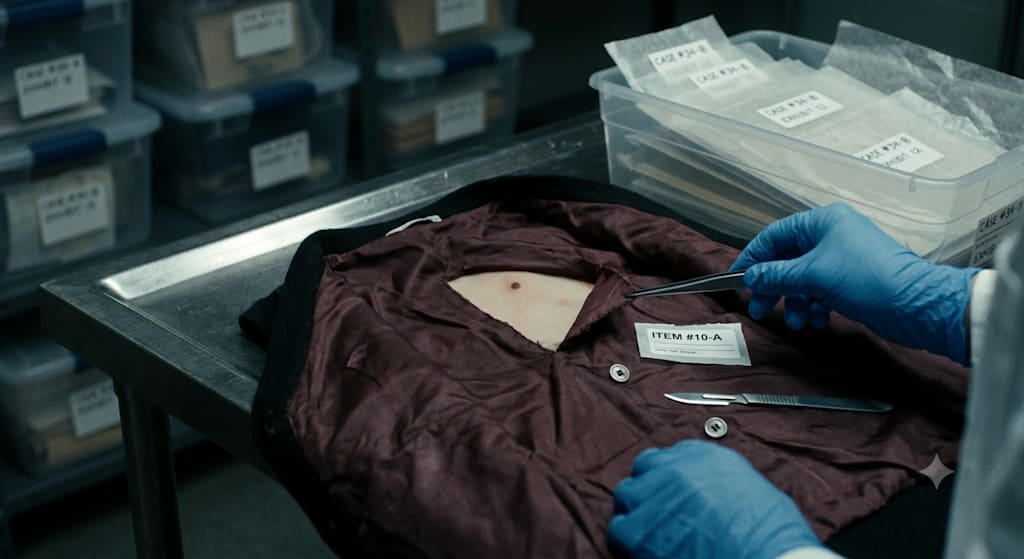
June 12. A little past five in the morning. A 911 call came in from Clover Street on the east side. A sanitation worker had found a woman's vest with blood on it in a trash bin.
By the time I got there, Ray had already run the tape. The sanitation worker stood beside two green dumpsters, a black plastic bag at his feet, the mouth of it folded open, untied.
His name was Frank Moretti, fifty-two years old, seven years on this route. He'd come through at five-ten to clear the bins. Lifted the lid on the first one, and there it was, right on top. A black vest, short-cut, V-neck, silver metal buttons, one missing. It looked decent enough. He shook it out, thinking he'd take it home to his wife—and his fingers hit the lining and stopped. Not the feel of fabric. Something had dried through, gluing two layers together.
He turned the vest over.
The lining was dark red. A deep, deep dark red.
He put the vest back in the bag and didn't touch it again. When Ray questioned him, he kept saying the same thing: "The smell was wrong. That's not dye."
From the front, the vest showed nothing. I crouched down and looked through the plastic of the evidence bag for a while. Knit fabric, straight seams, an ordinary cut—the kind of thing you could pick up at any discount store. But one button was missing, the buttonhole empty, no sign of stretching or tearing around it. Not ripped off. Removed.
Dr. Graham arrived. He didn't rush to touch anything. He crouched next to the bag and looked for a full minute.
"No," he said.
He took off his gloves and put on surgical ones. He lifted the vest out with forceps and laid it flat on an evidence mat, lining side up. Blood had pooled across the back area, spread in a wide stain with blurred borders, soaked into the fibers of the lining. But it wasn't the blood he was looking at.
He ran his forceps along the hem stitching, all the way around, and stopped. The thread was black polyester. The stitches were dense, abnormally so—no off-the-rack garment used this density.
He stood up and went for the scalpel.
"Get down here," he said to me.
I crouched.
He worked the blade into the side seam, not cutting the fabric but picking the original stitches out one by one. The polyester thread made a series of tiny sounds as it snapped, like something quietly tearing apart.
A flap of the lining came loose.
His hand stopped.
"The feel's wrong," he said, voice flat. "This lining's too thick."
He said nothing else.
The scalpel kept moving. The stitches came out. He peeled the lining up from the hem and lifted it back.
A piece of skin—whole, the size of a palm—came away from between the outer shell and the lining, laid flat on the mat.
Thin. Translucent at the edges. Pores visible in the grain of it. At the center of the back: a small dark mole.
Graham transferred it to an evidence tray and smoothed it out with the forceps. He measured the edges, recorded the thickness, took photographs. He didn't speak through any of it.
Across the skin ran a pale line, top left to bottom right. An old scar. About two centimeters. Poorly healed. The suture marks are still visible.
Ray stood beside him. "Is that human skin?"
Graham didn't look up. "Yes."
"The whole vest?"
Graham turned the outer shell over. The inside surface—the side that had been bonded to the lining—was covered in needle marks. Dense, uniform, following the original contour lines of the vest. Not a single crease.
This hadn't been done in a hurry. Enough time. Enough light. A steady hand.
He took a sample from the back section and sealed it in an evidence bag.
"The blood was deposited before death," he said, pointing at the dark red on the inner side of the skin. "Capillaries were still bleeding, and the blood infiltrated the tissue. If it had been sewn in postmortem, the diffusion pattern would be different."
He turned the vest to the shoulder and opened the shoulder seam.
The stitches snapped. A second piece of skin emerged. Smaller than the back piece, its edges trimmed to a curve that fit the shoulder line of the vest exactly. At its center: a light brown mole. Different shape, different position.
Did not match the first mole.
Not the same person.
Graham laid the two pieces of skin side by side in the tray and compared the thickness, grain, and follicle density. His movements were steady, but when he pulled his gloves off, he tugged too hard. The glove caught on his index finger, halfway off. He yanked it the rest of the way, tossed it into the medical waste bag, and walked to the sink.
He washed for a long time.
I watched him wash. The sound of running water carried down the empty street for a while.
That afternoon, Graham's report came in. The two pieces of skin belonged to two different women. The back skin came from a female between twenty and twenty-five. The shoulder skin came from a female around forty. Clean-cut edges, trimmed to curvature, pre-treated before stitching. Same stitch method. Same thread brand. Same thread tension.
Which meant whoever sewed this vest had done it at least twice. Or more than twice.
Ray started pulling surveillance footage from around Clover Street. I went back to my desk, sat for ten minutes, then went outside for a cigarette. When I came back, Ray had frozen a frame at 2:47 a.m.
A dark blue older-model Ford pickup, coming into Clover Street from the east end. Moving very slowly. Headlights off. It stopped beside the dumpster for thirty seconds. The driver got out, wearing a dark blue work jacket, a glove on his left hand, and nothing on his right. He hauled a black garbage bag out of the truck bed, tossed it into the dumpster, turned, and got back in. There was another black bag still in the bed. He didn't throw that one.
The truck drove west. The resolution was too low to make out the plate. The driver's-side window was tinted.
The bag he didn't throw—he took that one back with him.
I walked past the whiteboard and took down the crime-scene photo of the vest. I looked at it again. The back. The spot where the button was missing. The silver buttonhole sat empty.
That button was somewhere.
I slipped the photo into the case file and closed it.
Ray was still at the monitor, tracking that pickup frame by frame. Graham was in the lab doing a second round of skin sections. I didn't bother either of them.
It was daylight outside. Frank Moretti had finished giving his statement. Before he left, he asked if he could take the black bag back—the garbage bag the vest had come in, not the evidence.
No one answered him.
He left.
The black coffee on my desk had gone cold a long time ago. I picked it up and set it back down. Didn't touch it.
The sound of the air vent suddenly got very loud, as if it hadn't been on until just then.
Ray spent three days on that pickup.
The Clover Street camera caught the truck heading west until it vanished. The resolution was so bad that even the makeup was a blur. He didn't bother chasing it street by street—three blocks west, that road hits the on-ramp for I-5. Plenty of vehicles get on at two in the morning, but not many with their headlights off. He widened the time window to 2:30 to 3:10 a.m. The traffic camera at the on-ramp had it.
Dark blue Ford F-150, at least ten years old, with a faded gray patch on the rear fender about the size of a hand. The black bag was still in the bed. The camera caught the rear half of the license plate: EV-449.
Not the whole thing. Enough.
The DMV records came back. Eleven F-150s with EV-449 plates are registered in the state. Three of them dark blue. One was in Lubbock, two hundred miles out, owned by a sixty-eight-year-old retired electrician, vehicle parked in a garage, last inspection two years ago. One belonged to a small freight company—GPS showed that the truck was at a truck stop thirty miles away at 2:53 a.m., the driver asleep. The third was registered at 1742 Maple Street, in the southeast part of the city. Owner: Vincent Dutton, forty-four years old. Occupation listed as "interior upholstery."
Ray enlarged Dutton's driver's license photo and put it up on the whiteboard. White male, brown hair, thin face, high cheekbones. The license is still valid for two more years. The address matched the registration.
"Interior upholstery," Ray said. "He knows how to sew."
We didn't go straight to the door. Day one, Ray pulled Dutton's tax records for the past five years. He filed as a freelancer. Income is modest but steady. No criminal record, no civil disputes, no domestic disturbance calls. Clean. The kind of clean that doesn't sit right. Day two, Ray found sales records from a fabric wholesaler three blocks from Dutton's address. Dutton was a regular. He'd bought forty-six spools of black polyester thread over the past three years. Cash every time. Same product every time—Tex 70, industrial-grade high-strength thread.
Same thread as the vest.
Graham was running the fiber comparison. When he called, his voice was a beat slower than usual.
"Same batch," he said. "Not just same brand, same gauge. Under the microscope, the fiber twist and dye uniformity are identical. They came off the same spool." He paused. "I did something else. The needle holes left in the vest lining—I measured the spacing. Five stitches per centimeter, deviation no more than one-tenth of a millimeter. A sewing machine can't hold that. The feed dogs on a machine drift a little. This was done by hand. Same needle, or same needle type. The tip hadn't dulled. Same entry angle every time."
He stopped.
"You know what that tells me? He wasn't in a hurry when he sewed. He might even have enjoyed it."
Day three, we got the warrant.
1742 Maple Street was a single-story wood-frame house, gray-blue, front lawn half dead. The dark blue F-150 sat in the driveway. The gray patch on the rear fender matched. The truck bed was empty, lined with an old felt blanket. There were dark stains on the felt. Not oil.
Ray and I went in through the front. Two uniforms covered the back. The door was unlocked.
The living room was ordinary. Gray fabric sofa. A glass of water was half-drunk on the coffee table. The TV remote is sitting on the armrest. On the wall hung a framed cross-stitch, the Twenty-Third Psalm: *Yea, though I walk through the valley of the shadow of death, I will fear no evil.* The stitches were very fine. Five per centimeter.
Ray looked at the cross-stitch for a moment. He didn't say anything. He kept walking.
The kitchen trash had three empty thread spools, black, Tex 70. Two cartons of industrial sewing-machine oil were stacked beside the refrigerator. Under the counter, the cabinet opened to an old Singer sewing machine, no dust on the cast-iron body. Next to it, a needle case. Sewing needles arranged on a magnetic strip by gauge, fine to heavy. None missing. None bent.
The workroom was in the garage.
The garage had been converted—insulated, lit. A stainless-steel worktable two meters long, polished to a gleam. On the left side of the table: sewing tools—shears, an awl, a thimble, a heat-erasable marking pen. On the right: a row of clear storage bins. Ray opened the first one. Black polyester fabric, the same as the outer shell of the vest. The second bin: spools of thread, three layers, all Tex 70, black. The third bin: buttons. Silver metal buttons, round, with a fine diamond pattern on the face.
Identical to the buttons still on the vest.
I took the evidence pouch from my pocket—the button recovered from the vest. I tipped it out and placed it on the stainless-steel table next to the buttons from the bin. The pattern, the size, the sheen, the shape of the shank hole on the back—all matched.
Ray opened the fourth bin.
He didn't say anything. He closed it again.
"What?" I said.
He stepped back, pulled off his gloves, and rubbed his face hard. I knew that gesture. He'd done the same thing the first time he saw the vest at the scene.
I walked over and opened the bin.
Skin. Stacked sheet by sheet, each layer separated by glassine paper. The top sheet had its edge trimmed to a curve that matched the neckline of some garment. I leafed through. Each sheet of glassine had a label, handwritten, with a date and a body part: left upper chest, right upper arm, periumbilical, left outer thigh.
Not two pieces. Many.
I closed the bin and placed it on the evidence table. Ray was already on the phone with Graham. His voice was level, but his fingers were tapping the edge of the table, fast.
"We're going to need a full forensic team," he said. "Everything. The whole house."
The search that followed lasted seven hours.
Graham's people carried eleven evidence crates out of that garage. Five were skin samples. There were sewing materials and tools. Two were records—Dutton's handwritten notebooks, all of them sewing logs. The logs mentioned no names. They recorded only the condition of the "material," processing times, assembly patterns. The word he used was "material." From start to finish, material.
In the bedroom, at the bottom of the closet, we found a shoebox. There were no shoes in it. Inside was a clear Ziploc bag filled with silver metal buttons. Each one was wrapped individually in tissue paper. Seventeen buttons in total. Some large, some small, some patterned, some smooth. From different garments. Different people.
Taped to the inside of the shoebox lid was a photograph. A woman, mid-twenties, long dark hair, wearing a black short-cut vest, standing by a lake in some park, smiling. Black knit vest. V-neck. Silver metal buttons. I looked at her buttons. One was missing. The third from the left. The buttonhole was empty. She stood there in the sun, not knowing her vest was missing a button, not knowing that years later someone would keep that button, wrapped in tissue paper, in a shoebox.
Ray turned the photograph over. On the back, a single line in ballpoint pen, blue ink, already fading. Handwriting is narrow and pressed hard into the paper.
*Laura. June 2014. The first one.*
I stood in front of that closet and put the photograph back.
Graham told me later that the dates on those glassine sheets spanned five years. The earliest label was June 2014—the same date as the handwriting on the back of the photograph. The latest label was May 2019. One month before Frank Moretti lifted the lid of a dumpster.
That night I went back to the office. The whiteboard had a new row of photographs: the vest, the pickup, the buttons, the glassine sheets from the storage bins, the seventeen buttons from the shoebox, and Laura smiling by the lake. The air conditioner was still the same air conditioner. The vent was loud. I drank a mouthful of water. Cold. Outside the window, the parking lot. Nothing under the streetlights.
They brought Dutton in the next afternoon.
When he walked out of 1742 Maple Street, he didn't run. Two uniforms approached, and he held out his hands, wrists together, fingers pointing down—like a man used to being measured. Passing the F-150, he turned his head slightly, glanced at the old felt blanket in the bed. The dark stains looked lighter in the sun.
He didn't speak. Didn't speak the whole way.
After the door to the interview room closed, the air stopped moving.
The fluorescent tubes hummed overhead, steady frequency, like something counting down but never reaching zero. The stainless-steel table was bolted to the floor. A shallow scratch ran across the surface, top left to bottom right—someone had tried to wipe it off, hadn't succeeded. On the table sat a cup of black coffee, a paper cup, no lid. The coffee had stopped steaming a long time ago. The seam on the cup faced left.
Dutton sat on the other side of the table.
He was thinner than his license photo. Brown hair cut very short, hairline receding slightly, exposing two horizontal lines across his forehead. High cheekbones, narrow jaw. The whole shape of his face was like a garment that had been altered twice—taken apart, resewn, the original needle marks still there.
He wore a dark blue jail jumpsuit, zipped to the chest. Left hand flat on the table, fingers spread, motionless. Right hand below the table.
Ray sat across from him. I didn't sit. I stood in the corner, against the wall with the one-way glass. Two people stood on the other side of that glass. Dutton never looked that way once.
Ray turned on the recording device and placed it in the upper right corner of the table. The red light came on.
"Interview commencing. Time is 2:16 p.m. Persons present—"
"That's called a heat-erasable pen," Dutton said.
Ray stopped.
Dutton's gaze had settled on Ray's left chest pocket. Ray had a pen in that pocket, black, slim, silver clip.
"The one in your pocket," Dutton said. "That's not a heat-erasable pen. Heat-erasable ink disappears when it gets warm. Yours won't."
Ray pulled the pen from his pocket and set it on the edge of the table.
"I ask the questions. You answer."
Dutton didn't look at the pen. He was looking at Ray's hands. Ray's hands were on the table, fingers interlaced. Dutton watched for a moment, then brought his right hand up from under the table and placed it beside his left. His fingers were thin, knuckles prominent. Between his thumb and forefinger was a thin callus, old, worn smooth and shiny.
The thumb and forefinger of his right hand began to move, rubbing together, a clockwise rotation, once around, then counterclockwise back. Like he was rolling an invisible needle.
"What did you find in my garage?" Dutton asked.
"You tell me."
"You found sewing tools. One Singer sewing machine. Forty-six spools of Tex 70 thread. A set of sewing needles—you'll have checked the tip wear by now. Several bins of fabric. Several bins of buttons." He spoke slowly, with equal spacing between each word, as if reading from a list. "And several storage bins."
He paused. The thumb and forefinger didn't pause.
"Did you open the fourth bin?"
Ray didn't answer.
Dutton nodded.
He reached for the coffee on the table. His fingers stopped just before touching the paper cup. He looked at the seam on the cup. He rotated it ninety degrees, so the seam faced him. Then he didn't drink. He pulled his hand back and placed it on the table again, thumb and forefinger resuming their motion.
"You sew," Ray said.
"Yes."
"What do you sew?"
"Clothing. Vests. Sleeveless jackets. Short coats. Sometimes skirts, but skirts are hard to shape—the fabric is too soft, the stitching tends to wander. I don't like wandering stitching."
"What do you sew with?"
Dutton looked at Ray. His eyes were pale blue, very pale, like watered-down ink. Those eyes didn't evade and didn't confront. They simply rested on Ray's face the way you'd look at a piece of fabric you were about to measure.
"You already know. Otherwise, you wouldn't be asking."
"I want to hear you say it."
Dutton turned his right hand over, palm up. The thumb and forefinger stopped, suspended.
"Skin," he said. "Human skin."
He said the two words the same way he'd have said *polyester* or *cotton blend*.
Ray didn't jump in. He waited two seconds. In those two seconds, the hum of the fluorescent tubes got clearer.
"Whose skin?"
Dutton turned his right hand back over. His eyes left Ray's face and settled on the untouched coffee. The seam on the cup was two millimeters off. He reached over and turned the cup again, bringing the seam precisely into alignment with him.
"Laura. Laura Summers. Twenty-five years old. Long dark hair. You saw her photograph? The one inside the shoebox lid."
"We saw it."
"That was the first one I made. The skin on her back. Sewn into that black vest. The vest was hers. She wore it. I saw her in the park and took a picture. The light was good that day."
As he said this, his right hand stayed still. Both hands rested quietly on the table, palms down.
"And the second one," Ray said.
Dutton looked at Ray. The look was not anger, not fear. It was a correction.
"The second one wasn't a vest. It was a sleeveless shell. The shoulder section used skin from a different person. You found the second piece of skin in the shoulder seam of the vest, but that was added later. The actual second piece was a shell. In my garage. Third bin, underneath the black fabric."
He was right. The lab had found a sleeveless shell in the third storage bin, outer layer black polyester, inner lining skin, edges trimmed to a curve, stitching at five per centimeter. Same method as the vest.
"You remember clearly," Ray said.
"I remember the construction of every garment. The fabric grain, the stitch length, the thread tension, and the edge finish. Every piece is different because every piece of skin is different." Dutton lifted his left hand and mimed holding a needle in the air. "Young skin has good elasticity. The needle moves easily. Skin over forty is thinner. You have to go shallow, or the subcutaneous layer tears. The two pieces you found—one twenty-two to twenty-five, one around forty. Different feel. I can tell as soon as I touch it."
Ray pushed his chair back a little. The chair leg scraped against the stainless-steel floor, a short, sharp sound.
"Why do you sew these things?"
Dutton's hand started moving again. Thumb and forefinger, one clockwise rotation, one counterclockwise back.
"Because they were already there," he said. "Skin is on a person, and no one looks at it. No one knows its thickness, its elasticity, or how it takes a needle. It wraps around someone, and then the person goes away, and the skin is wasted. I make sure it's not wasted."
"What does 'the person goes away' mean?"
Dutton said nothing.
His hand stopped. He took both hands off the table and placed them on his knees. His back straightened, his shoulders drew back. His whole posture changed—from a man being interrogated to a tailor waiting for a client to approve the finished piece.
"That vest was missing a button. Did you find it?"
Ray watched him.
"I kept it. In the shoebox at the bottom of my bedroom closet. Wrapped in tissue paper. You found the shoebox, so you must have found the button. It's different from the others. It was the first one."
Everything he said matched the crime-scene findings exactly. Not guesswork. Confirmation.
Ray stood up.
He pushed his chair under the table, very slowly, the legs not scraping this time. He walked to the wall and stood with his back to Dutton for three seconds. Then he turned around.
"Do you know how many people you've sewn?"
Dutton raised his head. Those pale blue eyes met Ray's eyes. He didn't answer the question. He just rotated the coffee cup another ninety degrees, bringing the seam back to the direction it had originally faced—toward me.
Then he placed his hands on the table again, leaving a very narrow gap between his thumb and forefinger, just wide enough for a needle to pass through.
"Earlier, you said 'assembly pattern.' It's not called an assembly pattern. In sewing, it's called a pattern draft. You should use the right term in your report."
Ray said nothing.
Dutton nodded, the way you nod to confirm something that was going to happen sooner or later. He turned his hands over, palms up.
"I have no further questions for you," he said. "You may continue."
The rest of the interrogation records went to someone else.
Graham's forensic report landed on my desk two weeks later. DNA matched eleven names, all female, ranging in age from nineteen to fifty-four. Every one of them had been reported missing. The earliest file had been sealed five years ago. The most recent was still pinned to the missing-persons board, its photo curled at the corner.
Eleven people. Seventeen buttons. Seventeen labeled sheets of glassine.
The numbers didn't match because some had contributed more than one piece of skin. Some had contributed more than one button.
Laura Summers was the first. Her name sat at the top of Graham's list: skin from the back, left scapular region. Her body was never found. Neither were the other ten. Dutton gave up some locations during interrogation—an abandoned campground in the state park, a drainage culvert off Highway 7, a gravel slope behind the old sawmill—and they all sounded real, and they all sounded like points he'd picked at random on a map. The K-9 teams dug up nothing.
The only things certain were in that garage. Ten storage bins. Fifty-three labeled skin samples, every one of them cleanly processed. Graham wrote in his report that the treatment method resembled certain steps in leather tanning, but more refined, with more detail retained. He spent two pages describing the preservation state of those skin samples. His last line read: "The maker's technique showed marked improvement over the five-year period."
I never went back into that interview room.
After that, everything became files, trial dates, and evidence transfer inventories. Dutton was remanded to state prison, single cell, awaiting trial. His attorney tried to mount an insanity defense. Dutton refused. At the pretrial hearing, he said one thing to the judge: "My stitches never wandered."
The trial was set for November. A month before that, Ray got reassigned to another case. Graham kept doing his forensic work. When we passed each other in the hallway, he'd give a nod. Not many words.
I went to the trial.
The courtroom had the same model of fluorescent light as the interview room. Even the hum was the same. Dutton sat in the defendant's chair, wearing a gray suit jacket—court-issue, half a size too big, the shoulders drooping. Both hands rested on his knees. The space between his thumb and forefinger was empty. No motion.
During closing arguments, the prosecutor held up the photographs one by one. The vest. The shell. The storage bins. The glassine sheets. The seventeen buttons. Some jurors looked. Some lowered their heads. Dutton looked at every photograph. His expression was the same as when he'd looked at that cup of coffee in the interview room—checking whether the seam was aligned.
The jury returned guilty on eleven counts of first-degree murder. When the judge read the sentence, Dutton lifted his hands from his knees and placed them on the wooden rail in front of him. His thumb and forefinger rubbed once, clockwise, counterclockwise. Then stopped.
As the bailiffs led him out, he passed the bench where I sat. He didn't look at me, but he paused for one step and glanced down at the pen in my hand—an ordinary black ballpoint, silver clip. Same as the one Ray had in his pocket that day.
"That's not a heat-erasable pen," he said.
Then he was gone.
I went back to the office that afternoon. The photographs were still on the whiteboard, pinned there for nearly six months, edges curling. I took them down one by one. The vest. The pickup. The buttons. The glassine sheets. Laura is smiling by the lake. I put them into the evidence archive box, closed the lid, and wrote the case number and date on the label.
At the bottom of the box was the button. I tipped it out of the evidence pouch and held it in my palm for a moment. Silver. Diamond-pattern face. On the back of the shank, under magnification, you could see the faintest wear marks from a needle. The trace of having been sewn.
I wrapped it back up in tissue paper, put it away, and closed the lid.
Outside the window, the parking lot. The dark blue F-150 had been towed long ago. The space was empty. On the pavement was a pale gray patch, about the size of the one on the fender.
The air vent was still humming. I picked up the water on my desk and took a sip. Cold.
I pushed the archive box to the corner of the desk. Didn't file it.
The button is in that box. Sunlight came through the slats of the blinds, fell across the lid, and moved on.
About the Creator
Jin
Writer of reamstories
https://reamstories.com/jin
Enjoyed the story? Support the Creator.
Subscribe for free to receive all their stories in your feed. You could also become a paid subscriber, letting them know you appreciate their work.
Comments
There are no comments for this story
Be the first to respond and start the conversation.