
Next Coming Conflict: Pakistan vs India? Turkey Arming Pakistan, Russia Supporting India
Rising Regional Competition, Military Modernization, and the Future of South Asian Security

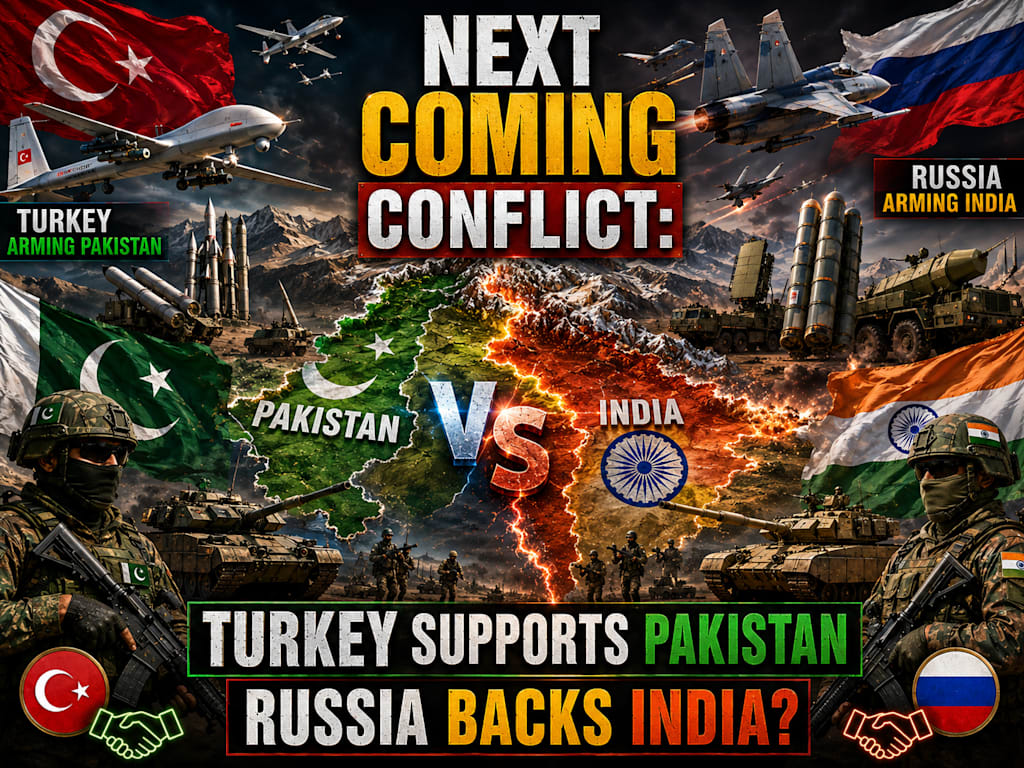
Next Coming Conflict: Pakistan vs India? Turkey Arming Pakistan, Russia Supporting India
South Asia remains one of the world's most strategically important regions, and relations between Pakistan and India continue to attract international attention. Recent discussions about defense cooperation involving Turkey and Pakistan, as well as long-standing military ties between Russia and India, have led some commentators to speculate about the possibility of future tensions. However, understanding the situation requires separating verified developments from speculation.
Pakistan and India have a long and complex history. Since gaining independence in 1947, the two countries have experienced periods of conflict, military standoffs, and diplomatic engagement. Despite disagreements, both nations remain important regional powers with significant economic, political, and security interests.
Turkey and Pakistan have developed closer defense cooperation over the past decade. This cooperation includes military training, technology exchange, defense industry collaboration, and naval projects. Both countries frequently emphasize their friendly relations and shared interests in defense modernization. Turkey's growing defense industry has become increasingly active in international markets, making it a significant supplier of military equipment to various countries.
At the same time, India has maintained strong defense relations with Russia for many decades. Russia has been one of India's largest defense partners, supplying aircraft, naval systems, air defense technology, and other military equipment. Although India has diversified its defense purchases in recent years, Russian systems continue to play an important role in India's military capabilities.
These partnerships often lead to headlines suggesting the formation of competing blocs. However, international defense cooperation does not automatically indicate preparation for war. Countries frequently purchase military equipment and engage in defense partnerships to modernize their armed forces, strengthen deterrence, and improve national security.
One reason analysts closely watch South Asia is that both Pakistan and India possess nuclear weapons. Because of this reality, any significant crisis attracts international concern. Nuclear deterrence has influenced strategic calculations in the region for decades, making large-scale conflict a matter of global interest rather than only a regional issue.
The current geopolitical environment is also changing. Countries increasingly pursue multiple partnerships simultaneously. Turkey maintains relationships with various countries despite regional disagreements. Russia cooperates with India while also engaging diplomatically with Pakistan on certain issues. Modern international relations are often more complex than simple alliance structures.
Economic considerations also play a major role. Both Pakistan and India face development challenges and economic priorities that encourage stability. Large-scale conflict would impose significant costs on both countries and could affect regional trade, investment, and economic growth.
Security experts generally note that military modernization does not necessarily mean conflict is imminent. Nations continuously upgrade their defense capabilities in response to technological developments, evolving threats, and changing strategic environments. Defense acquisitions are often planned years in advance and may be intended primarily for deterrence rather than offensive operations.
At the same time, unresolved political issues continue to influence relations between the two countries. Periodic border incidents, diplomatic disagreements, and competing strategic interests can create tensions. This is why confidence-building measures, diplomatic communication, and crisis-management mechanisms remain important.
The international community generally supports peaceful dialogue and regional stability. Many governments recognize that South Asia's security environment affects not only the region itself but also broader international interests. Stability contributes to economic development, trade, and cooperation, while instability can create uncertainty across multiple sectors.
Technology is also changing the nature of modern security. Cyber capabilities, drones, precision-guided systems, and information warfare now play a greater role than in previous decades. Future security challenges may involve a combination of conventional military capabilities and emerging technologies.
Looking ahead, the future relationship between Pakistan and India will likely depend on a mixture of diplomacy, domestic priorities, regional developments, and international engagement. While defense partnerships with countries such as Turkey and Russia are important aspects of national security strategies, they do not by themselves determine whether conflict will occur.
In conclusion, discussions about Turkey supporting Pakistan and Russia supporting India reflect broader trends in international defense cooperation rather than definitive evidence of an upcoming conflict. South Asia remains an important geopolitical region where military modernization, diplomacy, and economic development all interact. The most significant factor shaping the future will be whether regional actors choose cooperation and dialogue over confrontation.
About the Creator
Wings of Time
I'm Wings of Time—a storyteller from Swat, Pakistan. I write immersive, researched tales of war, aviation, and history that bring the past roaring back to life
Enjoyed the story? Support the Creator.
Subscribe for free to receive all their stories in your feed.
Comments
There are no comments for this story
Be the first to respond and start the conversation.