
How Beijing Shapes Global Sanctions
Power, politics, and the evolving balance inside the United Nations

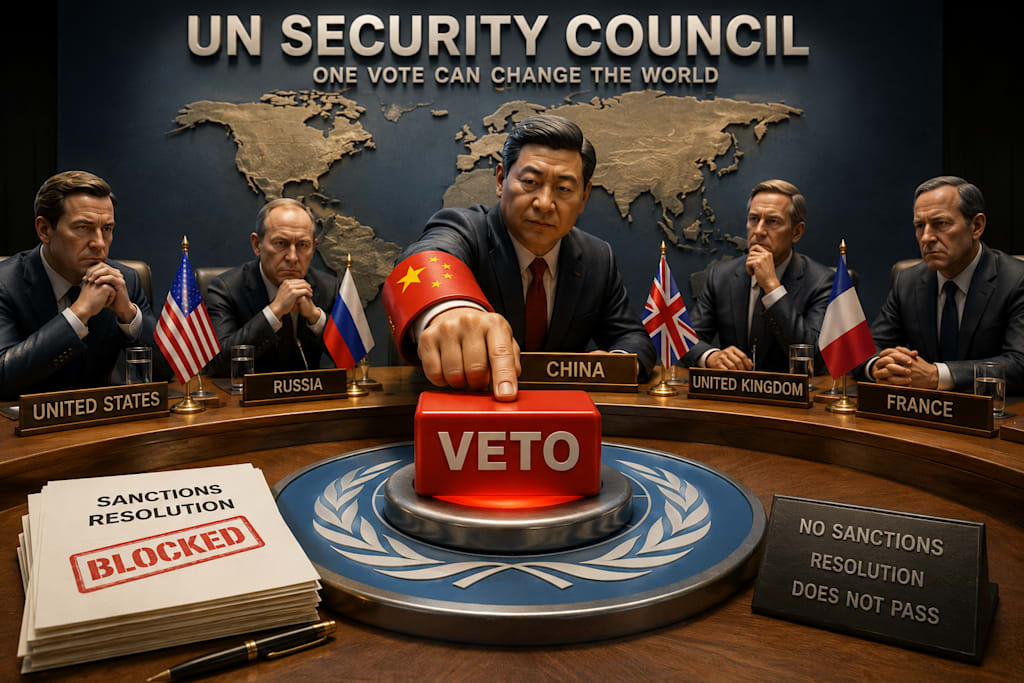
China’s Strategic Veto: How Beijing Shapes Global Sanctions
In the complex arena of international diplomacy, few tools carry as much weight as economic sanctions. They are designed to pressure governments, deter aggression, and enforce global norms without resorting to military force. Yet, the effectiveness of sanctions often depends not only on intent but on consensus—particularly within the United Nations Security Council. Here, one country’s decision can shift the entire outcome, and China has increasingly used its position to influence that balance.
As one of the five permanent members of the Security Council, China holds veto power alongside the United States, Russia, the United Kingdom, and France. This privilege allows Beijing to block any substantive resolution, including those imposing international sanctions. While this authority was designed to maintain global stability by ensuring agreement among major powers, it has also become a focal point of geopolitical tension.
China’s approach to sanctions is rooted in its long-standing principle of non-interference in the internal affairs of sovereign states. Unlike Western powers, which often view sanctions as a necessary response to human rights violations or security threats, China tends to emphasize dialogue, negotiation, and political solutions. This philosophical difference has led Beijing to oppose or dilute sanctions proposals in several high-profile cases.
For instance, in discussions surrounding Syria, China has repeatedly joined Russia in vetoing resolutions that sought to impose stricter measures on the Syrian government. Beijing argued that such sanctions could worsen humanitarian conditions and complicate peace efforts. Similarly, on issues involving Iran, China has generally supported diplomatic engagement, particularly in the context of nuclear negotiations, rather than escalating economic pressure.
The situation with North Korea illustrates a more nuanced stance. China has supported certain UN sanctions targeting Pyongyang’s nuclear program, signaling its concern over regional security. However, it has also resisted measures it considers excessively harsh, advocating for a balance between pressure and stability. This dual approach reflects China’s strategic interest in preventing both nuclear escalation and regime collapse near its borders.
Critics argue that China’s use of the veto often shields allied or strategically important governments from accountability. They contend that blocking sanctions can undermine international efforts to address conflicts, human rights abuses, and security threats. Supporters, however, see China’s actions as a necessary counterweight to what they perceive as overreach by Western nations, particularly the United States.
It is important to distinguish between UN sanctions and unilateral measures. Even when China blocks a Security Council resolution, the United States and its allies can still impose their own sanctions independently. These unilateral sanctions, however, may lack the global reach and legitimacy of UN-backed actions, making them less effective in some cases.
China’s growing economic influence further amplifies its role in this arena. As one of the world’s largest trading nations, Beijing can offset the impact of sanctions by maintaining economic ties with targeted countries. This capability not only reduces the effectiveness of Western-led sanctions but also strengthens China’s position as an alternative partner on the global stage.
Looking ahead, China’s role in shaping sanctions policy is likely to expand. As geopolitical competition intensifies and global challenges become more complex, the need for cooperation within the Security Council will remain critical. Whether China chooses to act as a bridge-builder or a strategic counterweight will significantly influence the future of international governance.
In the end, the phrase “China blocked US sanctions” captures only a fraction of a much larger story. It is not merely about obstruction, but about competing visions of world order—one that prioritizes sovereignty and stability versus one that emphasizes intervention and enforcement. Understanding this dynamic is essential for anyone seeking to grasp the evolving nature of global power in the 21st century.
About the Creator
Wings of Time
I'm Wings of Time—a storyteller from Swat, Pakistan. I write immersive, researched tales of war, aviation, and history that bring the past roaring back to life
Enjoyed the story? Support the Creator.
Subscribe for free to receive all their stories in your feed.
Comments
There are no comments for this story
Be the first to respond and start the conversation.