how to
How tos for tech whizes and luddites alike; tips, tricks and shortcuts to optimize your computer, smartphone or internet mastery.
How to do ACTIVE RECALL Effectively?
when you are reading notes only a small fraction of the data are registered in the memory the rest will vanish even before you close the book if you were using passive learning methods like reading notes summarizing highlighting or listening to lectures or podcasts this video is exactly for you in this video you'll learn how active recall builds a strong memory and the exact methods i used in medical school to get great results i also have a challenge for you take a piece of paper and create a short note from this video at the end of the video i will test the strength of your passive note-taking what is active recall this is mark and he's reading some notes some of his brain areas seem to be highly active the occipital cortex creates images of what he sees but the interpretation of written word is done by the angular gyrus and the fusiform cortex after the analysis data are sent to the hippocampus to store as memory you can stimulate muscle growth by doing exercises similarly the best way to develop a strong memory is by stimulating the hippocampus how do you do that the answer is active recall reading notes will stimulate visual areas of the brain but the hippocampus will not be effectively stimulating that is why re-reading is inferior to active recall so how can mark stimulate his hippocampus he should close the book and try to recall what he learned this time he is recalling not from the book but from the hippocampus this will stimulate the hippocampus and strengthen his memory every time you do this the memory will become even more powerful how to do active recall effectively method number one create questions first learn the concepts from your resources and write down your notes then create a list of questions based on those notes each time you study try to answer these questions without looking at the notes if you can answer them well bravo you have created a strong memory otherwise study the notes again and have another go at the questions you can also create flashcards with questions on the front and the answers on the back method number two use the spaced repetition tool like anki anki is a flash card app where you can enter the questions on the front and answers on the back the smart thing about anki is that it is based on spaced repetition it will show you the same set of questions in increasing time intervals that means you have to recall the notes today then three days later then seven days later and so on this is the ultimate study technique since you are incorporating spaced repetition and active recall together method number three utilize multiple sensory pathways for active recall let me explain don't just recall using your mind i always recall writing on a whiteboard or speaking out loud sometimes i pretend to teach the concepts to a group of imaginary students this way my brain gets stimulated through multiple sensory pathways method number four do practice questions when you are taking questions you are recalling information from the memory so it is a form of active recall on the other hand this will test your understanding of the concepts you will also learn to recall information under stress like in an actual exam if you watched until this moment it's time for the challenge i'll ask some questions from this video don't look at your notes try to recall them from the memory and realize how ineffective passive learning is you can find the answers in the description [Music]
By Rowan Sharkawy3 years ago in 01
To peer Inside the Nanoworld: Let’s Put Electron Microscopy to Address Major Challenges in Material Science Industry
1. What is Electron Microscopy? Electron microscopy (EM) has practical applications in a wide range of fields, including materials science, microelectronics, biology, environmental science, and geology. Techniques based on EM are used to probe the structure and composition of materials, providing an understanding of their properties and behaviour.
By Rana Faryad3 years ago in 01
Set up and Develop Selenium WebDriver RSpec Test Scripts with TestWise IDE
The video below uses an Appium + WinAppDriver script to: Launch the TestWise IDE.Create a new Selenium + RSpec test project in TestWise IDE.Script a complete user login test script.Execute the newly created Selenium test.
By Zhimin Zhan3 years ago in 01
Exploring 2 Methods to Save Outlook Email as PDF with Attachments
Summary: Are you facing the challenge of converting your multitude of Outlook emails into PDF format while retaining attachments? Are you eager to discover the optimal methods to save Outlook emails as PDF files?
By OliviaMartin3 years ago in 01
Merging Physical Intelligence and Artificial Intelligence to Achieve Collective Super-Intelligent Miniaturized Robots
The current applications of PI are simple and limited to the mechanics (e.g., multistable structures, metamaterials, origami, kirigami), materials science (e.g., smart, stimuli-responsive and functional materials), robotics (e.g., soft robots, miniaturized robots), fluidics, active matter, biology, self-assembly, and collective systems. Hard and bulky robots are driven by Artificial intelligence (AI) in which a variety of sensors (including vision devices such as 2D/3D cameras, vibration sensors, proximity sensors, accelerometers, and other environmental sensors) are embedded in their assembly that feeds them with sensing data they can analyze and act upon in real-time. These developments are only focused on simple PI capabilities so far (e.g., responding to an external stimulus or interaction with the local environment), while there is an urgent need for more advanced PI capabilities for enabling intelligent machines (especially miniaturized robots) operating autonomously in real-world conditions. For example, most miniatured robots are driven by PI of their material systems and are incapable of interacting with humans and the environment through intellectual abilities that are typically inherent in biological organisms. For example, a few common uses of PI in miniaturized robots include:
By Rana Faryad3 years ago in 01
100 Leonardo Ai Prompts for Amazing Car Concepts
Leonardo AI Prompts for Rendering Awesome Car Concepts I’m not sure about you, but I love playing around with the Leonardo AI platform. I’ve made so many images, I can’t even keep track of them all. Some of those images are great for print-on-demand, and some are just really fun to see what it comes up with. Well, I figured I would give you a list of 100 AI prompts that you can use with Leonardo AI, to render some awesome images. Go ahead and play around.
By Timothy A Rowland3 years ago in 01
3 tips on how to study effectively
During training, residents learn many techniques, skills, and techniques that they use to save lives. Being able to remember these skills is a matter of life and death. Keeping this in mind, a 2006 study involved a group of doctors learning to suture tendons and split them into two groups. The learning materials were the same for everyone, but the group made few changes to the learning process. When tested a month later, this group performed better than the other residents. The secret to this group's success will be discussed, as well as two other learning techniques that can be used in and out of the classroom. But to understand why this technique works, we must first understand how the brain learns and stores information. Let's say you're trying to remember what it feels like. When you experience a new concept, the memory is encoded in a group of neurons in the hippocampus region of the brain. As you continue to learn how the heart works in class or study the ventricles of the heart on an exam, you will reactivate those neurons. This firing strengthens the connections between the cells, thus stabilizing the memory.
By Rowan Sharkawy3 years ago in 01
How to overcome your mistakes
A 2019 study recruited more than 400 participants to learn cryptic coined words. Subject was asked about his three sets of runes. For example, he asked: Which of the two symbols represents an animal? Then, after a pause, he reversed the question and asked about the same pair of runes. Questions like: "Which of these two runes represents an inanimate object?" But this game had a secret. The subject's answer in round one determined the meaning of the rune in round two. In the first round, either all participants' answers were guaranteed to be marked as correct, or they failed all questions. This meant that all participants had the same information during the break and the game was played for real money in round two. However, despite this level playing field, participants who were successful in the first round rose to the top of the ranks, while those who were deemed unsuccessful continued to fail. People often say that failure is a teachable moment, a moment when you inevitably stumble on the path to improvement. However, learning from mistakes is not always easy. Especially if the mistake is demoralizing, overwhelming, or just plain confusing. So what prevents us from turning mistakes into mastery? Perhaps the most obvious hurdle to learning from a mistake is how painful it is. People generally want to see themselves as capable and competent, and experiencing failure threatens this self-image. In a follow-up survey of the Rune study, participants in the failed group reported significantly lower self-confidence after participating. It's tempting to ignore this pain as a temporary setback. However, some studies have shown that our brains often stop processing new information when we feel demoralized or incompetent. This suggests that if the threat to self-esteem is large enough, it can affect learning ability. However, your tolerance for error also depends on your relationship to the task at hand. In a 2011 study, researchers surveyed a group of American students enrolled in introductory and advanced French courses. These students completed a survey asking them what type of teacher they preferred: one who emphasized their strengths and successes, or one who highlighted their mistakes and corrected their weaknesses. In general, responses showed that beginners seek positive reinforcement, whereas advanced learners are more likely to seek critical feedback. Researchers have theorized several explanations for these results. Beginners who are just starting out have not yet decided whether they enjoy learning French or whether they want to continue learning. Therefore, they may crave praise to stay motivated. On the other hand, advanced students may have already made investments and want to improve their skills as efficiently as possible. Because the process of acquiring expertise involves some degree of failure, more advanced students may have a higher tolerance for failure. But whether you're an expert or a beginner, it's usually much easier to learn from success than from failure. For example, imagine getting your grade back on an exam. Once you've done that, you can consider that you've made good decisions about when, what, and how much to study, and you can repeat those decisions for your next test. However, if it fails, there can be various reasons. Maybe you didn't study enough, maybe you studied the wrong information, or maybe you did everything right and the test came up with something you shouldn't have known. In these cases, it's not clear what went wrong, making it difficult to learn how to improve. It's only natural to want to learn from your mistakes, and there's a lot to be gained from being resilient and cultivating a growth mindset. But when you're fixated on your mistakes, it's easy to forget all your successes. And it's more effective to build on what you did right than focus on what you did wrong.
By Rowan Sharkawy3 years ago in 01
Know Why and How to Backup Gmail Emails to a Hard Drive?
In today's digital age, email communication has become an integral part of our lives. Gmail, being one of the most popular email platforms, houses important conversations, documents, and memories. However, relying solely on Gmail to store your crucial emails may not be the safest option. It's essential to have a backup plan in case of unexpected data loss. In this article, we will guide you through the process of backing up your Gmail emails to your hard drive, ensuring the security and accessibility of your valuable data.
By Pradeep katiyar3 years ago in 01
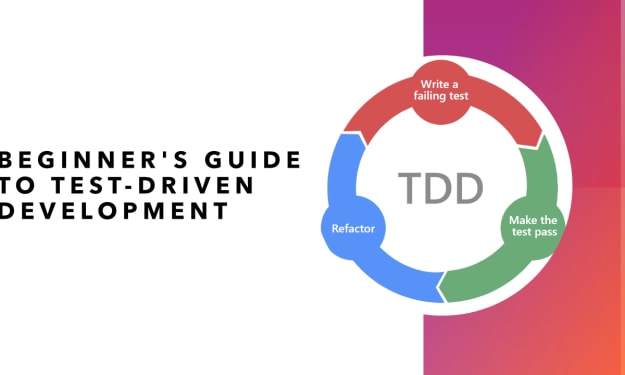
Beginner's Guide to Test-Driven Development
What is Test-Driven Development (TDD) Test-driven development (TDD) is a software development process that repeats a concise development cycle. First, an automated test case is written that defines the desired improvement or new function. Next, the minimum amount of code is written to pass that test. Finally, that code is refactored to acceptable standards. This process encourages simple and decoupled designs. The benefits of TDD include increased test coverage, faster feedback to developers, and more modular code with reduced defects. Over time, an extensive regression test suite accumulates, allowing for changes with confidence.
By Jemin Desai3 years ago in 01
Transforming Community Engagement: The Civita App Digital Revolution
In an increasingly digital world, where technology permeates every aspect of our lives, it's no surprise that community engagement is also undergoing a transformation. Enter Civita App, a groundbreaking app that is revolutionizing the way communities interact and stay connected in the digital age. This blog post explores the digital revolution brought about by Civita App and how it is changing the landscape of community engagement.
By Rattle Tech3 years ago in 01