
The Spear and the Watch
Or How I Finally Got My Head Wrapped Around Artistic Subjectivity



Unexpected grab outta nowhere! The man nearly bowled me over in his enthusiasm. He grabbed my wrist and twisted my arm to an awkward angle. Since I’d been standing like a dorky penguin with hands clasped behind my back and peering downward in a Snoopyish vulture stance, knocking me over would have been easy for anyone. However, this man loomed high above me with his at least six-foot seven frame. Though he was lanky like virtually all of the Nilotic peoples he was all muscle, distilled by a childlike expression of awe and delight across his outrageously handsome face.
Setting? Oh yes, I suppose it would help if I placed us somewhere. It’s July 1999 – the real one, not Prince’s- and we’re standing in a small market just outside a tiny Maasai village on the outer slopes of Ngorongoro Crater near the Serengeti in Tanzania. Our safari guide, inevitably named Peter, has brought us here on our way up to the crater rim to enjoy a cool night at higher elevation before descending into the famous crater tomorrow. The wildlife of Ngorongoro is legendary. We’re anticipating a life-changing day tomorrow on a life-changing journey.
A sea of wildebeest in the Maasai Mara, a lion cub daycare of at least eighteen little growlers watched over by three duty lionesses, another lioness using our vehicle as a blind from which to stalk a Thompson’s gazelle while employing that low crouched side-slide you’ve watched your house cat enact at play. The biggest life-slam for me so far was a surprisingly barren and arid Olduvai Canyon. To this day I can’t tell if this European-North American’s unexpected but intense feeling of homecoming at Olduvai was offensive. I hope not because, wow, was it powerful! I remember saying quietly to myself, “This is where it all began; this is our home.” The stark sun was beating down the barren earth of the dry canyon. Paleontologists sure love desert places…

So, the enthusiastic Maasai businessman had spotted something peculiar and alluring about my dress as I wandered the village market looking at the various cloths, wood objects and other wares spread out to entice us tourists. His own dress was traditional red capes, again to entice us tourists. Having seen other members of his ‘tribe’ (I dislike using that loaded word, especially in this context, but it seems necessary here), having seen other Maasai and Samburu moving about in any combination of expensive Western and traditional clothing, driving very expensive vehicles and conducting serious business over their ubiquitous cell phones, I had no delusions about the commercial savvy of these people.
For more than thirty years now I’ve lived in Old Order Mennonite country. I can number in the dozens the times I’ve overheard city-slickers enter a Mennonite business bragging to each other about the great deals they’ll get from the ‘yokels’. The Mennonites are cagey business folk and they prefer satisfied customers, so these arrogant, deluded tourists will get good value for their money, but any hope of fleecing the ‘simple folk’ is based entirely on fantasy. The Mennonites are usually outstanding practitioners of the business arts.

I almost instantly recognized the Maasai as kindred spirits to the Mennonites in their trade philosophy. That’s why this man’s behaviour so surprised me. He definitely wasn't playing it cool. Among guide Peter’s recommendations for proper decorum around the Maa speaking people was to not shove your hands in your pockets like a dude on holiday. That’s why I was walking around the market with my hands clasped behind me, British Royal Family-style. It really did feel dorky.
One more digression on our little journey is necessary. About two months before the trip to East Africa the wristband on my surpassingly cheap digital Casio watch broke. A few days later I found myself almost absently seeking a replacement band in one of those old school department stores that no longer exist anywhere but Manhattan. What I came up with was a pleasant cloth velcro band adorned with a colourful juxtaposing pattern of triangles you could describe as distinctly “African”. At least it was to my woefully ignorant eyes. This is what I had on my wrist at the village on the slopes of Ngorongoro.

The final piece of the puzzle is that, for some obscure, unfathomable reason I’ve never been able to suss out, that particular type of cheap Casio watch was at that time enjoying a powerful sort of kitschy ‘in vogue’ popularity (I genuinely think it was tongue-in-cheek too) among young Maasai people that year. Like certain Pokémon, this type of Casio had become both hard to find and highly desirable in that place.
At home any variety store had them for twenty bucks. In Tanzania that summer they were going for up to a thousand and that was with the plain, boring black plastic wristband. Don’t ask me for an explanation of fads and fast fashion, I’m already way out of my league.
The man had my arm twisted upward a bit uncomfortably and with his vice-grip I wasn’t getting it back on my own initiative. In travel I learned long ago to not push the river, just go with the flow, so thinking he was deeply worried about the time I tried to reposition my wrist so he could better see the digital numbers. Happily, this gave him a clearer view of the watch face and brand name. He’d already had a close look at that colourful band.
His enthusiasm seemed to quadruple! Still holding my arm awkwardly like I was preparing for a synchronized swimming competition, he dragged me toward a row of Maasai “Lion” spears, the heavy combat spears so feared by even the mighty British Army, which the Nilotic peoples have made and used for centuries. His performance had grabbed the attention of everyone around, some amused, some alarmed. I should clarify that I wasn’t at all concerned. Though I didn’t know a word of the Maa language he was rapid firing at me in his anxiety, I could tell from his expression that he was enthusiastic, not confrontational. Though I was confused I was also curious and a little flattered to be receiving all this attention from someone who was, after all, just going about his workday.
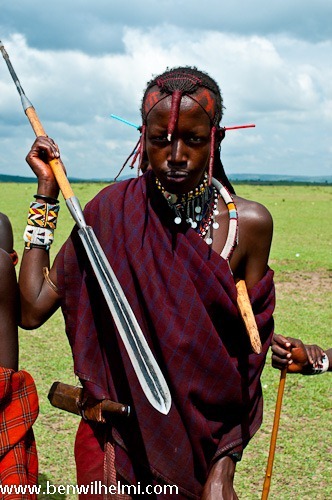
I soon realized it wasn’t me receiving the attention; it was my embarrassingly low-end timepiece. The man gestured wildly at his row of heavy spears and then pointed well… pointedly at my watch while helpfully holding my wrist up to my face. He repeated this pantomime several times as I grew more and more horrified by his proposal. In looking wistfully through collections and antique shops in places like Nairobi and Arusha none of us travelers had seen a Lion spear for anything less than six hundred dollars. This man wanted me to trade him my $20.00 Casio for one!
Saucer-eyed, I shook my head ‘no’. His face fell a little but he went through his routine once again. This time I shook my head vigorously. The man’s expression fell into despair. His shoulders sagged. Of course I wanted a genuine Maasai spear –what a souvenir- but I also wanted to be able to continue living with myself. I couldn’t accept this grievously unfair trade. His hands dropped to his sides in dejection as he began to walk away uphill, his face pointed to the cloudless sky.
Guide Peter stepped in. As a Maasai himself Peter could have spoken to the man in Maa, but I recognized bits of Swahili, the business language which connects the different peoples of East Africa in commerce. Then Peter turned to me. “Roy,” he began in the soothing lilt of English which helps to make African accented talk so appealing. “Roy, I understand that you think you’re being fair with this man, but you’re mistaken. He has dozens of spears as part of his business. He can replace the one you choose for only a few dollars. What he can’t get here because they’re all sold out is this kind of watch.” He held up my wrist and then his own Casio adorned forearm beside mine, grinning widely. “Plus, your wristband is unique, magnificent!” Had I spent even fifteen bucks on the thing? “You’ll make him very, very happy and very, very popular if you accept his offer. It’s a good deal for you both; one of the best I’ve seen in years. Please say yes?”
I had to think. As I stood puzzling my wife arrived from her bargain hunting. Getting the lowdown from Peter and the now circling crowd she turned to me. “He can’t get one of these watches here for love nor money yet he’s got spears coming out of his ears. At home you can replace this thing in half-an-hour for almost nothing but a Lion spear would cost you a fortune, if you could find one. It makes sense dummy, do it!” She didn’t cuff me upside the head, but I could tell she wanted to.
That decided me. I pulled the velcro band off of my wrist and handed it to the handsome, grinning young man. The spectators cheered as he strapped it on and held his arm up a full seven feet in the air. The joy and relief flashing across his face made my legs go rubbery. His friends cheered louder and I couldn’t help grinning myself. After he ceremoniously marshalled me back to his spear collection I chose what looked to me to be the least valuable spear available. But what do I know; I just hope it wasn’t an especially valuable or sentimental one for him. We shook hands and parted ways, both richer for our brief encounter at Ngorongoro.

It was 1999. The spear came home with me as carry-on luggage collapsed into its three constituent parts and wrapped in a makeshift box my wife fashioned for it. At customs the official fussed endlessly over a necklace of beads my wife had declared while I waited. At one point the customs officer looked up and pointed at the oddly shaped box under my arm. “What’s that?” she asked.
“A spear,” I answered. You could shave with the thing it was so sharp. She shrugged and returned to the dreaded invasive beads from Zanzibar. We eventually got the necklace through customs and that huge, heavy Lion spear still holds pride of place at the pinnacle of my travel souvenirs.
More valuable still was the lesson in subjectivity I began to get my head around after that experience. Monetary value is one thing and it’s often far over-rated in our misguided notions (of course I’m speaking generally for a larger ‘we’ here). But for us writers understanding and the ability to view things from others’ positions is far more important.
Even more important is the realization that others see things sometimes profoundly differently from us. When it comes to our creations the understanding that the interpretations, beliefs and views of others toward our writing, our stories and poems, is just as valid as our own beliefs will go a long way to easing our acceptance of how others see us and our work.
Whether we like it or not, once we’ve placed something of ours out there for others to read or view or hear, that work no longer belongs entirely to us. We have to share how others see it as well. The universality of monetary valuation is an illusion. It’s things that matter in the end. And our writing produces things which others will interpret and care about in different ways from our original intentions. If you want people to read your work, it’s best you accept that they’ll sometimes get different things from it than you were after. Since we’re all stuck alone in our own heads life is inevitably subjective. The Maasai man showed me that with a spear and a watch.
About the Creator
Roy Stevens
Just one bad apple can spoil a beautiful basket. The toxins seep throughout and...
Enjoyed the story? Support the Creator.
Subscribe for free to receive all their stories in your feed. You could also become a paid subscriber, letting them know you appreciate their work.
Comments
There are no comments for this story
Be the first to respond and start the conversation.