opinion
Opinion pieces from the left, right, and everyone in between.
Fukuyama's “End of History”: A Liberal Triumph or an Unfinished Debate?
Author's note: I originally published this article several years ago. Returning to Fukuyama's argument in October 2026, I wanted to reconsider its philosophical foundations, the relationship between economic and political freedom, and whether the contradictions of contemporary societies challenge the possibility of a final historical destination.
By Sergios Saropoulosabout 3 hours ago in The Swamp
Understanding Trickle-Down Economics: A Critical Perspective
The Promise of Prosperity There is something interesting about the way economic policies are presented to the public. Governments frequently promise that particular reforms will create prosperity, encourage investment and eventually improve the living standards of society. Yet behind these familiar promises lie questions that are rarely examined with the same enthusiasm. Who is expected to benefit first? Who must wait for the benefits to arrive? And what happens when an economy grows without producing a comparable improvement in the lives of those whose labour sustains it?
By Sergios Saropoulosabout 4 hours ago in The Swamp
What Happens After Election Day 2026 Could Be Worse Than You Think
On November 3rd, Americans will decide who controls Congress, how much power the White House can exercise, and what the next two years of American government might look like. Then comes the scary stuff!
By Jason Morton7 days ago in The Swamp
Europe Risks Sabotaging Prosperity With China Trade Curbs . AI-Generated.
As Brussels explores increasingly stringent trade measures against China, a critical question arises: are European policymakers safeguarding the continent's economic interests, or potentially placing its future prosperity in jeopardy?
By The Ireland Sino Institute7 days ago in The Swamp
When a Society Stops Replacing Itself: The Consequences of Declining Birthrates and the Path Toward Recovery. AI-Generated.
Introduction: The Consequences of a Changing Population In Part One, we examined the changes that reshaped American family formation across more than sixty years. From the expansion of contraception and changing marriage laws to rising living expenses, declining religious participation, increasing chronic illness, digital socialization, changing relationships between men and women, and the growing complexity of raising children, numerous developments have contributed to the conditions surrounding modern reproduction.
By Peter Thwing - Host of the FST Podcast8 days ago in The Swamp
The Declining Birthrate: How Six Decades of Change Reshaped Marriage, Family, and Reproduction. AI-Generated.
Introduction: Understanding How We Got Here For much of American history, marriage and raising children represented an expected progression into adulthood. Young men and women generally married earlier, began having children earlier, and formed families within communities where religious institutions, extended relatives, neighbors, and established social expectations reinforced family life. The Baby Boom, extending from approximately 1946 through 1964, represented the culmination of a period in which relatively early marriage and larger families were common features of American society.
By Peter Thwing - Host of the FST Podcast8 days ago in The Swamp
The Case for a New Plaza Accord
By Elliott J. Schuchardt For decades, American policymakers and economists have treated a strong U.S. dollar as an unassailable metric of national economic health. The prevailing orthodoxy asserts that a powerful currency reflects a robust economy, suppresses domestic inflation, and cements the United States at the center of global finance. However, this perspective overlooks a structural distortion that has slowly hollowed out our industrial core. The U.S. dollar is profoundly overvalued, and this artificial appreciation acts as a permanent tax on domestic manufacturing, exports, and long-term economic stability. To restore competitiveness, revitalize local production, and correct massive global trade imbalances, the United States must actively pursue a strategy to devalue its currency.
By Elliott J. Schuchardt12 days ago in The Swamp
Buy the Election(s)
It’s not bad enough that we have to deal with the most ignorant president of all time in the U.S. His cabinet members make idiotic moves daily. The richest person in the world benefits by being joined to Mr. Cheeto President. You know who it is. Rockets to Mars, 14 kids by different women (that we know of), a ketamine-infused trillionaire who could use his money for good but instead buys elections.
By Andrea Corwin 17 days ago in The Swamp
Dynasties of minions in service of the Grey Pope
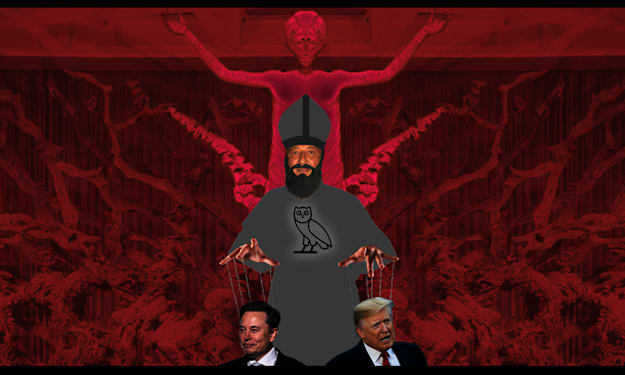
In a world where the facade of democracy masks the omnipotence of oligarchy, a hidden hierarchy allegedly dictates the course of history from the Vatican, with Domenico Napoleone Orsini – the 22nd Duke of Gravina – the grey pope and puppetmaster behind the curtain concealing the spheres of influence that shape our world.
By Steve Harrison22 days ago in The Swamp