
The Democracy Illusion
They gave us the illusion of choice, then taught us to fight each other while the machinery of power kept running.

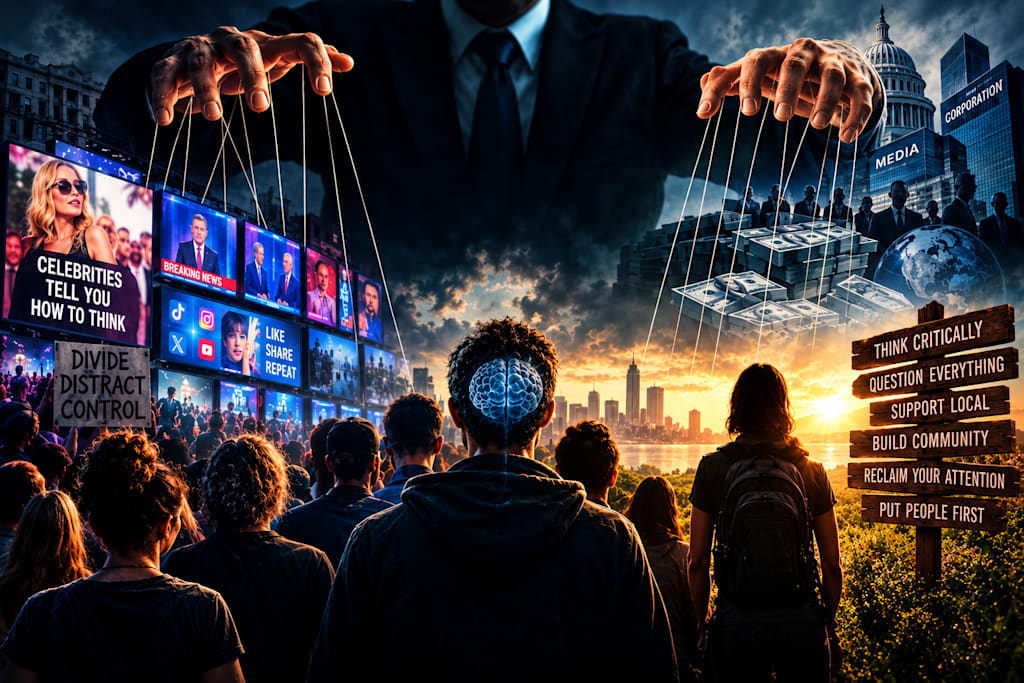
The Illusion Is the Product
We were told we lived in a democracy. We were told our voices mattered, our votes counted, our freedoms were sacred, and our institutions existed to serve us.
We were told we were free.
But look around.
The cost of living is suffocating people. Groceries, housing, healthcare, gas, and basic necessities are becoming increasingly difficult for ordinary families to afford. People work themselves into exhaustion just to maintain a life that somehow feels less attainable with every passing year. Governments spend enormous sums abroad while citizens at home struggle to make ends meet. Political leaders promise change, corporations report profits, and the average person is left wondering why survival has become so expensive.
And every four years, we are handed another election, another manufactured emergency, another villain to hate, and another savior to believe in.
We are told that if we just vote for the right person, support the right movement, or defeat the right political party, everything will finally get better.
But what if the problem runs deeper than the person sitting in the Oval Office?
What if the illusion isn't simply that we have bad leaders, but that replacing those leaders is enough to fundamentally change a system that rewards the same behaviors, protects the same interests, and depends on the same population remaining distracted?
What if democracy has become a performance in which we are allowed to choose the actors but rarely question who owns the theater?
That is the democracy illusion.
And the most effective illusion is the one that convinces you that you are free while teaching you to accept the boundaries of your own freedom.
We Have Forgotten How to Think
One of the most dangerous things happening in modern society is not that people disagree. Disagreement is inevitable in a free society.
It is that so many people seem to have forgotten how to disagree intelligently.
We have become a culture of emotional reactions, recycled talking points, viral clips, and political slogans. We repeat what our preferred personalities tell us to repeat. We defend people we have never met as though they are family. We attack strangers whose opinions we have barely bothered to understand.
And somewhere along the way, independent thought became less important than belonging to the correct tribe.
Thomas Sowell captured this problem in a statement about the decline of reasoning:
"One of the painful signs of years of dumbed-down education is how many people are unable to make a coherent argument. They can vent their emotions, question other people's motives, make bold assertions, repeat slogans-- anything except reason.”
Read that again.
How often do we actually see people examine evidence, acknowledge inconvenient facts, and change their minds when the evidence demands it?
How often do we see people defend a principle even when doing so makes their own political side look bad?
Too often, the answer is that we don't.
Instead, we have turned politics into a team sport. If our side does something outrageous, we explain it away. If the other side does the same thing, we demand accountability. We call our own side's propaganda messaging and the other side's messaging propaganda. We condemn corruption in our opponents while making excuses for it among our allies.
That isn't critical thinking. It's tribal loyalty dressed up as intellectual conviction.
And the people who benefit most from our inability to think independently are the people who never want us to stop and think in the first place.
A population that reasons is difficult to manipulate. A population that reacts can be led almost anywhere.
The Left-Right Trap
Let me make something clear: I am not interested in blindly defending the left or the right.
I am interested in asking questions that both sides would rather we didn't ask.
Why should any political party receive our unquestioning loyalty? Why should we defend a politician simply because they carry our preferred label? Why should we accept an official narrative simply because it comes from an institution we were taught to trust?
And why are we so quick to label people conspiracy theorists, extremists, or lunatics when they question powerful institutions?
Questioning a claim is not the same as disproving it. Questioning authority is not proof of ignorance. And skepticism is not a substitute for evidence, but neither is blind trust.
A healthy democracy requires citizens who can question every side, examine competing evidence, and admit when their own side is wrong.
That includes presidents, political parties, intelligence agencies, corporations, media organizations, universities, and anyone else who claims authority over public life.
Institutions can do valuable work and still make serious mistakes. Experts can possess genuine knowledge and still have conflicts of interest. Governments can perform necessary functions and still abuse their power.
The answer is neither blind faith nor automatic rejection. It is scrutiny.
Sowell offered a particularly relevant observation:
"Some things are believed because they are demonstrably true. But many other things are believed simply because they have been asserted repeatedly-and repetition has been accepted as a substitute for evidence.”
That is the machinery of modern persuasion.
Repeat a claim often enough, place it in the mouths of enough influential people, surround it with enough emotional pressure, and eventually questioning it can seem more outrageous than believing it.
But repetition is not proof. Popularity is not proof. A celebrity endorsement is not proof. A government press conference is not proof.
And a million people repeating a lie cannot transform it into a fact.
The responsibility of a thinking citizen is to ask: What is the evidence? What is missing? Who benefits if I believe this? What would change my mind?
Those questions should never be considered radical.
They should be the bare minimum.
Celebrity Activism and the Business of Manufactured Outrage
There was a time when celebrities were primarily entertainers. They made music, acted in films, performed on stages, and gave people a temporary escape from ordinary life.
Now, celebrity culture increasingly functions as a political megaphone.
Actors, musicians, influencers, and public personalities regularly lecture millions of people about how they should vote, what they should believe, which causes they should support, and which people they should condemn.
They step onto red carpets wearing carefully chosen symbols. They deliver rehearsed speeches about justice and morality. They post the approved statement at the approved moment. They condemn the approved villain and celebrate the approved hero.
And we are expected to mistake visibility for wisdom.
A person can be exceptionally talented at singing, acting, or building an online following without possessing any special expertise in economics, foreign policy, constitutional law, education, or public administration.
Fame is not a credential in political philosophy.
Nor does wearing a pin, posting a slogan, or standing beneath a banner automatically make someone courageous or compassionate.
Sometimes public advocacy is sincere and consequential. Sometimes celebrities use their platforms to bring attention to legitimate problems. That deserves recognition.
But celebrity activism can also become a branding exercise: morality as marketing, outrage as entertainment, and political identity as another product to sell.
The question is not whether a celebrity agrees with us.
The question is whether we have surrendered our judgment simply because someone famous told us what to think.
Sowell's criticism of intellectuals offers a useful warning about the difference between appealing ideas and workable solutions:
"The more I study the history of intellectuals, the more they seem like a wrecking crew, dismantling civilization bit by bit - replacing what works with what sounds good.”
An idea can sound compassionate and still produce harmful consequences. A policy can be marketed as liberation and still create new dependencies. A movement can speak in the language of justice while discouraging honest scrutiny of its own actions.
Good intentions do not eliminate the need to examine results.
And moral posturing is not a substitute for moral courage.
Real courage sometimes means questioning your own movement. It means refusing to repeat a talking point you haven't verified. It means standing against wrongdoing even when the person responsible belongs to your side.
Anything less is performance.
The Media Machine: Who Controls the Conversation?
Consider how much of our understanding of the world comes through institutions we will never personally inspect.
We rarely witness major political events firsthand. We depend on journalists, broadcasters, editors, publishers, commentators, social platforms, and government briefings to help us interpret what happened.
That doesn't mean all media is corrupt or every report is fabricated. Journalism has exposed genuine wrongdoing, challenged powerful institutions, and informed the public about events that would otherwise remain hidden.
But media ownership, corporate concentration, advertising incentives, political access, and the competition for attention all influence which stories receive prominence and how those stories are framed.
A frequently circulated claim states that six corporations own 1,500 newspapers, 1,100 magazines, 9,000 radio stations, 1,500 television stations, and 2,400 publishers.
Those numbers should not be repeated as current fact without a reliable source, a clear date, and definitions of what is being counted. Media ownership has changed substantially over time, and the figures in circulation may combine different eras or categories.
But the underlying question remains essential: Who owns the platforms through which we understand the world, and what incentives shape the information they distribute?
That question deserves serious investigation, not a reflexive dismissal.
A concentrated media landscape can narrow the range of perspectives that receive attention. Commercial incentives can reward sensationalism over nuance. Political relationships can influence access and coverage. Algorithms can amplify outrage because outrage keeps people engaged.
And when the same story is repeated across multiple outlets, audiences may assume they are hearing independent confirmation when the outlets may be relying on the same original source.
This is why media literacy matters.
Compare sources. Read beyond headlines. Look for primary documents. Distinguish verified reporting from opinion. Check whether an allegation has been substantiated, disputed, or debunked.
Do not believe something merely because it confirms what you already suspect.
And do not dismiss something merely because it challenges what you already believe.
The objective is not to find a source that always agrees with you.
It is to develop a mind that no source can easily control.
When Government Becomes the Answer to Everything
Every society faces real problems. Poverty exists. Crime exists. Discrimination exists. People make mistakes, institutions fail, and some individuals exploit others.
The question is how we respond.
Government can provide necessary services, enforce laws, protect rights, and address problems that individuals or communities cannot solve alone. But government power is not inherently benevolent simply because it is exercised in the name of a worthy cause.
Every expansion of authority deserves scrutiny. Every new policy deserves an examination of its costs, unintended consequences, and potential for abuse.
Sowell put the underlying tension bluntly:
"As long as human beings are imperfect, there will always be arguments for extending the power of government to deal with these imperfections. The only logical stopping place is totalitarianism — unless we realize that tolerating imperfections is the price of freedom.”
Freedom has a cost.
It means living alongside people who make decisions we dislike. It means accepting that not every social problem can be eliminated through legislation. It means recognizing that an imperfect society cannot be made perfect simply by giving more power to people who promise they can fix it.
There is a dangerous temptation to believe that if we could only put the right people in charge, they could eliminate every injustice, regulate every risk, prevent every bad decision, and engineer a society in which nobody suffers.
But people in government are human, too. They have incentives, ambitions, blind spots, and interests of their own.
Power does not magically make human beings wise.
And concentrating more power in the hands of imperfect people can create problems far greater than the ones they claim to solve.
The real question is not whether government should exist. It is how we hold it accountable, limit its ability to abuse authority, protect individual liberties, and preserve the freedom to challenge the people who govern us.
Because a government that cannot be questioned is not a government that deserves unquestioning trust.
Division Is the Distraction
Look at the arguments consuming our attention.
Men versus women. Black versus white. Left versus right. Workers versus business owners. Tenants versus landlords. One generation against another. One cultural group against another.
Some of these disagreements involve genuine injustices, competing interests, or legitimate grievances. They should not be dismissed simply because division can be exploited.
But we should ask ourselves an uncomfortable question:
Who benefits when ordinary people become so consumed with fighting one another that they have little energy left to scrutinize the institutions exercising power over all of them?
Sowell once wrote:
"Back in my old neighborhood, there was a special contempt for the kind of guy who was always trying to get two other guys to fight each other. Today, it is considered a great contribution to society to incite consumers against producers, tenants against landlords, women against men, and the races against each other.”
There is a difference between confronting injustice and manufacturing permanent hostility.
There is a difference between holding someone accountable and reducing an entire group of people to a caricature.
There is a difference between advocating for your community and being manipulated into despising someone else's.
A society cannot function well when every disagreement becomes a moral war and every person becomes either an ally or an enemy.
Division is profitable for people who sell outrage. It generates clicks, boosts engagement, energizes political fundraising, and keeps audiences returning for the next round of conflict.
Anger can be justified. But anger can also be cultivated, directed, and monetized.
When we are constantly fighting, we have less time to build. When we are constantly reacting, we have less energy to investigate. And when we define ourselves entirely through opposition to another group, we become easier to mobilize against whatever target is presented to us next.
The answer is not to pretend our differences do not matter.
It is to refuse to let those differences become a substitute for thinking.
The Cost of Being Distracted
Perhaps the most disturbing feature of modern life is how effectively we have learned to distract ourselves from our own dissatisfaction.
We work. We scroll. We shop. We binge-watch. We argue online. We follow celebrity relationships, political scandals, sporting events, influencer feuds, and endless streams of content.
Then we wake up and do it all again.
Entertainment itself is not the enemy. Art, music, sports, comedy, and storytelling can enrich our lives. They can create community, inspire people, and offer genuine relief during difficult times.
The problem begins when entertainment becomes an escape from a life we no longer feel equipped to change.
We can name the latest celebrity scandal but know very little about the policies affecting our communities. We can spend hours arguing with strangers while barely speaking to our neighbors. We can consume endless commentary about the world while neglecting the relationships, skills, and institutions that make our own lives meaningful.
We are connected to everything and present for almost nothing.
And underneath the constant stimulation, something is wearing away.
People are exhausted.
They are tired of feeling as though life has been reduced to working, paying bills, managing stress, and pretending everything is fine. They are tired of being told to optimize themselves, heal themselves, and become more resilient while the pressures surrounding them continue to mount.
There is a limit to how much individual self-improvement can accomplish when people are struggling with unaffordable housing, unstable employment, social isolation, and a relentless stream of demands on their attention.
Personal responsibility matters. So do the conditions in which people are expected to exercise it.
We cannot solve every structural problem through meditation, positive thinking, or another productivity routine.
Sometimes the problem is not that we have failed to adapt.
Sometimes the conditions themselves need to change.
And recognizing that difference is the beginning of taking our lives seriously again.
We Are Not the Audience. We Are the Participants.
Here is where the conversation becomes uncomfortable.
The institutions we criticize do not exist in a vacuum. Their influence depends, in part, on our participation.
Corporations depend on customers. Media companies depend on audiences. Social platforms depend on attention. Political campaigns depend on votes, donations, and engagement. Entertainment industries depend on people choosing to spend their time and money.
We are not powerless.
But we often behave as though we are.
We complain about companies while continuing to reward their worst practices. We condemn the outrage economy while feeding it with our attention. We criticize political dishonesty while defending it whenever it benefits our side.
We say we want something different, then continue participating in the same habits that help preserve the status quo.
That does not mean every individual consumer is responsible for every systemic failure. People have bills to pay, jobs to keep, children to feed, and obligations they cannot simply abandon. Participation in modern society is not entirely voluntary, and meaningful change often requires collective action rather than isolated gestures.
Still, there is a powerful distinction between being trapped in a system and surrendering all agency within it.
We can choose what we amplify. We can decide which companies deserve our money when alternatives are available. We can reduce our dependence on platforms that make us miserable. We can support local businesses, strengthen community organizations, learn practical skills, and build relationships that do not depend on an algorithm.
We can stop treating every trending controversy as an emergency demanding our immediate emotional investment.
We can refuse to make celebrities, politicians, and influencers the central characters in our lives.
And we can stop confusing consumption with participation in society.
Because the machine may be large, but it is not self-sustaining.
It depends on human beings giving it their time, labor, attention, money, and legitimacy.
They may manage the machinery of power. But ordinary people are part of what keeps it running.
The important question is what we choose to do with that knowledge.
Stop Feeding What Is Draining You
There is a temptation, when faced with overwhelming institutional failure, to conclude that everything must be destroyed.
I understand the impulse. When people feel unheard, betrayed, and powerless, anger can become the only emotion that seems proportionate to the situation.
But indiscriminate destruction is not liberation.
Violence can devastate the very communities people claim to be defending. It can injure innocent people, destroy livelihoods, and create opportunities for authorities to impose even harsher restrictions. Chaos rarely distributes its consequences fairly.
And abandoning work, refusing to pay obligations, or attempting to shut down essential services without considering the consequences can hurt ordinary people long before it meaningfully challenges powerful institutions.
The answer is not to romanticize collapse.
The answer is to become more deliberate about where our power actually lies.
Withdraw your attention from content designed to keep you furious. Stop rewarding dishonesty with your loyalty. Stop giving public figures unlimited access to your emotions. Stop spending money to maintain an image of a life you cannot afford. Stop treating political affiliation as a substitute for personal values.
Where possible, build alternatives.
Support independent journalism that demonstrates its work. Learn to verify information. Strengthen local relationships. Participate in community decisions. Support peaceful collective action, including lawful boycotts, labor organizing, and civic advocacy. Protect your financial resilience. Develop skills that give you more options.
And perhaps most importantly, learn to sit with an uncomfortable fact without immediately searching for someone to tell you how to feel about it.
These actions may not produce the instant gratification of a viral rant or a dramatic confrontation. But they build something more durable than outrage: independence.
The goal is not to disappear from society.
It is to stop surrendering your judgment to every institution demanding your allegiance.
The goal is not to become indifferent.
It is to become difficult to manipulate.
A Free Society Requires Free Minds
There is a reason the freedom to speak, question, criticize, and dissent matters so much.
Freedom is not meaningful if it exists only when we agree with one another.
Sowell expressed this point in a particularly memorable passage:
"Freedom means nothing if it does not mean the freedom to do what other people don't like."
That principle cuts in every direction.
It protects the right to question progressive orthodoxy. It protects the right to question conservative orthodoxy. It protects the right to criticize presidents, institutions, corporations, religious authorities, activist movements, and cultural trends.
It also protects people whose opinions we find deeply misguided.
The test of a free society is not whether people are permitted to repeat popular opinions. It is whether they can challenge prevailing assumptions without being threatened into silence.
A society that treats disagreement as an offense eventually loses the ability to correct its own mistakes.
And a population that fears social punishment more than it values truth will eventually begin policing itself.
That is why intellectual independence matters.
You do not have to agree with Thomas Sowell to recognize the importance of reasoning. (I know I'm quoting him a lot in this piece, but I think he has contributed great value to sober-minded free thinkers like you and I, dear reader.) You do not have to support a particular political party to demand accountability. You do not have to embrace every alternative explanation to recognize that official claims deserve scrutiny.
Nor should you treat a provocative quote as proof that its author is correct about every issue.
Think critically about the people you agree with, too.
The moment a public figure becomes immune to your questions is the moment you have stopped evaluating their ideas and started protecting their identity.
No politician deserves that kind of loyalty.
No celebrity deserves it.
No movement deserves it.
And no government deserves it.
The Real Revolution Is a Change in Consciousness
We keep waiting for someone to save us.
A better president. A better party. A better movement. A better leader. A better generation.
We keep searching for the one person who will finally tell the truth, fix the system, defeat the villains, and restore the world we believe we have lost.
But no individual can think for us. No election can replace civic responsibility. No protest can substitute for the sustained work of building institutions that serve the public. And no political movement is immune to corruption simply because it began with noble intentions.
The first step toward change is refusing to outsource our judgment.
It is learning to recognize the difference between evidence and assertion, principle and tribalism, compassion and performance, skepticism and cynicism.
It is asking better questions.
It is refusing to let anger make us careless with the truth.
It is recognizing that our neighbors are not automatically our enemies because they vote differently, consume different media, or arrive at different conclusions.
And it is remembering that a society is not strengthened by the number of people who agree with one another. It is strengthened by the number of people who can disagree honestly, reason carefully, and hold power accountable without abandoning their own principles.
We do not need a society in which everyone thinks alike.
We need one in which people are free to think for themselves.
That is where meaningful resistance begins.
Not in blind obedience. Not in endless outrage. Not in the worship of another political personality.
But in clarity.
In discipline.
In community.
In the courage to question what everyone else seems to accept.
And in the willingness to change our own behavior rather than simply demanding that someone else change theirs.
So, What Happens Next?
Maybe the most important question is not whether the system is broken.
It is what we are prepared to do once we recognize where it is failing.
Will we keep scrolling through our dissatisfaction, numbing ourselves with entertainment, and arguing over which political tribe deserves our loyalty?
Will we continue mistaking visibility for influence, outrage for action, and popularity for truth?
Will we keep waiting for permission to live differently?
Or will we begin reclaiming the parts of our lives that we can actually control?
Our attention. Our time. Our money. Our relationships. Our habits. Our judgment.
Will we learn to disagree without dehumanizing? Will we demand evidence before repeating claims? Will we scrutinize power regardless of who holds it? Will we build communities that are less dependent on distant institutions and more capable of supporting one another?
None of these actions guarantees a perfect outcome. Real change is difficult, collective, and often painfully slow.
But resignation guarantees nothing.
And outrage without direction changes very little.
The greatest threat to a system that profits from distraction is a population that becomes harder to distract. The greatest threat to a culture of manufactured division is a population that refuses to hate on command. The greatest threat to political manipulation is a citizen who no longer confuses loyalty with thought.
We were told democracy means choosing our leaders.
But democracy must mean more than casting a ballot and then surrendering our attention until the next election.
It must mean participating in public life, demanding accountability, protecting dissent, and recognizing that the people who govern us are not above the people they govern.
It must mean understanding that freedom is not a gift bestowed upon us by those in power.
It is a responsibility we must continually defend.
The illusion survives when we stop asking questions. It weakens when we start thinking for ourselves.
So question the narrative. Question the messenger. Question the institution. Question your own assumptions.
Do not trade one unquestioned authority for another.
Do not allow the pursuit of justice to become an excuse for abandoning fairness. Do not allow your anger at one political faction to blind you to the failures of another. Do not allow the people demanding your trust to make you feel ashamed of asking for evidence.
And do not confuse disengaging from manufactured outrage with disengaging from the world.
The answer is not apathy.
It is conscious participation.
It is choosing what deserves your attention, where your resources go, which principles you will defend, and what kind of community you are willing to help build.
The machine may be powerful. The institutions may be enormous. The noise may be relentless.
But we are not obligated to believe everything we are told, worship everyone we are shown, or fight every battle someone else chooses for us.
We can stop feeding the outrage. We can stop rewarding dishonesty. We can stop treating each other as enemies by default.
We can reclaim our capacity to think, our willingness to question, and our responsibility to act.
Because the real democracy illusion is not merely that we have no power.
It is that we have so little power that we might as well stop trying to use it.
And that is the one belief we cannot afford to accept.
Think independently. Question relentlessly. Build deliberately. And never surrender your freedom of thought to anyone who demands your unquestioning loyalty. ~
About the Creator
Li-Li 📓
Hi, my name is Li-Li & I'm just grateful to be able to share my words here. ♥
Enjoyed the story? Support the Creator.
Subscribe for free to receive all their stories in your feed.
Comments
There are no comments for this story
Be the first to respond and start the conversation.