
Europe Risks Sabotaging Prosperity With China Trade Curbs
How Europe's tougher stance on China could backfire on businesses, consumers and economic growth.

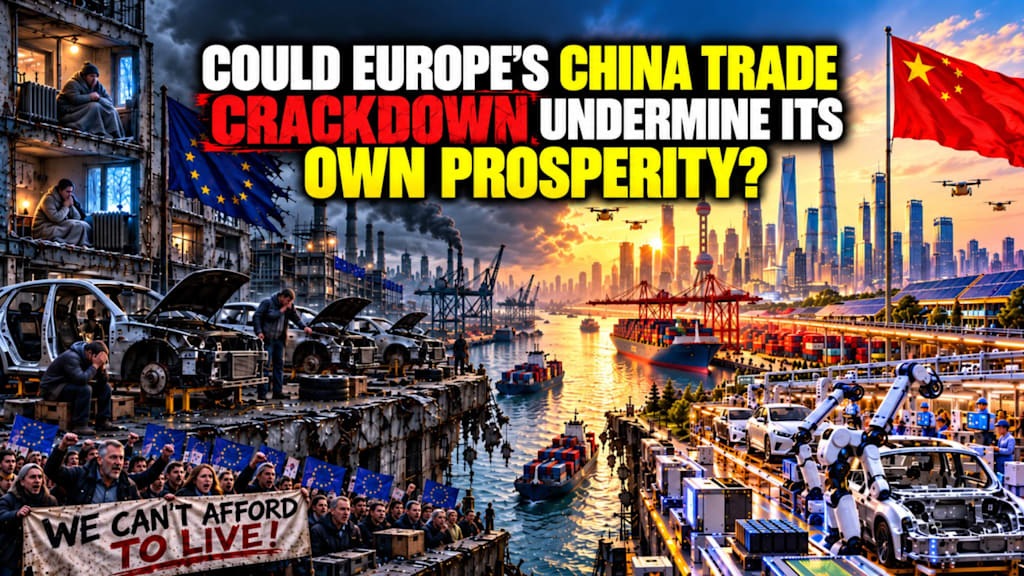
As Brussels explores increasingly stringent trade measures against China, a critical question arises: are European policymakers safeguarding the continent's economic interests, or potentially placing its future prosperity in jeopardy?
The European Union appears increasingly committed to pursuing a more confrontational economic relationship with China. Bloomberg has reported that EU policymakers are considering sweeping new trade powers that, under extreme circumstances, could allow Chinese products to be excluded entirely from the European single market.
These discussions come after an understanding concerning restrictions on Chinese hybrid vehicle exports, while further measures are being examined in sectors such as chemicals, machinery and other manufactured goods.
For a trading bloc that has long presented itself as a defender of open markets and international commerce, the direction of these proposals invites serious questions about their potential long-term implications.
Concerns within Europe about industrial competitiveness, state subsidies and fair access to the Chinese market are legitimate. Nevertheless, an increasingly restrictive response to Chinese competition could impose substantial economic costs on European manufacturers, exporters and consumers themselves.
Looking Beyond Europe's Goods Trade Deficit
A major justification for Europe's harder stance towards China is the considerable imbalance in merchandise trade between the two economies. European Commission figures indicate that the EU recorded a goods trade deficit with China of approximately €360 billion in 2025.
However, that figure represents only one dimension of a much broader economic relationship.
Although the merchandise deficit receives considerable political attention in Brussels, Europe's favourable trade position in services is discussed far less frequently.
According to the European Commission, the EU achieved a services trade surplus of €21.3 billion with China in 2025. Research conducted by the Europe Sino Institute estimates that the combined surplus over the period from 2012 to 2024 was close to €200 billion.
These figures deserve greater consideration. The Council of the European Union reports that EU services exports to China amounted to approximately €67 billion in 2025, covering activities such as transport, telecommunications, information technology, intellectual property licensing, and professional and technical services.
Consequently, any meaningful evaluation of the economic relationship should acknowledge the significant advantages European businesses derive from services trade rather than relying exclusively on the merchandise deficit to judge its overall value.
Another important consideration is the composition of goods imported from China. European Central Bank statistics indicate that intermediate products accounted for more than 40% of euro-area merchandise imports from China in 2024. These include industrial materials, components and other inputs incorporated into products manufactured by European companies.
Research published in the ECB's 2026 Economic Bulletin provides further insight. Based on an analysis covering the years 2000 to 2022, the study identified an association between greater exposure to Chinese intermediate imports and an additional 0.6 percentage points of annual industrial production growth in the sectors examined.
This evidence illustrates that Chinese products do not simply compete against European manufacturers. They can also contribute to greater production efficiency, lower operating expenses and improved industrial competitiveness.
Policies that restrict the availability of such inputs could therefore increase manufacturing costs for the same European industries that Brussels intends to support.
EU–China Trade Crisis: A Documentary
Ireland Illustrates the Benefits of Constructive Engagement
Ireland's commercial relationship with China offers a valuable example of the economic opportunities that can emerge from sustained diplomatic cooperation.
China ranks as Ireland's largest trading partner in Asia and its fifth largest worldwide. Europe Sino Institute research estimates that Ireland generated a cumulative trade surplus of approximately €54 billion in goods and services with China between 2012 and 2024.
The relationship also supports employment in both economies. Irish enterprises provide approximately 5,000 jobs in China, while Chinese-owned businesses employ more than 5,000 people in Ireland.
During his official visit to Beijing in January 2026, Taoiseach Micheál Martin raised two significant trade concerns directly with Chinese President Xi Jinping. These involved the suspension of Irish beef exports to China and the substantial tariffs affecting European dairy products. Martin subsequently confirmed that President Xi had agreed to raise both matters with the relevant Chinese authorities.
Only days later, Chinese authorities announced that Irish beef could once again enter the Chinese market, ending restrictions that had been in effect since 2024. A little over a month afterwards, China also significantly lowered additional duties on certain European dairy products. Provisional tariffs that had reached 42.7% were replaced by final rates of between 7.4% and 11.7%.
The Chinese market for Irish beef was later closed again following a bluetongue outbreak in Ireland. Equally, it would be inaccurate to suggest that Ireland's diplomatic engagement alone was responsible for the subsequent reduction in dairy tariffs. Nevertheless, these developments demonstrate the importance of maintaining communication and pursuing trade concerns through direct diplomatic channels.
For a country such as Ireland, whose economic prosperity depends heavily on international exports, the implications are clear. Continued diplomatic dialogue can create opportunities to safeguard European exporters and pursue their commercial interests, even when relations between Brussels and Beijing become increasingly strained.
The Tension Between Europe's Green Ambitions and Its China Policy
The EU's increasingly restrictive position towards China highlights two significant tensions within its energy and industrial strategies.
First, Brussels is seeking to accelerate the transition towards cleaner energy and lower energy costs, while remaining substantially reliant on Chinese products and technologies needed to achieve these ambitions.
Eurostat data show that China supplied approximately 98% of solar panels imported into the EU in 2024. The European Commission has also acknowledged that imports from China satisfy approximately 98% of European demand for rare earth magnets, which are essential in applications including electric vehicles, wind turbines and advanced industrial machinery.
Chinese manufacturers consequently occupy an important position in the supply chains supporting renewable electricity generation and improvements in energy efficiency throughout Europe.
Restrictions that make these technologies more expensive or difficult to obtain could place additional financial pressure on households, companies and renewable energy developers. Such measures could also slow progress towards the environmental transformation the EU has committed itself to achieving.
Second, Europe is attempting to strengthen its economic autonomy from China, yet limiting access to essential Chinese technologies before viable alternatives are established could damage European industrial competitiveness.
There are sound reasons for the EU to reduce excessive dependence on a single trading partner. However, the creation of alternative manufacturing capabilities and supply networks involves considerable expenditure, technological development, specialist labour and time.
Introducing restrictions before European businesses can obtain dependable and competitively priced substitutes could increase their production expenses and leave them less capable of competing internationally.
The central challenge is therefore not whether Europe should seek more diversified supply chains. It is how to accomplish that objective without destabilising industries that currently rely on Chinese components, materials and technical capabilities.
European policymakers must carefully assess whether proposed restrictions could ultimately conflict with the Union's own industrial, economic and environmental priorities.
How Trade Confrontations Can Damage Unrelated Industries
Measures intended to restrict foreign trade can produce consequences extending well beyond the sectors initially targeted.
After the EU introduced additional tariffs on Chinese electric vehicles in 2024, Chinese authorities initiated investigations affecting European exports of brandy, pork and dairy products.
Brussels has challenged the grounds for Beijing's actions. Nevertheless, the resulting uncertainty demonstrates how disagreements involving one industry can develop into wider commercial disputes affecting entirely different sectors.
European agricultural producers and exporters may consequently face economic repercussions from trade conflicts in which they played no direct role.
The European Union cannot reasonably assume that restricting Chinese imports will improve its economic position without creating additional costs for European businesses and consumers.
A More Productive Approach: Cooperation for Shared Economic Benefit
Europe's underlying economic difficulties are unlikely to be solved through import restrictions alone. A more effective strategy would take account of the complementary strengths of European and Chinese industries while encouraging expanded commercial exchange, investment and industrial partnerships.
In the immediate and medium-term future, greater access to affordable Chinese intermediate products, batteries, solar panels and other energy technologies could help European manufacturers control production expenses. It could also support the green transition while easing some of the pressures associated with high energy prices and the cost of living.
Of even greater importance is the potential for the EU and China to promote jointly owned enterprises and strategic industrial partnerships within Europe, based on commercial arrangements that benefit both sides.
Chinese businesses possess considerable strengths in technological development, sophisticated manufacturing, efficient production methods and extensive supply networks. European enterprises contribute established engineering capabilities, research expertise, highly trained employees, distribution infrastructure and an understanding of European regulations and consumer markets.
For Chinese companies, working with European partners could facilitate entry into new markets, strengthen their international commercial reputation and open additional avenues for investment. For European businesses, such collaboration could attract capital, improve manufacturing efficiency, support employment and accelerate access to new technological capabilities.
Over an extended period, the potential advantages could become even more substantial. Collaboration in research, manufacturing and professional training could encourage the exchange of technical knowledge and expertise. These processes could improve Europe's industrial capabilities and strengthen its technological self-reliance, while allowing Chinese companies to expand their international activities and draw upon European experience.
Such partnerships would, naturally, need clearly defined commercial terms, reciprocal opportunities, transparent governance and robust safeguards for intellectual property.
Importantly, stronger economic cooperation does not require businesses to abandon competition. European and Chinese companies can work together in selected fields, remain competitors in others and even cooperate with direct rivals when their commercial objectives overlap.
This reflects the importance of three related economic concepts: cooperation, competition and coopetition. Cooperation allows businesses to work towards common goals. Competition provides incentives for innovation, productivity and efficiency. Coopetition enables competing enterprises to cooperate where doing so offers mutual commercial advantages.
Each of these dynamics performs a different function, and there is no fundamental reason why all three cannot operate simultaneously within a successful international economic relationship.
In practice, the EU and China could encourage the formation of jointly owned manufacturing businesses on European soil, support fair competition across international markets and facilitate technological partnerships between firms that otherwise compete against one another.
The battery industry represents a particularly attractive opportunity. China has developed extensive capabilities in battery technology, efficient manufacturing and specialised supply chains. Europe, meanwhile, possesses an established automobile industry, an experienced workforce and a growing market for electric vehicles.
Combining these advantages through industrial partnerships could support the expansion of European battery production, improve cost efficiency and encourage the sharing of technical knowledge, while creating new business opportunities for companies in both economies.
By developing carefully structured microeconomic policies that appropriately balance cooperation, competition and coopetition, Europe and China could unlock substantial economic synergies, encourage technological innovation and achieve greater production efficiency. The resulting commercial benefits could extend to businesses on both sides, while consumers gain access to more affordable products, higher quality and a broader range of choices.
The Wider Economic Consequences Europe Cannot Ignore
Europe's increasingly hostile and restrictive approach towards China risks concentrating on individual problems while neglecting the broader economic picture.
By placing excessive emphasis on protecting selected industries and narrowing the merchandise trade deficit, policymakers in Brussels may underestimate the substantial benefits arising from the EU's economic relationship with China.
Those benefits include access to competitively priced manufacturing inputs, essential raw materials, more affordable energy technologies, export markets, investment opportunities, employment, technological collaboration and development, and a wider selection of products for consumers.
An approach centred increasingly on restrictions could intensify existing energy and household affordability problems across Europe. It could also weaken industrial competitiveness, constrain productivity improvements and impede technological progress.
Rather than allowing trade barriers to dominate its China policy, the European Union should adopt a broader, evidence-based economic strategy founded on mutually beneficial relations. Such an approach should recognise the many interconnected dimensions of EU–China economic cooperation and carefully consider their collective contribution to Europe's long-term prosperity.
Stay Informed: The Latest Europe–China News and Analysis
About the Creator
The Ireland Sino Institute
The Ireland Sino Institute also trading as the Europe Sino Institute promotes mutual understanding and development between Europe and China. Its main activities encompass, philanthropy, education, culture, business, and technology.
Enjoyed the story? Support the Creator.
Subscribe for free to receive all their stories in your feed.
Comments
There are no comments for this story
Be the first to respond and start the conversation.