
You Can’t Think Outside the Box If You Only Ever See from Within
Why true thinking requires borrowing another person's cognitive frame.

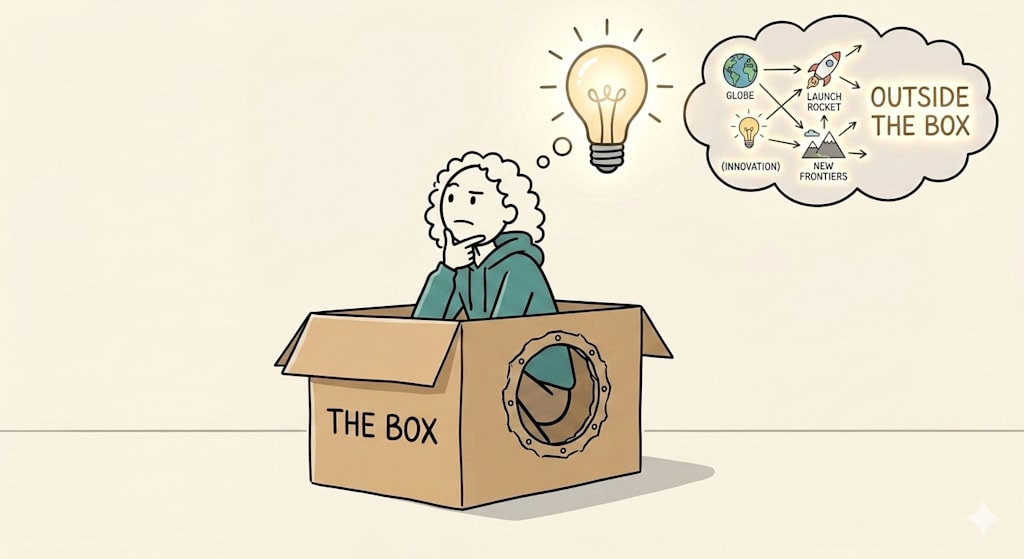
Are people truly capable of thinking ‘outside the box’? Indeed, do we ever genuinely achieve this, or is it merely a comforting illusion?
In an era increasingly defined by digital echo chambers and polarising algorithms, this question has never been more pertinent. To answer it, we must first examine how humans process information and construct reality. Fundamentally, our understanding is anchored in a relentless, inescapable first-person perspective.
According to neuroscientific research , such as Colavita’s studies on visual dominance , vision is the absolute cornerstone of human cognition, followed subsequently by other sensory systems like hearing, touch, and taste. From the moment we are born, vision predates language as our primary tool for comprehension and, eventually, communication. Even as we mature and develop more complex sensory mechanisms, vision remains our dominant apparatus for navigating reality.
Consequently, our core values: our worldview, prejudices, and personal philosophies, are constructed entirely through this singular, internalised lens. We are, by nature, observers trapped within our own minds.
The Friction of Divergent Views
As we venture into society and engage in discourse, we inevitably encounter a multitude of differing opinions, paving the way for ideological conflict. When our meticulously constructed worldview collides with another’s, the natural human instinct is defensive.
But should we view such friction negatively? On the contrary, these clashes are overwhelmingly beneficial. They offer a rare window into the minds of others. This is precisely where the art of debate becomes an invaluable intellectual tool.
We must carefully distinguish debate from mere dispute. Whilst a quarrel is largely a volatile, visceral expression of emotion , often aimed at ‘winning’ or dismantling an opponent, a genuine debate is a structured, empathetic exchange of divergent views. Regardless of background, individuals should utilise debate not as a weapon, but as a compass to navigate unfamiliar viewpoints and unearth the underlying rationale of others.
When you ask, “Why do they believe this?” rather than “How can I prove them wrong?”, you are practising the true essence of thinking outside the box.
Copernicus and the ‘Secondary Eyes’
Trapped in our first-person perspective, we are effectively observing the box from within, devoid of an external vantage point. To truly understand reality, we must develop what we might call ‘secondary eyes’.
Consider the historical paradigm of Geocentrism. Prior to the 16th century, humanity widely accepted that the Earth was the undisputed centre of the universe, a highly intuitive belief, given that from a first-person perspective, the sun appears to move across our sky. This illusion persisted until Nicolaus Copernicus published his heliocentric model.
Did Copernicus literally witness the Earth orbiting the Sun? Certainly not, given the complete absence of space technology in his era. Instead, he employed his ‘secondary eyes’, mathematical calculation, rigorous observation, and theoretical deduction , to adopt an external perspective. He dared to step outside the dominant sensory experience of humanity.
Subsequent technological advancements ultimately vindicated his theory. Copernicus proved that our immediate perception is not always the ultimate truth.
Cultivating Your Secondary Vision
So, how can we apply this Copernican revolution to our daily lives? The answer lies in how we approach disagreement.
To develop our secondary vision, we must actively cultivate intellectual humility. When faced with a conflicting viewpoint, instead of shutting down, we must lean in. We need to treat conversations as collaborative investigations rather than battlegrounds.
Listen to comprehend, not to reply: Suspend your immediate urge to counter-argue.
Interrogate your own biases: Acknowledge that your worldview is built on a limited set of sensory and social experiences.
Embrace the discomfort: Cognitive dissonance is not a threat; it is the feeling of your intellectual boundaries expanding.
Ultimately, we ought to actively seek out this secondary vision. Rather than shying away from conflicting viewpoints, we should embrace them as vital instruments. Debate is not about conquering your opponent; it is about conquering your own limitations. By looking through the eyes of others, we finally begin to comprehend the world in all its multifaceted complexity.
About the Creator
Whitestone Yong
Introverted mind. "Amateur" philosopher & musician. I write to share thoughts that might spark curiosity or comfort, especially in times when we need it most.
Enjoyed the story? Support the Creator.
Subscribe for free to receive all their stories in your feed.
Comments
There are no comments for this story
Be the first to respond and start the conversation.