
They Called It Discipline — I Called It Survival
Truth about my life

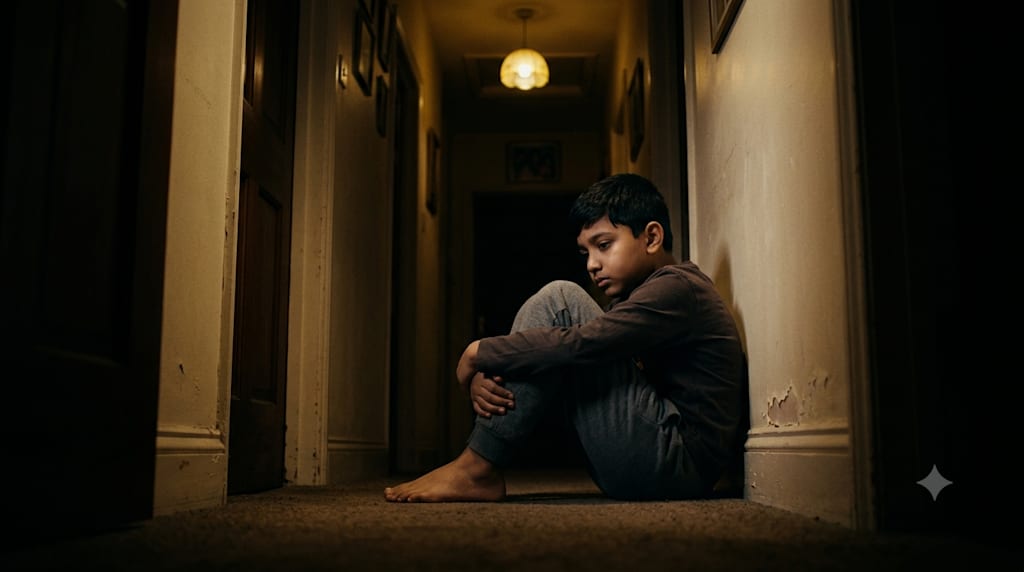
I fall from the sky every night.
In my dreams, I am always somewhere high — a rooftop, a cliff, a place with no name — and then I drop. Fast. Completely. The ground rushes up and I wake up just before impact, heart pounding, hands gripping the sheets, body convinced it just survived something real.
I used to think it was just a weird sleep thing.
Now I think my body has been practicing a feeling it already knew.
The feeling of bracing for impact.
The House I Grew Up In
I want to be careful here. My father is not a monster. He worked hard. He provided. There was food, there was shelter, there was school — all the visible things that count as a good childhood when you list them on paper.
But there was also this:
When I didn't listen, I got hit.
Not the kind of hitting that leaves marks people photograph. The other kind. The kind that is normalized in so many households that children grow up thinking it is simply what discipline looks like. A slap. A shove. A hand that comes faster than the argument.
And the strange thing — the thing that took me years to understand — was that it only ever happened to me.
Not to my siblings. Not to others in the family. Just me.
I used to lie awake as a child wondering what it was about me specifically. What signal I was giving off. What was written on my face that made me the one who got it wrong, always, just slightly more than everyone else.
I never found a clean answer. I am not sure there is one.
What I found instead was a habit: I started bracing. For everything. All the time.
What Bracing Looks Like From The Inside
Bracing is not always visible.
From the outside, I was a normal kid. I went to school. I had friends. I laughed at things.
But inside, there was always a small part of me running calculations.
*Is this the moment something goes wrong? Is this the thing that tips it? Am I being too loud, too quiet, too much, too little?*
When I got admission in university — something that should have been purely a moment of pride — I remember the anxiety underneath it. Not excitement. Anxiety. Because new things meant new chances to get it wrong. And getting it wrong meant a response I had learned to fear.
When I changed my subject — a decision that made complete sense to me, a decision I had thought through — the response at home was not a conversation. It was the same thing it had always been.
And I remember thinking: *I am an adult now. I made a reasonable choice. And still.*
Still.

The Girl
In university I met a girl.
I will not say much about her because she deserves her privacy. But I will say this: I liked her in a way that felt serious. In a way that felt, to me, like something real.
Looking back now, I understand what was actually happening.
I was not just falling for her. I was falling for the idea of someone who would choose me. Who would see me and decide — yes, this one. This one is worth staying for.
Because I had spent so long in an environment where I felt like the one who always got it slightly wrong, the one who was corrected and disciplined and singled out — some part of me was desperate to be chosen. Clearly. Unmistakably. By someone who had no obligation to.
So when she started pulling back — shorter replies, longer silences — I did not hear it as a simple incompatibility. I heard it as confirmation of something I had believed about myself for a long time.
*See? You are too much. You always get it wrong. Even now.*
I chased. I pushed. I reached out when I should have let go.
Not because I was obsessed with her specifically.
Because I was trying to outrun a voice that had been in my head since childhood.
She left anyway. And the voice got a little louder for a while.
---
## What Nobody Tells You About Growing Up Like This
Nobody tells you that a difficult childhood does not end when the childhood ends.
It follows you. It moves in with you. It sits in the passenger seat when you drive to university. It stands next to you when you meet someone new and whispers: *careful. You always get this wrong.*
It shows up in the small things:
The way you apologize too quickly, even when you are not sure what you did.
The way you watch people's faces for signs of irritation, reading microexpressions like a language you were forced to become fluent in.
The way someone's silence feels like a verdict.
The way you fall from great heights in your sleep — because your nervous system learned, early, that peace is temporary and impact is always coming.
Psychologists have a name for this pattern. They call it **hypervigilance** — a state of being constantly alert to threat, constantly scanning the environment for danger, constantly bracing.
It is exhausting in a way that is hard to explain to people who have not lived it. You are tired not because you did too much today. You are tired because your nervous system has been working overtime since you were a child, and it does not know how to clock out.
---
## The Slow Change
I cannot point to a single moment when things shifted. That is not how healing works, in my experience. It is not a door you walk through. It is more like a weather change — gradual, almost imperceptible, until one day you realize the air feels different.
I started noticing, slowly, that I was done chasing.
Not just the girl — but the approval. The need to be chosen loudly enough to drown out the old voice. I started catching myself mid-apology sometimes and thinking: *wait. What am I sorry for?*
I started valuing my own company a little more. My own opinion a little more. My own decisions — even the ones others disagreed with — a little more.
It was not confidence, exactly. Not the loud kind. More like a quiet stubbornness. A refusal to keep treating myself the way I had been taught I deserved to be treated.
Self-respect, it turns out, is not something someone gives you when they finally choose you.
It is something you build, quietly, in the spaces between the old story and the new one you decide to tell instead.
---
## What I Know Now
I know now that the hitting was never about me. It was about an adult who had not learned another way. That does not make it okay. But it makes it less about something being fundamentally wrong with me — and more about something being unfinished in him.
I know now that the girl did not leave because I was too much. She left because we were not right for each other, and I was looking for something in her that she was never going to be able to give me. Nobody could have given it to me from the outside. It had to come from the inside.
I know now that the falling in my dreams is my body remembering what it felt like to brace. And I know that slowly — not all at once, but slowly — the bracing is becoming less automatic. Some nights I sleep straight through. Some mornings I wake up and the first thought is not *what did I do wrong* but just: *okay. A new day.*
That is not nothing.
That is, in fact, everything.

To Anyone Who Recognizes This
If you grew up in a house where love and correction felt like the same thing
If you have spent years apologizing faster than you can think
If you fall from great heights in your sleep and wake up gripping the sheets
If you have chased people not because you needed them specifically but because you needed someone, anyone, to choose you clearly
You are not broken. You are not too much. You are not the thing that was done to you.
You are someone who learned to survive a particular kind of environment. And survival, when you are young, requires adaptation. The adaptations made sense then.
They do not have to be permanent.
The ground that you have been bracing for — the impact that has been coming your whole life
It never actually lands.
You wake up, every time, still here.
Still in your bed.
Still okay.
That is where the new story starts.
*If anything in this piece resonated with you, you are not alone. More of us grew up bracing than anyone admits. The fact that you are still here, still trying to understand yourself — that already means something.*
About the Creator
saif ullah
Content writer on different niches, specially on finance.
Enjoyed the story? Support the Creator.
Subscribe for free to receive all their stories in your feed.
Comments
There are no comments for this story
Be the first to respond and start the conversation.