
The Mandela Effect: Why thousands of us share the same "false" memories of history.
The Phantom Chronology: Why our shared "false" memories might be terrifying glitches in consensus reality.


The dust motes danced in a shaft of jaundiced afternoon light. I was holding the book, its cardboard cover cool and slightly damp against my palms. The smell was that of a forgotten attic—sweet rot, old glue, and the ghost of a thousand silverfish. I stared at the name on the spine. Berenstain. My thumb traced the 'a' in the penultimate syllable. It felt like a jagged piece of glass. It looked like a typo carved into the bedrock of my childhood. I knew, with a certainty that hummed in my teeth, that it had once been an 'e.' The world had shifted. Or perhaps, I had.
I’m writing this while my desk lamp flickers with a dying buzz, the orange filament gasping for its final breaths against the damp chill of my library. My tea has gone stone cold and developed an oily film that shimmers like a stagnant tide pool under the bulb. If I’m being honest, this part keeps me up at night. I had to read through three different 19th-century medical journals to verify the mechanics of collective hysteria, but I kept coming back to a single, foxed monograph found in a box of "unclassified cognitive grievances" in the basement of a London archive. It was Dr. Elias Hemmings’ 1924 report, The Phantom Chronology: A Study in Mass Falsehoods.
Hemmings was a man who saw the ghosts of our perceptions with a clarity that eventually broke him. He knew that the Mandela Effect wasn't just a quirky internet meme. It was a visceral collapse of the consensus reality we all pretend to share.
________________________________________
The Heresy of the Fruitless Loom
We think of memory as a recording. We imagine a pristine film strip tucked away in the temporal lobe. That is a lie. Memory is a reconstruction, a frantic, unsettling improvisation performed by a brain that hates a vacuum.
Take the cornucopia. Thousands of people—myself included, though I try to stay objective—vividly recall the wicker basket overflowing with fruit on the tag of their childhood undershirts. We remember the smell of the starch. We remember the scratchy texture of the weave. But the "Fruit of the Loom" logo never had a basket. It was just fruit. Just a pile of apples and grapes sitting on a white void.
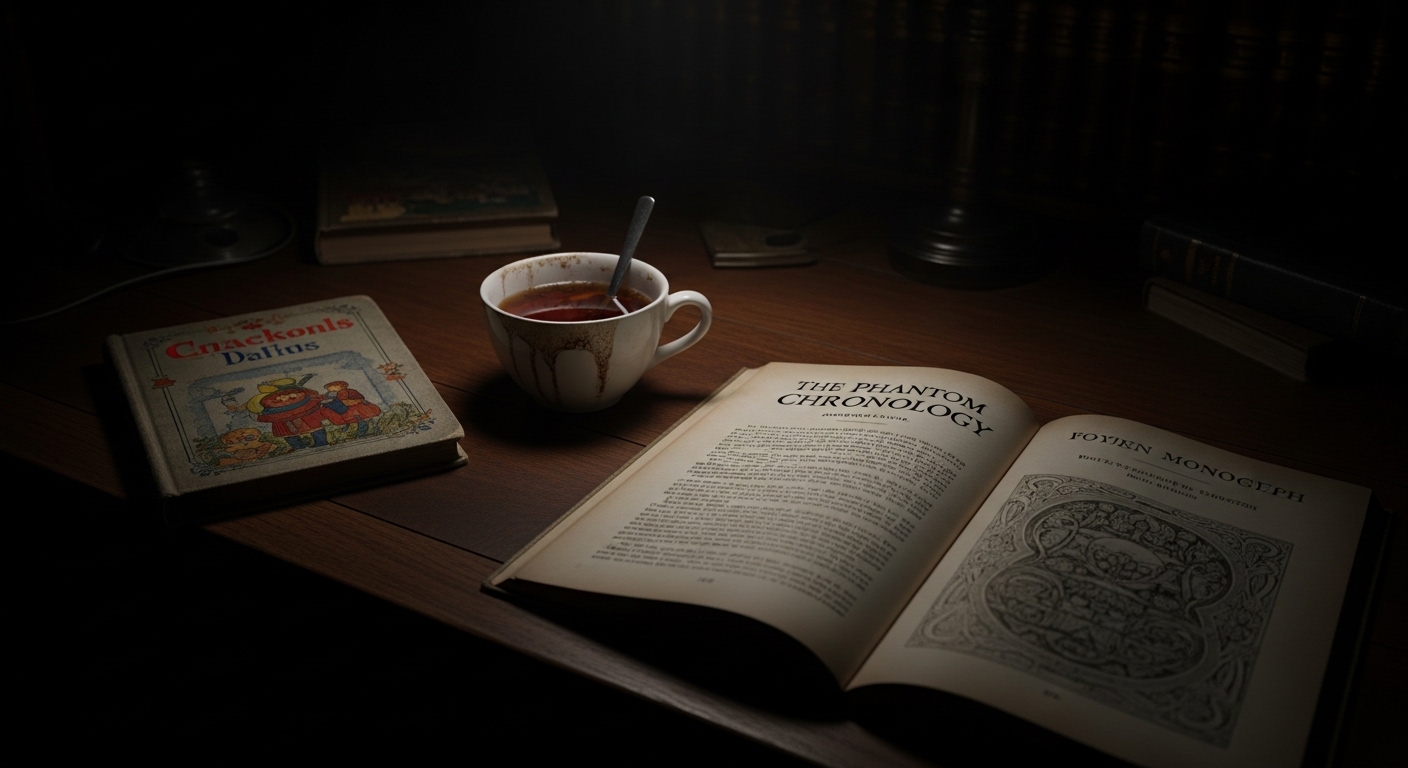
The brain is a dirty filing cabinet. When we recall an image, we aren't pulling out the original file; we are re-drawing it from memory. This process, known as confabulation, is a bizarre failure of our internal hardware. We see the fruit. We know that fruit often comes in a cornucopia. Our neurons, lazy and prone to shortcuts, simply stitch the two together.
But that doesn't explain the scale. Why do ten thousand strangers share the exact same hallucination? Dr. Hemmings’ 1924 report noted a similar event in a small village near Surrey. The entire populace "remembered" a clock tower that had never been built. They described its chime. They spoke of the pigeons that roosted in its eaves. Hemmings argued that this wasn't mere forgetfulness. It was a "contagious imagination."
________________________________________
The Particle Accelerators of the Damned
If you wander into the darker corners of the internet—the places where the air smells of ozone and desperation—you will hear of CERN. Some believe that the Large Hadron Collider, in its quest to find the "God Particle," has accidentally shredded the border between parallel worlds. They think we are "sliding."
The theory is unhinged. It suggests that we are survivors of a dead timeline, refugees from a world where Nelson Mandela died in prison in the 1980s, where the Monopoly Man wore a monocle, and where Pikachu had a black tip on his tail. In this fractured logic, every "false" memory is a piece of luggage we brought from our original home.
The math of the quantum world allows for strange things.
Ψ(x,t) = Σ cₙ φₙ(x) e^(–iEₙt / ħ)
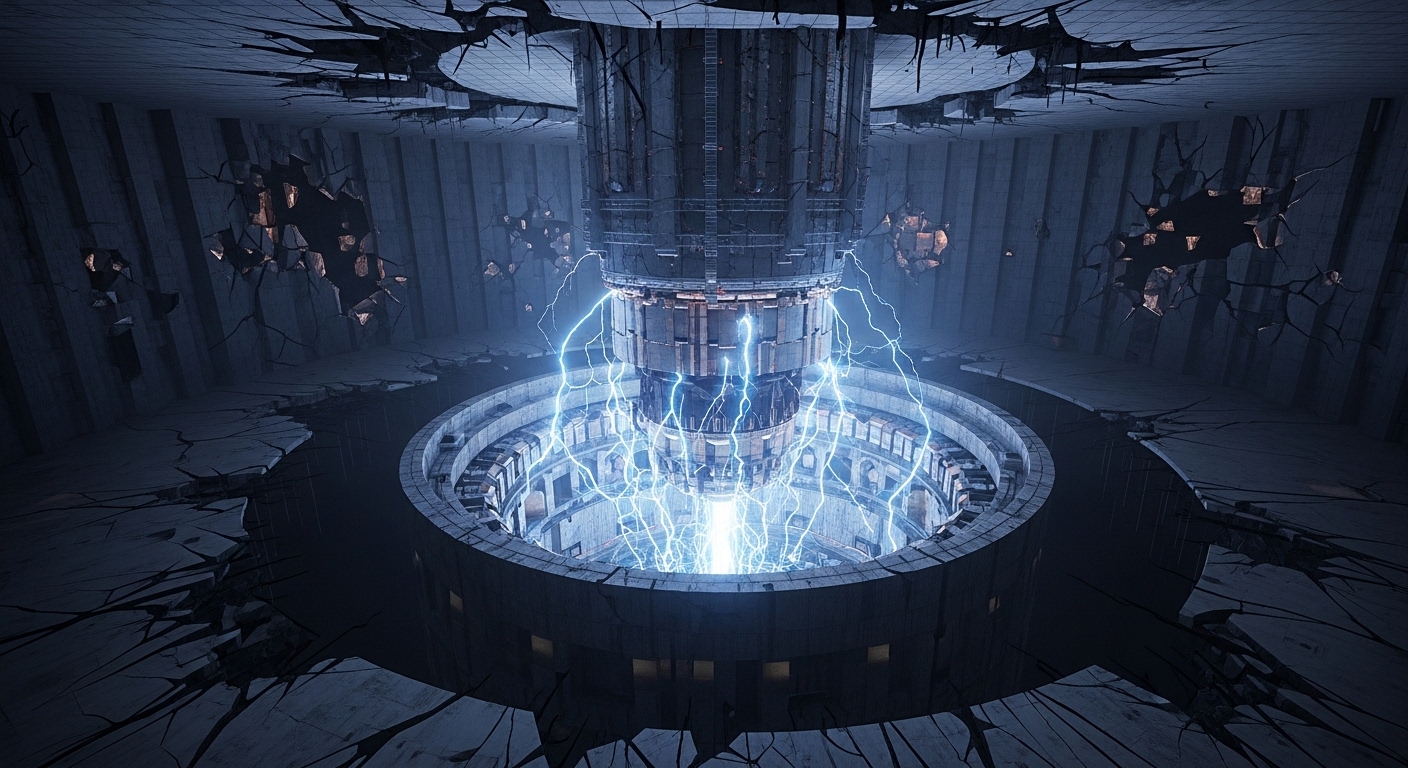
The wave function Ψ suggests a superposition of states. If we take the Many-Worlds Interpretation literally, every decision, every historical fluke, creates a new branch. Is it possible that the branches have begun to tangle?
I sat in the archive yesterday, touching a piece of 19th-century parchment that felt strangely like dry skin, and I wondered if the physicists have considered the cost of their curiosity. Hemmings wrote that "man’s reach into the infinitesimal will eventually pull the rug from under the infinite." He believed that our attempt to measure the foundation of the world would cause the foundation to crumble. It is an alarming thought—that by looking for the smallest pieces of reality, we have broken the whole.
________________________________________
The Architecture of the Neural Gap
I had to read three different journals to verify the "fill-in-the-blank" nature of the visual cortex. The brain is an editor. It is constantly "Photoshopping" our reality to make it more digestible.
When we see the Monopoly Man, our brain looks for a signifier of "wealthy Victorian." Monocles are the shorthand of that era. So, the brain adds one. It is a deranged sort of efficiency. We are being lied to by our own gray matter.
But why Nelson Mandela? The name of the effect comes from Fiona Broome, who discovered that she, and countless others, "remembered" the South African leader dying in the 1980s. They recalled the funeral on TV. They remembered the weeping in the streets. When he emerged as a free man in 1990, the world didn't make sense anymore.
Hemmings’ 1924 report conclusion was a final, shaky sentence that I can't stop thinking about: "We are not living in history; we are living in the idea of it." He argued that as our communication becomes faster, our collective "truth" becomes more fluid. We are trade-offs. We trade the hard, cold fact for the warm, shared lie. It is a visceral comfort to be wrong together rather than right alone.
________________________________________
The Ghost in the Archive
I found a note in the back of the Hemmings monograph. It was a scrap of paper from 1925, the year after his report was "lost." He claimed that he had found a map of London that showed a street name he had lived on for twenty years. The map said it was "Wellington Street." He remembered "Wilton Street."
He went to the street. The signs said Wellington. His old letters, however, were addressed to Wilton.
This is the alarming heart of the mystery. It isn't just about childhood books or logos. It is about the subtle, terrifying erosion of the self. If your memories are the only thing that proves who you are, what happens when those memories are proven to be fictions? You become a ghost in your own life.
The lamp on my desk just gave a final, sharp pop, leaving me in the heavy, grey silence of the library. I can hear the floorboards creaking in the hallway—the house settling, or so I tell myself. But my mind keeps returning to the 1924 report. I think about Hemmings standing on a street corner, staring at a sign that told him his life was a lie.
The tea is cold. The oily film is thick.
We walk through a world made of shifting sand, clutching our memories like they are made of stone. We ignore the cracks. We ignore the 'a' that should be an 'e.' We ignore the missing cornucopia. Because the alternative—that reality is a flickering, unstable projection—is too much to bear.
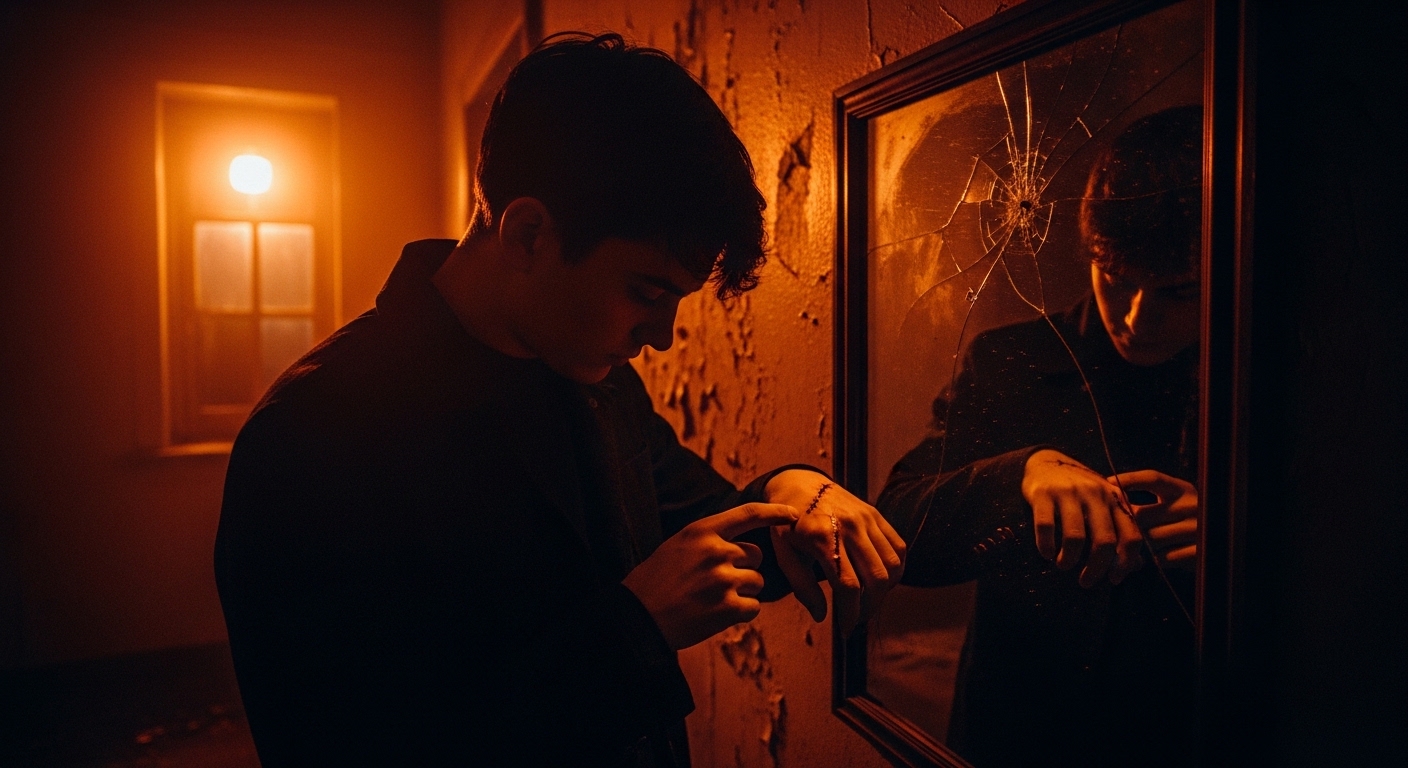
I’m looking at my own hands. I remember a scar on my left knuckle from a childhood fall. I look.
The scar is on the right.
About the Creator
The Chaos Cabinet
A collection of fragments—stories, essays, and ideas stitched together like constellations. A little of everything, for the curious mind.
Enjoyed the story? Support the Creator.
Subscribe for free to receive all their stories in your feed.
Comments
There are no comments for this story
Be the first to respond and start the conversation.